Photo: Broad Arrow Auctions
Most corporate espionage involves buying a rival’s car, tearing it apart, and weighing the bits. Ferdinand Piëch took a stranger route. Rather than benchmark BMW’s best sports sedan from the outside, he put a Volkswagen engine inside one and, by the auction house’s account, drove it himself.
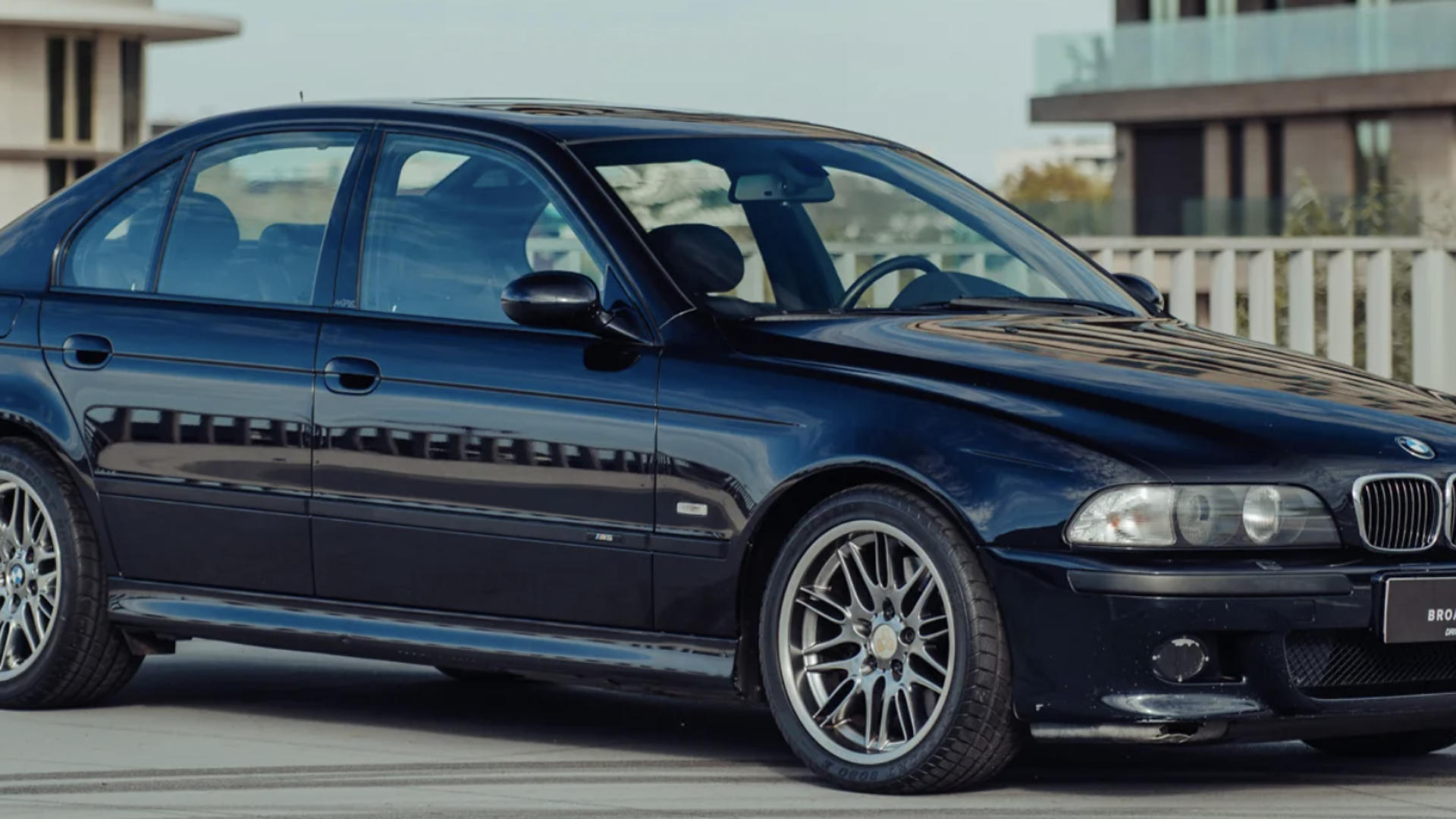
That car, a 2000 BMW M5 with an experimental Volkswagen W10 where the S62 V8 used to be, is heading to auction. Broad Arrow Auctions will offer it at its Zoute Concours Auction on Friday, October 9, 2026, at Approach Golf in Knokke-Heist, Belgium, with an estimate of €250,000 to €350,000. That’s according to Broad Arrow’s announcement, and the lot includes a second, standalone W10. More on why that matters below.
Why a VW boss needed a BMW
The E39 M5 was a problem for everyone else around 2000. BMW’s own records say the E39 launched in 1998 as the first M5 with a V8, a five-liter unit making 294 kW (400 hp) and 500 Nm, which made it the most powerful M car in the range at the time. BMW Group Classic notes it was built from October 1998 to June 2003, and power went through a six-speed manual.
Related Articles
- F1’s V8 Comeback Has a Cylinder Count and Not Much Else. December 10 Is the Date to Watch
- Police Say a Stolen Elantra Fled Officers, Then Hit a City Bus in a Baltimore School Zone. Sixteen People Were Hospitalized
Volkswagen had nothing like it. The auction house says that at the turn of the millennium Piëch decided to explore a Volkswagen rival to the M5. He took the VR engine concept, already familiar from the VR6, and stretched it into the W10: a 5.0-liter engine making 473 hp and 592 Nm of torque.
The man behind it matters to the story. Piëch was named Car Executive of the Century in 1999. He was the grandson of Ferdinand Porsche, and he ran the Volkswagen Group for more than two decades after pulling it back from near-bankruptcy in 1993. He was an engineer-executive who treated cylinder counts like a personal hobby. This car is what that looks like when nobody is allowed to say no.
What a W10 actually is
People throw the term “W engine” around loosely, so here’s the short version.
A VR engine is a V engine with a bank angle so narrow that both cylinder rows can share one cylinder head. The result is roughly as compact as an inline engine. A W engine bolts two of those narrow-angle banks together on a common crankcase at a wider angle. You get a lot of cylinders in a very short package.
Bugatti’s engine history describes the same trick at a larger scale: two eight-cylinder blocks set at 90 degrees to each other, which is why the W16 is no bigger than a V12. The W10 is that philosophy with ten cylinders, which suits an engine bay designed for a V8.
Now look at the numbers. Against BMW’s rating, the W10 makes 79 more horsepower than a factory M5 and 92 Nm more torque (about 68 lb-ft). Per liter, the W10 produces roughly 95 hp and about 118 Nm. The S62 manages around 81 hp and 101 Nm per liter. Both engines are naturally aspirated, and the S62 was no slouch; it was also good enough for BMW to put in the Z8. For a skunkworks prototype to beat it on specific output is a real engineering result, not just a party trick.
From sedan project to Bugatti
The W10 never reached a Volkswagen showroom. According to Broad Arrow, it became the basis of the W16 that powered the Bugatti Veyron, not a performance sedan. Piëch used the M5 as his personal car during testing.
Bugatti’s own account shows how tangled the W-engine family tree was. In 1997, Piëch sketched an engine idea on an envelope while riding the Shinkansen from Tokyo to Osaka and handed it to VW engine chief Karl-Heinz Neumann. The sketch was for 18 cylinders; it later became the W16. That engine first ran in 2001 and made the required 1,001 PS on its very first test.
In other words, the W10 sits in the middle of that period, a working, road-driven proof that stacking narrow-angle banks could produce a dense, powerful engine.
There’s also a nice irony here. BMW eventually went to ten cylinders itself. BMW M says the 2005 E60 M5 used a naturally aspirated V10 making 507 hp and revving to 8,250 rpm. So Piëch built a ten-cylinder M5 years before BMW did, and put it in BMW’s own car to do it.
Two out of three
The detail collectors will obsess over is the engine count. Broad Arrow says only three W10 engines were ever made. One is still in Germany, one is offered in standalone form as part of this lot, and the third is under the hood of the M5. Whoever wins the car goes home with two-thirds of the world’s W10 supply.
That spare engine isn’t just a display piece. It’s the most important practical feature of the lot. A one-off prototype engine has no parts catalog, no dealer network, and no aftermarket. If the running engine breaks a major internal part, the standalone unit is the only realistic source of matching hardware. Buyers should find out before bidding whether that second engine is complete, what state it’s in, and whether it has ever run. The public listing materials don’t say.
The rest of the car is ordinary E39 M5 in a good way. It’s finished in Carbon Black Metallic over black leather, and the suspension, brakes and body are standard BMW, which a specialist can maintain. The risk is concentrated in the engine and whatever control electronics were built to run it. Any shop working on this car will be reverse-engineering, not following a manual.
The price, and what it really costs
Broad Arrow says the project was developed in secret and is believed to have cost €2 million before it was shelved. The top estimate is about 17.5 percent of that. Development money never turns into resale value, so that’s not a bargain signal on its own, but it does show how much engineering effort you’re buying per euro.
Remember that the hammer price isn’t the final bill. Under the sale’s terms, the buyer’s premium on vehicles is 15 percent of the first €250,000 of the hammer price, plus 12.5 percent of anything above that, with VAT charged on the premium. At the low estimate, that’s about €287,500 before VAT on the premium. At the high estimate, it’s about €400,000. Import duties and local taxes are the buyer’s responsibility, too.
The venue history helps. Broad Arrow’s first Zoute sale in 2025 brought in €26.3 million with 78 percent of lots sold. That’s a crowd that shows up to spend money on unusual European metal.
Insurance and the paperwork problem
Insuring this car on a standard policy is out of the question. With no comparable sales, an agreed-value collector policy backed by a professional appraisal is the only sensible approach. The underwriter will care most about the engine, because a serious engine failure could wipe out much of the car’s value even if the body is untouched. Worth noting: Broad Arrow is owned by Hagerty, which also sells collector-car insurance, so the buyer won’t need to look far for a quote.
Related Articles
- One Thing We’d Actually Buy: The NOCO Boost Plus GB40, Because Begging a Stranger for Jumper Cables Is Not a Plan
- This 1967 Maserati Quattroporte Became a Formula 1 Fire Truck, and Now It’s on Bring a Trailer
American buyers should read the fine print before getting excited. NHTSA’s import rules allow a vehicle at least 25 years old to be imported without meeting federal safety standards, with the 25 years counted from the manufacture date. A 2000 M5 clears that bar.
Emissions are the problem. EPA’s import form says the 21-year exemption applies to vehicles in original unmodified configuration, and vehicles with replacement engines don’t qualify unless the replacement is the same model as the original, or an engine from a certified vehicle no older than the one being imported. A prototype Volkswagen W10 is neither. So a U.S. buyer should plan on treating this as a display or collection piece unless an import specialist finds another path. In Europe, the swap will almost certainly complicate registration too, since the drivetrain doesn’t match anything BMW ever homologated.
Who should bid
This isn’t an M5 for someone who wants the best E39. A clean factory car is cheaper, easier to maintain, and simpler to register. This is a document on wheels: evidence of how one of the industry’s most demanding engineers tested ideas, and a working relative of the engine that made the Veyron possible.
The smart bidder will focus on three questions: whether the spare engine is usable, whether the development records survive, and where the car can legally be driven. Get good answers to those, and you’re buying a piece of Volkswagen Group history that happens to wear a BMW roundel. Get bad ones, and you’re buying a very expensive sculpture.
The W10 M5, or a mint factory E39 and a lot of change? Make the case in the comments.
Sources
- Broad Arrow Auctions: Zoute 2026 sale announcement (GlobeNewswire, Sept. 24, 2026)
- Broad Arrow lot listing: 2000 BMW M5 Volkswagen W10 Prototype, ex-Ferdinand Piëch
- BMW M: The generations of the BMW M5
- Bugatti: The W16 engine, the last of its kind
- NHTSA: Importation and certification FAQs
- EPA Form 3520-1: Importation of motor vehicles (PDF)
Images Via: Broad Arrow Auctions
About the Author