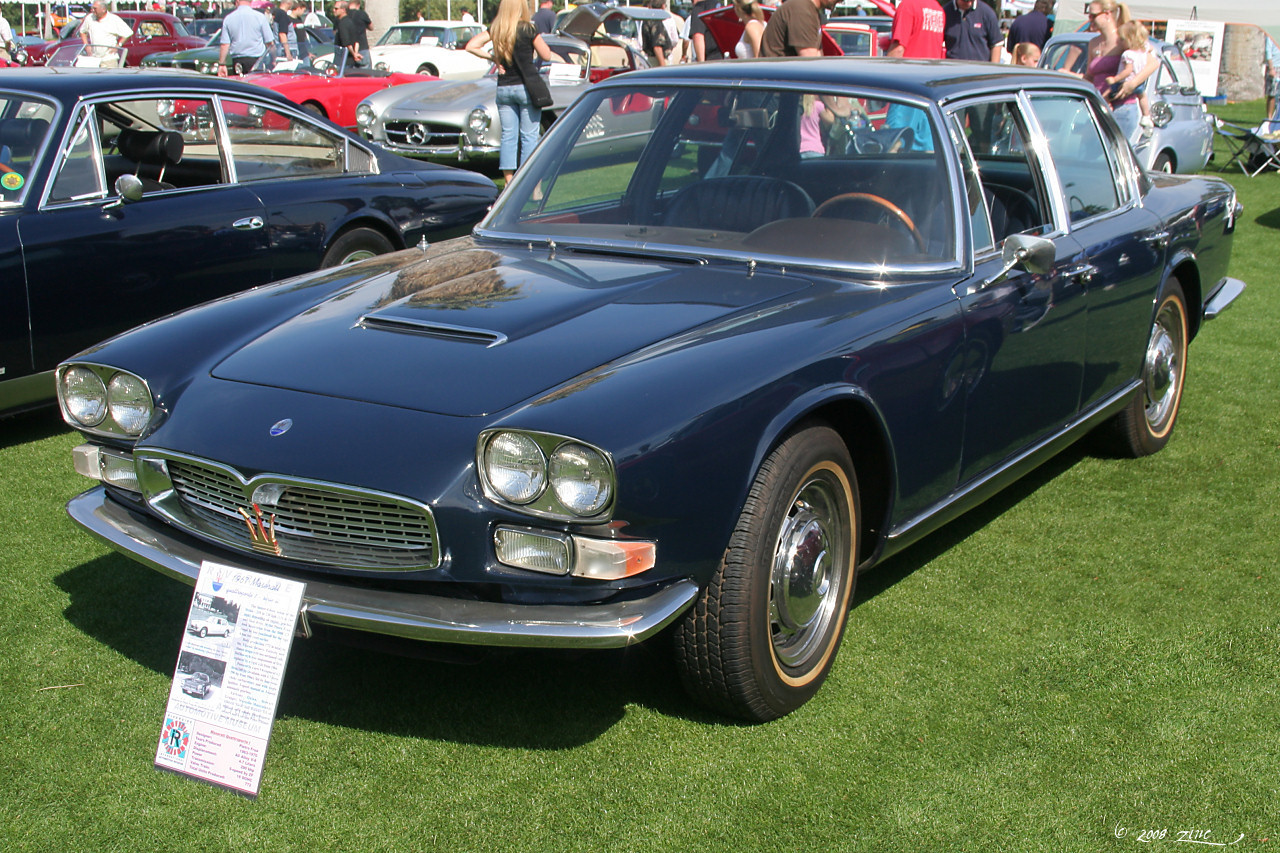
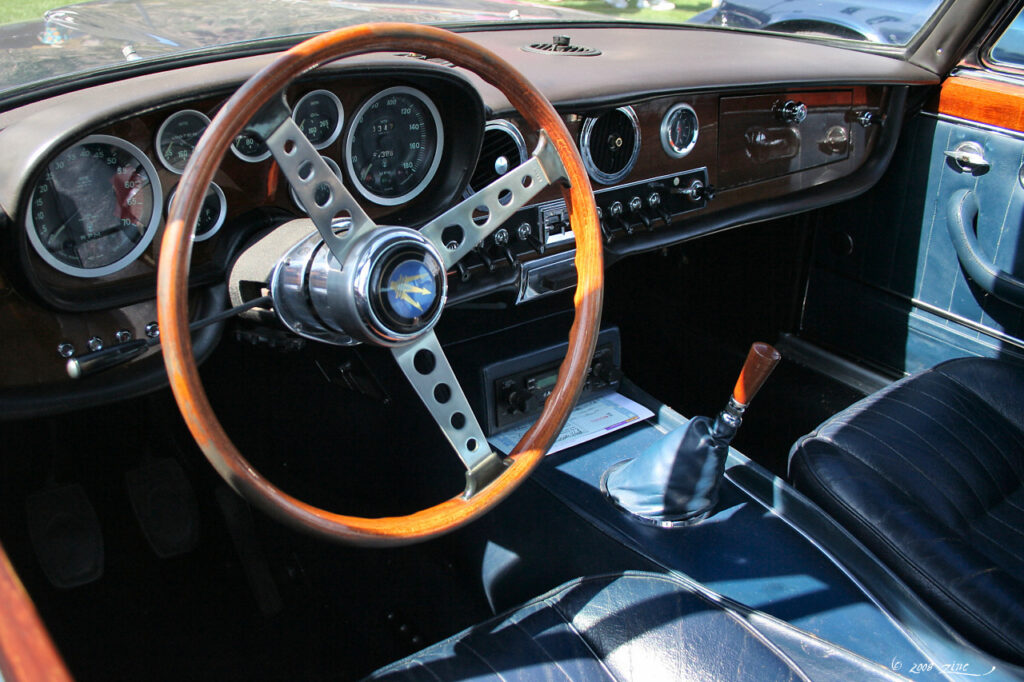
A stock 1967 Quattroporte Series II, the four-door the CEA fire car started life as. Photo: Rex Gray via Wikimedia Commons (CC BY 2.0)
Maserati built the Quattroporte in 1963 to prove an Italian four-door could run with the grand tourers. In 1970, a coachbuilder in Bologna took a saw to one, removed the roof over the back seat and the rear doors, bolted a foam cannon behind the cabin and sent it to work at Formula 1 races. That Maserati Quattroporte fire truck, chassis AM107 1452, is now for sale on Bring a Trailer, and with four days left, bidding sat at $10,000.
Ten grand buys a tired Crown Vic. Here it’s buying a quad-cam V8 Maserati with a racing-safety history and a seller who says more than €200,000 went into its restoration. That bid will climb; the question is how far.
What it is: a Maserati sedan that went to work
The Quattroporte (factory code Tipo AM107) was styled by Pietro Frua, bodied by Vignale and built from 1963 to 1969. Only about 776 first-generation cars were made across two series. The Series II, which this car is, swapped the early cars’ De Dion rear suspension for a simpler leaf-sprung live axle. It kept the 4.1-liter V8 with twin cams per bank and four Weber carburetors, rated at 264 metric horsepower and good for about 143 mph in period. In 1967 that made it one of the fastest sedans on sale.
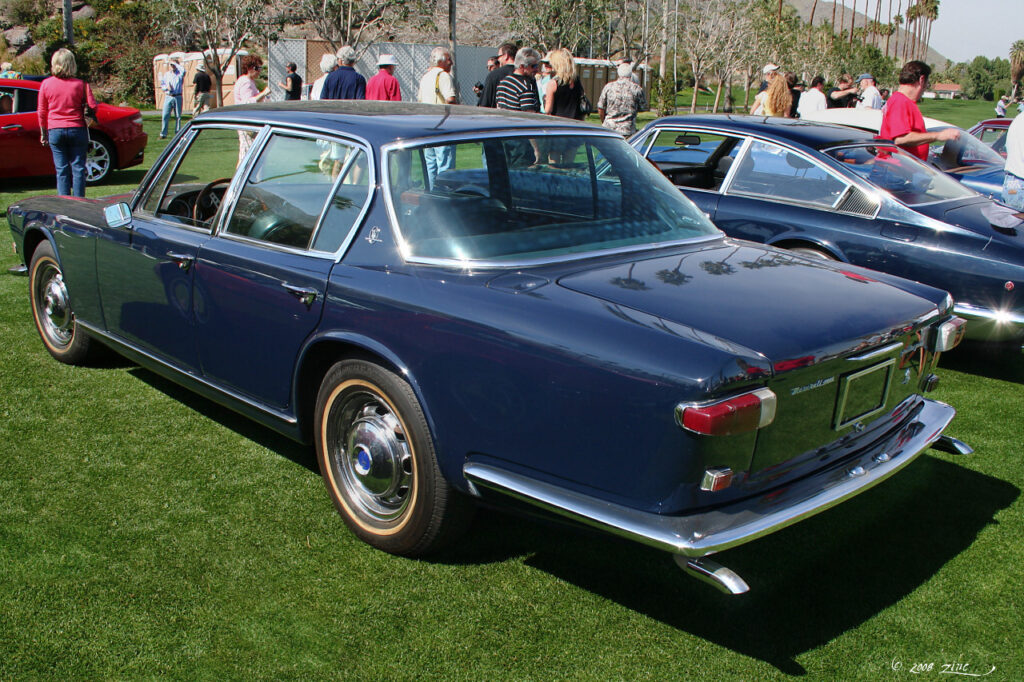
According to the listing, this one was sold new in Rome, and its Maserati Certificate of Origin dates the build to July 1967. In 1970 it went to Carrozzeria Grazia in Bologna, which turned it into a two-door pickup with side equipment lockers and a swiveling foam cannon over the bed. The badges now read “due porte,” two doors, which is funny if you know the name means “four doors.”
The Quattroporte fire trucks of CEA Squadra Corse
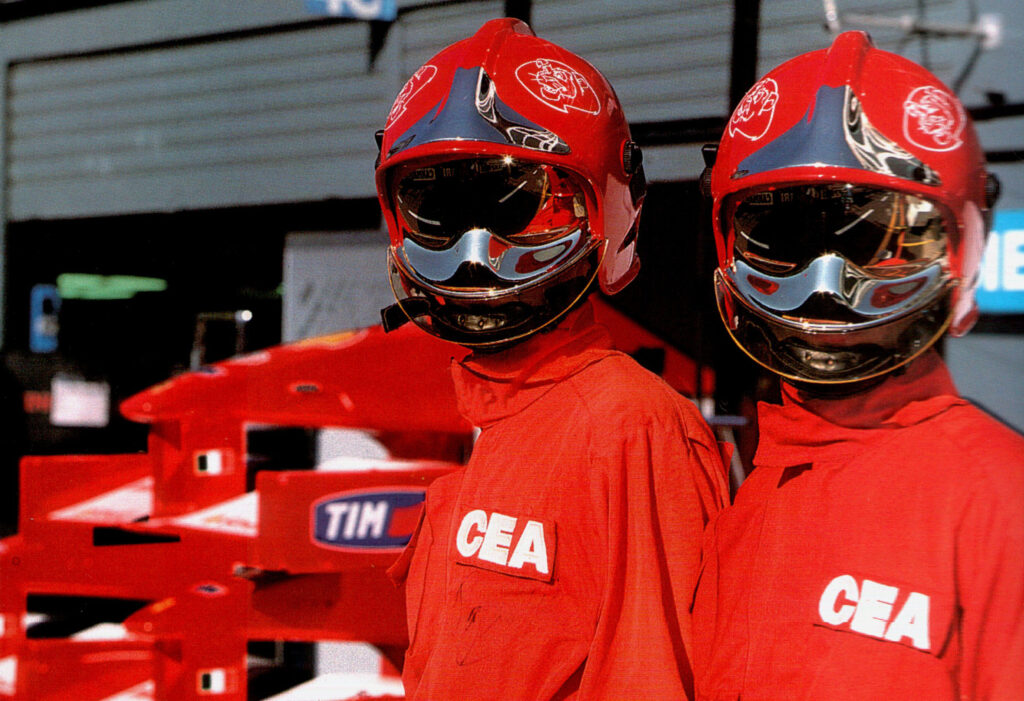
The customer was CEA, the Italian fire-extinguisher company Ermete Amadesi founded in 1967. In 1970, Imola’s managers asked Amadesi to take over fire coverage after regular fire crews pulled out of racetracks, and CEA Squadra Corse was formed to do it. The first rapid-response cars were Quattroportes with the roof cut off and a foam gun in the back. The seller says up to six were built. Treat that number as folklore until someone shows the paperwork.
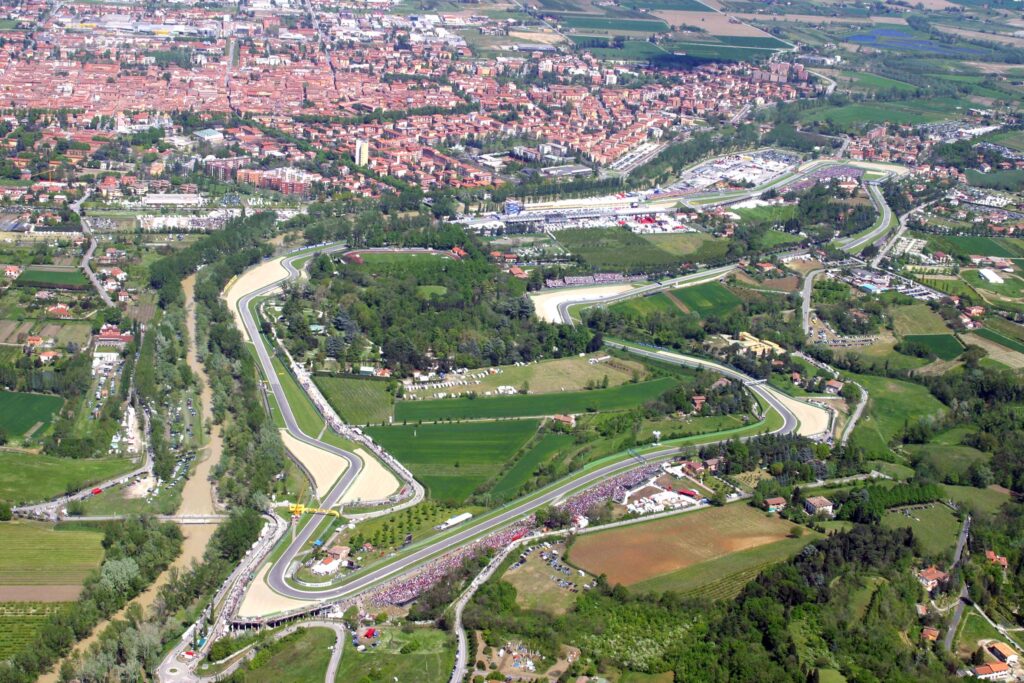
The cars had to be fast because the job was. A fuel fire in an F1 car can kill a trapped driver in under a minute, and a fire truck that trails the field isn’t much help. A 140-mph sedan with a bed full of foam got a crew to a crash in seconds. CEA’s firefighters earned the nickname “Leoni,” the Lions, at Monza in 1978, the multi-car first-lap crash that killed Ronnie Peterson. At Imola in 1989, they pulled Gerhard Berger out of his burning Ferrari at Tamburello, the same corner where Ayrton Senna would die five years later. (We dug into Senna’s road car history when his personal Honda NSX went to auction.)
Ten years at the track, six years in the shop
The listing says chassis 1452 stayed with CEA for close to ten years, then passed through owners in Italy and France. The current Swiss owner bought it in 2011 and spent six years on the rebuild. Bodywork and upholstery were done in Italy, and the engine rebuild and final assembly in Germany. It now has a FIVA identity card, issued in 2026, and Swiss registration.
What a buyer should inspect
This Maserati Quattroporte fire truck is a 59-year-old Italian exotic that someone cut up with a saw in 1970. You’re buying the metalwork, the engine and the story, and the story is where the value is. Here’s where to look:
- Proof it’s a CEA car. A Maserati Certificate of Origin proves how the car left the factory, not what happened in 1970. A FIVA card is an identity document, not a guarantee of history. Ask for period photos tied to this chassis number, Italian registration records showing CEA ownership, and any Grazia paperwork. If CEA itself will confirm the car, that could be worth more than the paint.
- The structure behind the conversion. Take the roof off a sedan body and it loses a lot of stiffness. Get the car on a lift. Look at the sills, the floors, the rear bulkhead where Grazia boxed off the cab, and the corners of the bed, where water sits. The listing shows photos from the bare-metal stage, so compare them with the finished car. It also shows a dent in the right door and a crack in the paint.
Mechanicals, mileage and getting it home
- The engine rebuild invoices. Maserati’s all-aluminum quad-cam V8 is lovely and expensive to fix. A 90-degree block, chain-driven cams and four Webers mean valve adjustment and carb syncing are specialist work. Ask for the German shop’s invoices, and pay for compression and leak-down tests. Look closely at the heat-wrapped headers too. Wrap can hide cracks and trap moisture against the pipe.
- Mileage and gearbox. The five-digit odometer has rolled over and reads about 3,700 km. The seller says about 5,000 km were added in their ownership, so true total mileage is unknown. The ZF S5-20 five-speed is tough, and parts are easier to find than for many Italian gearboxes.
- The foam system. Find out whether the cannon still works, what’s in any tank, and whether anything is pressurized. An old pressure vessel is a safety problem and a shipping problem. If it’s decorative, get that in writing.
- Shipping it to the U.S. At 59 years old, the car is well past the federal age cutoffs for safety and emissions compliance. The tariff is the catch. In the U.S. tariff schedule, passenger cars carry a 2.5% general duty, most light trucks 25%, and “fire fighting vehicles” (8705.30) enter free. Customs decides which one a Maserati pickup with a foam cannon is. Get a customs broker’s opinion before you bid.
Does the Maserati Quattroporte fire truck price make sense?
At $10,000, obviously not. It’s a placeholder, and nobody should expect a V8 Maserati with this history to sell for Crown Vic money. The best recent benchmark is on the same site: a Euro-spec 1968 Quattroporte Series II project sold on Bring a Trailer for $28,000 in July 2026. That was a complete, original four-door that needed everything. A running, freshly rebuilt Quattroporte should beat that easily. On a normal car, a hacked-off roof would kill the value. Here the conversion is the reason the car is special.
The restoration bill doesn’t set the price
The seller’s €200,000-plus restoration figure is a sunk cost, not a price. Restorations almost never earn their money back, and these cars are no exception. Exotic Italian four-doors have also been a weak market for decades, and even the brand is fighting for its future right now. What this car has that ordinary Quattroportes lack is a story F1 fans already know, a livery you can spot from the grandstand, and no easy substitute.
Our read: with solid CEA documentation, a result in the mid-five figures to low six figures would be fair for a one-off with this much motorsport history, and it would still come in well below the cost of the rebuild. If the paper trail is thin, it’s an expensive, well-restored conversion with a good story, and you should bid like it. Either way, the buyer gets a Maserati nobody else at Cars and Coffee has. With the Maserati brothers’ story heading to the big screen, Bologna’s odder chapters may get more attention than they have in years.
The auction is scheduled to end Friday, October 2, 2026, at 2:00 p.m. ET. The car is in Weggis, Switzerland.
Listing details and bid figures come from the Bring a Trailer listing as of September 28, 2026. Photos: Rex Gray (CC BY 2.0), Precisetti (public domain) and Marpol (public domain) via Wikimedia Commons. The photos show a stock Quattroporte, CEA firefighters and Imola. They are not photos of the car for sale.
About the Author