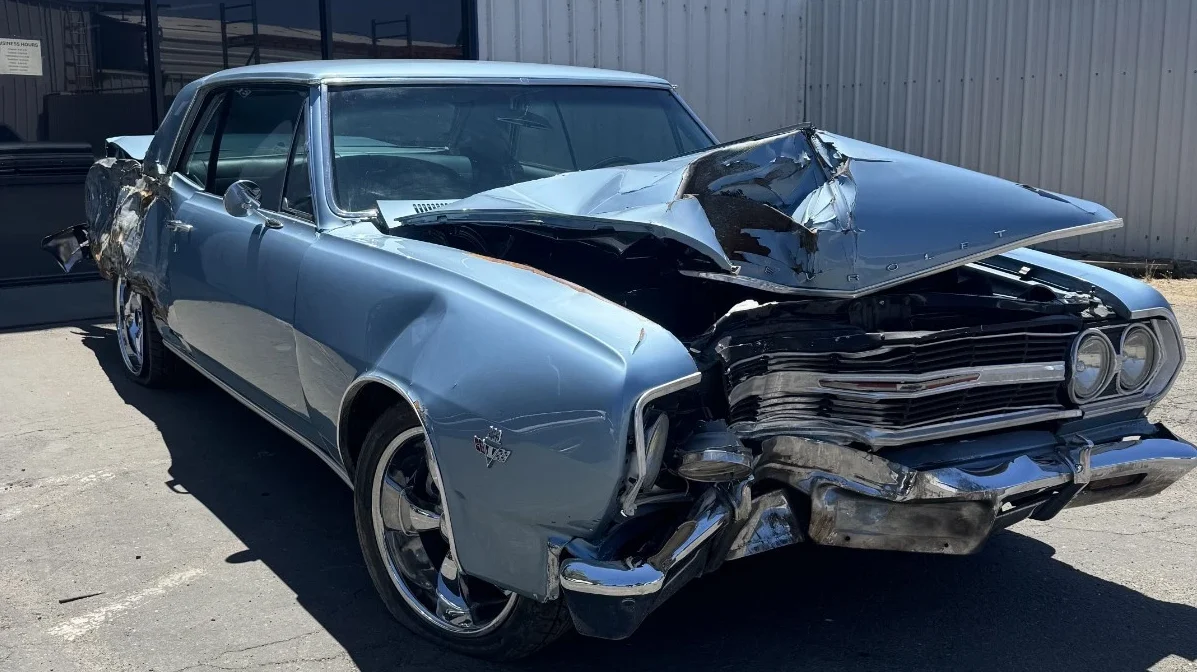
A battered 1965 Chevrolet Chevelle Malibu SS restomod showed up on eBay a month ago with a crushed front clip and a fresh salvage title. It’s still there. Same VIN, same crumpled sheet metal, same seller, and an asking price that has barely moved since the last time anyone checked in on it.

The car has a legitimate pedigree buried under the damage. The VIN and the Fisher body tag both confirm this coupe left the Kansas City assembly plant as a genuine factory Malibu SS Sport Coupe before someone spent real money turning it into a pro-touring build. Under the hood sits a 6.2-liter LS3 crate engine paired with a 4L70E four-speed automatic, feeding a GM 10-bolt rear axle with 3.73 gears and a Yukon DuraGrip limited-slip differential. The chassis carries drop spindles, tubular control arms, adjustable coilovers, and sway bars front and rear, with four-wheel disc brakes and a power steering box handling the stopping and turning. Eighteen-inch chrome Billet Specialties wheels, air conditioning, power windows and locks, a Custom Autosound stereo, and Dakota Digital gauges round out a build that clearly wasn’t assembled on a beer budget. Matching a VIN and body tag this cleanly is exactly the kind of paperwork trail that mattered when police untangled a decades-old stolen Chevelle case earlier this year, and it’s worth knowing how to read before buying any car with an unusual title.
Then came the wreck. The listing states the Chevelle struck a pole with its right front corner and slid along a barrier, crumpling the fender and frame and tearing a long scrape down the right side. The seller says the opposite side, the rear glass, and the interior all held up fine, and that the frame was pried back just enough to snap photos and coax the engine back to life. The impact broke the air conditioning compressor, though no damage is visible on the engine block itself. It’s being pitched as either a repair-and-drive project or a rolling donor car for somebody else’s LS swap.

We first spotted this car when it listed with a salvage title and an as-is, where-is disclaimer at $33,299.26. That much hasn’t changed. What has changed is barely worth mentioning: the price has drifted down to $32,999.19, roughly $300, on a car that opened its eBay run asking nearly $37,000. A $500 deposit is still required up front, with the balance due within seven days, and California buyers get a bill of sale carrying a salvage acquisition number rather than a clean title, a process the seller says takes about two weeks. Out-of-state buyers get a salvage certificate and a bill of sale instead.
That paperwork matters more than it sounds. A salvage title isn’t just a black mark on a vehicle history report, it’s a legal status that keeps a car off the road until it clears a formal inspection. In California, that means a CHP or BAR salvage verification confirming the VIN, structure, and safety systems check out before the DMV reissues anything resembling a normal title, and the car comes back branded as revived salvage for the rest of its life. Other states run similar programs under different names, but the outcome is consistent: the car is legally undrivable and largely uninsurable for comprehensive coverage until someone clears that inspection, and the resale value takes a permanent hit even after the paperwork is sorted.
The listing photos don’t fully convey the labor involved. Straightening a crushed front frame rail on a 60-year-old A-body isn’t a quick pull-and-paint job, especially once a pro-touring suspension that was aligned around a straight chassis needs to be dialed back in. The fender, the crushed lower valance, and whatever’s hiding behind that scraped rocker panel all need replacing or repairing, and matching Metallic Mist Blue on a car this customized means blending paint across panels the impact never touched. None of that is cheap, and it doesn’t even account for a broken air conditioning compressor on a retrofitted system being its own few-hundred-dollar line item. A shop estimate for this kind of repair, done properly rather than cosmetically, can realistically stack into five figures before anyone touches the upholstery.
That math likely explains why the price hasn’t moved much. This isn’t a numbers-matching survivor with a documented history propping up its value the way an unrestored LS6 Chevelle can when it heads to a Mecum auction; it’s a modified car whose worth is tied entirely to the parts bolted to it and the labor required to make it whole again. It’s the same calculus buyers face at the cheap end of the market too, like an Ohio seller who recently offered fourteen rusted-out Geo Metros for $5,000 in one lot: the sheet metal is never the expensive part, making it presentable again is. The seller here, a Rancho Cordova outfit called Specialized German, mostly deals in BMW, Porsche, Audi, and Volkswagen parts rather than flipping muscle cars, which may explain why a six-figure build gone wrong is priced like a hopeful swing rather than a calculated flip. Anyone seriously considering it should budget for a full teardown inspection instead of trusting the sunny parking-lot photos, confirm the frame damage doesn’t extend past what the seller’s own pulled-back panel suggests, and treat the LS3, 4L70E, and 10-bolt rear as the real value here rather than the dented body wrapped around them.
With dozens of people watching the listing and hundreds of views rolling in daily, there’s clearly curiosity about where this one lands. Whether that curiosity turns into a sale before this listing runs out, or whether the Chevelle sits through a second month and another token price cut, is a more interesting story than the wreck itself. Photos and listing details courtesy of eBay seller Specialized German, viewable in the full listing along with all 30 photos and two walkaround videos.
About the Author