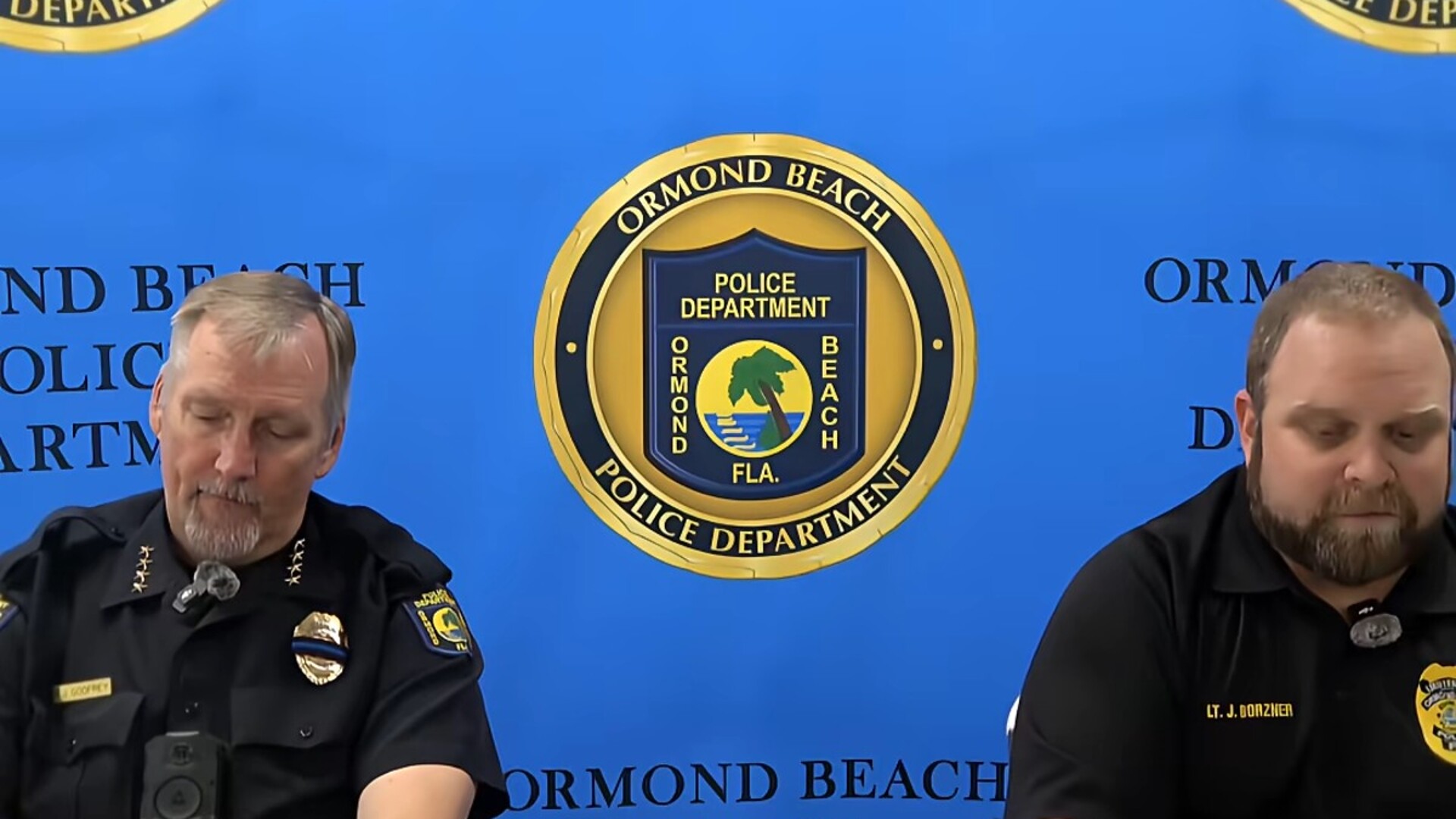
Screenshot from video: Ormond Beach Police Department officers, via Snarp on TikTok
A TikTok video posted by the account Snarp shows two uniformed Ormond Beach, Florida, police officers seated in front of a department backdrop, under a yellow banner reading “NEW LAW FOR BIKERS IN FLORIDA! DO WHEELIES AND GO TO JAIL IMMEDIATELY!” The banner is Snarp’s, not the department’s. The statute behind it, section 316.191 of the Florida Statutes, took its current form in 2024, and it makes a wheelie stunt driving only when the rider is part of a street takeover.
@snarp.official NEW LAW FOR BIKERS IN FLORIDA! DO WHEELIES AND GO TO JAIL IMMEDIATELY!
Video: Snarp on TikTok, showing Ormond Beach Police Department officers. The clip runs 1 minute 30 seconds and carries the hashtag #Biketoberfest. This article relies on the statute and the legislative record, not on the clip’s audio.
Where a wheelie becomes a crime
The Legislature defines a wheelie as a maneuver in which a motor vehicle is ridden for a distance with its front wheel or wheels off the ground. It defines stunt driving in subsection (1)(k) as performing burnouts, doughnuts, drifting, wheelies or other dangerous activity on a highway, roadway or parking lot “as part of a street takeover.” A street takeover is the taking over of a portion of a highway, roadway or parking lot by blocking or impeding the regular flow of traffic in order to race, drift, wheelie or perform other stunts.
The element that turns the wheelie into the crime is the blocked road. A rider who pulls one past a green light with traffic moving falls outside that definition. A rider who does it while a crowd holds an intersection closed falls inside it. The definition names no minimum number of riders; the 10-vehicle threshold in the statute applies only to its felony tier for a “coordinated” takeover.
What a conviction costs
A first violation is a first-degree misdemeanor, which in Florida carries up to a year in jail, plus a fine of $500 to $2,000 and a one-year driver license revocation. A second violation within a year of a conviction is a third-degree felony, with a $2,500 to $4,000 fine and a two-year revocation. A third violation within five years is a second-degree felony, with a fine of $3,500 to $7,500 and a four-year revocation.
Those numbers are recent. House Bill 449, Chapter 2024-146, took effect July 1, 2024, after the House passed it 106 to 2 and the governor approved it on May 6, 2024, according to the House final bill analysis. Before it, the first-offense fine topped out at $1,000, and a second offense was still a misdemeanor, with a five-year look-back. The 2026 edition of the statute lists no amendment after that chapter, so the “new law” in the banner is more than two years old.
Passengers, cameras and spectators
The statute reaches past the rider. It is unlawful to knowingly ride as a passenger, to coordinate an event through social media, to block or slow traffic for one, or to drive a vehicle for the purpose of filming the participants. Bona fide news media are exempt from the filming provision. The Florida Department of Highway Safety and Motor Vehicles lists passengers, people filming, organizers and promoters among those who can face the same first-degree misdemeanor. Spectators face a noncriminal traffic infraction with a $400 fine.
Arrest and impoundment
An officer with probable cause can arrest without a warrant, so the banner’s “immediately” has a basis for takeover cases. After an arrest, the vehicle can be impounded for 30 business days, about six weeks. The 2024 bill removed the wording that limited impoundment to a vehicle the arrested person owned or co-owned, so a borrowed or financed motorcycle can be held as well. Forfeiture is a separate and narrower step: it applies only when a vehicle was used in a violation within five years of a prior conviction and the owner is the person charged.
A single wheelie falls under a different law
Outside a takeover, an officer’s other option is reckless driving, which covers driving in willful or wanton disregard for the safety of persons or property. A first conviction carries up to 90 days in jail, a fine of $25 to $500, or both. Whether a particular wheelie meets that standard is decided by the officer, then the prosecutor, then a judge. The penalty gap is wide: $25 to $500 for reckless driving against $500 to $2,000 plus a year without a license for a takeover charge.
Central Florida riders are already living under tighter rules. Backfire News reported in June on a motorcycle YouTuber who said the state’s Super Speeder law is why he may stop posting.
What decides the next case
The statute leaves the line between a crowd and a takeover to charging decisions made case by case. Prosecutors choose between a takeover charge and reckless driving, and nothing in the definition says how many riders or how much blocked traffic it takes. That is the question a judge will eventually have to answer when a rider charged with a first offense contests the “takeover” element.
Should a rider doing a wheelie on an open road face the same criminal charge as a pack that shuts down an intersection, or does Florida’s takeover law draw the line in the right place?
Lead image: Screenshot via Snarp on TikTok
About the Author