Photo: Mecum Auctions
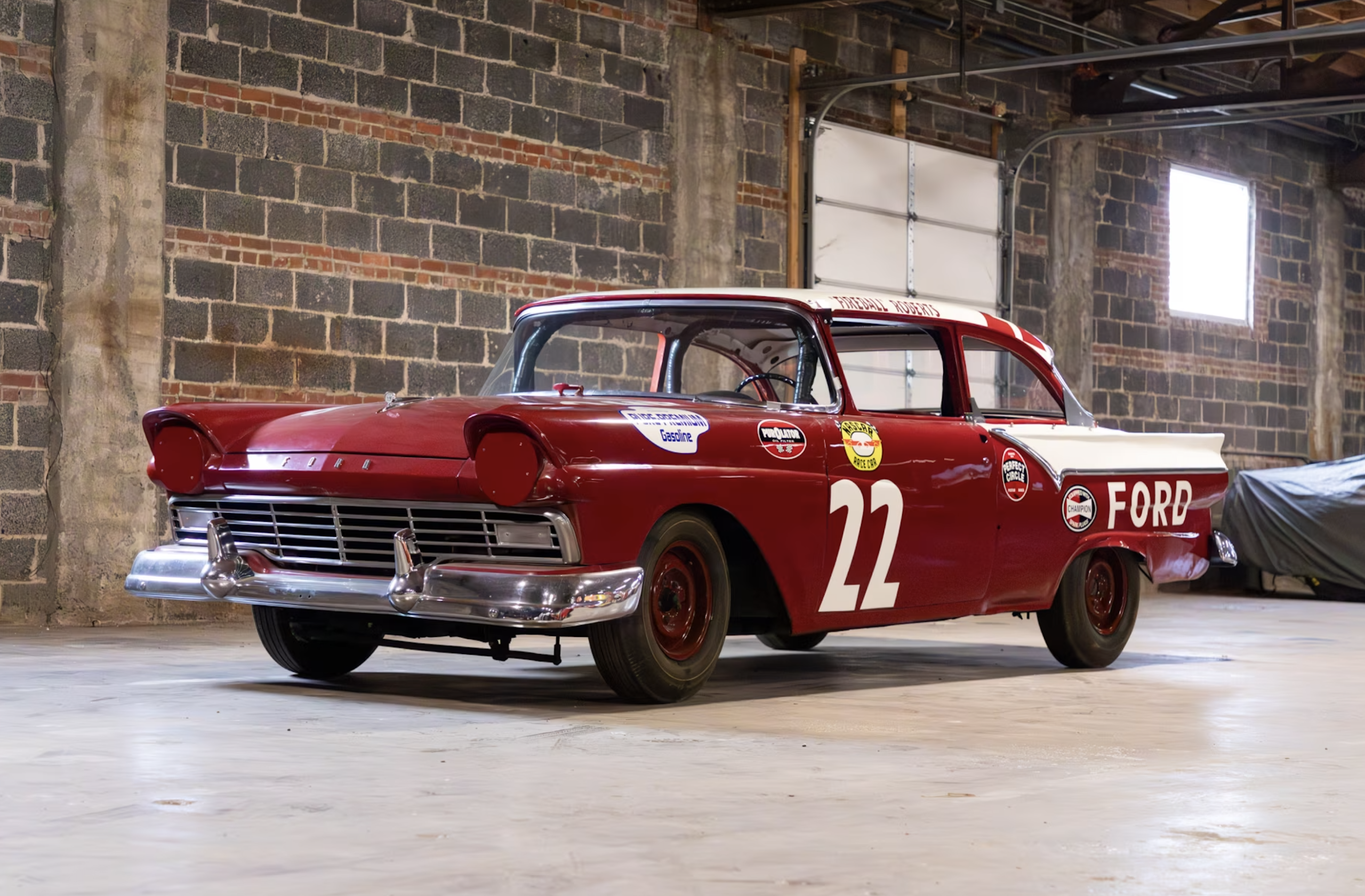
Lot S247 at Mecum’s Nashville 2026 sale doesn’t look like much beyond a boxy red-and-white two-door with a hand-painted number 22 on the doors. But this 1957 Ford Fairlane is one of the more significant pieces of NASCAR hardware to hit the block in years. Glen “Fireball” Roberts drove it to eight premier series victories during the 1957 season, including three straight wins at North Wilkesboro, Langhorne Speedway, and the Southern States Fairgrounds.
1957 was the last real hurrah for factory-backed stock car racing before Detroit got spooked. That June, after a spectator was killed when a car left the track during a convertible-division race in Martinsville, Virginia, the Automobile Manufacturers Association passed a resolution urging its members to pull out of racing and racing-related advertising entirely. NASCAR moved to cool off Detroit’s horsepower war that same year, too, banning multi-carburetor setups and other factory experimental parts that had drifted too far from what a customer could actually buy off a dealer’s lot. Roberts’ Fairlane was built and raced right in the middle of that turning point, a factory Ford campaigned at the peak of Detroit’s involvement, just before the door slammed shut.
Roberts was already one of the sport’s biggest draws by 1957, known as much for his good looks and quotable personality off the track as his aggression on it. That crossover appeal between Hollywood and NASCAR never really went away, either. Decades later, Dale Earnhardt Jr. was trackside with Tom Cruise at Daytona while Paramount worked out details on a Days of Thunder sequel, a reminder that stock car racing’s pull beyond the infield started well before modern-day marketing departments figured out how valuable it was.
Under the hood is Ford’s 312-cubic-inch Y-block V8, rated at 300 horsepower and backed by a column-shifted 3-speed manual. That is a stout number for a naturally aspirated engine running under 1957’s “strictly stock” NASCAR rulebook, and it’s exactly the kind of output that pushed the AMA and NASCAR to put the brakes on Detroit that same year. Mecum’s listing shows the car finished in the red-and-white team livery with a matching red interior, consistent with photos of Roberts’ Ford effort from that season.
The car’s post-racing life is arguably as interesting as its win record. Mecum’s listing states the Fairlane was found sitting in the backyard of Roberts’ former Charlotte home and was restored for display at the 57 Heaven Museum in Branson, Missouri. It was later tapped by the NASCAR Hall of Fame for its Glory Road exhibit, the permanent display of the sport’s most significant race cars in Charlotte, where it sat from 2017 through 2020. That kind of institutional vetting matters to collectors. A Hall of Fame loan is about as close to third-party authentication as vintage stock car provenance gets, short of an original factory build sheet. Provenance like that is the whole game right now: Modern Car Collector has watched the collector market pay up for certainty and walk away from everything else, and it regularly follows barn-find cars surfacing after decades in storage.
Documented ex-factory NASCAR cars with a museum pedigree occupy a different tier of the market than the tribute and recreation builds that circulate at a fraction of the price. Buyers considering something like this should treat the provenance paperwork, race records, exhibit loan agreements, and prior restoration invoices as seriously as the car’s mechanical condition, since that paper trail is what separates a genuine Hall of Fame piece from a well-done clone. It’s also worth insuring and appraising separately from a typical driver-quality classic, since replacement value on a car this documented has almost nothing to do with what a similar-looking Fairlane would cost at a regular collector car sale.
Mecum has increasingly leaned into these blue-chip motorsports consignments. The same auction house that’s fielding a numbers-matching Chevelle LS6 out of Harrisburg this year is now handling a car with an actual NASCAR Hall of Fame exhibit history, and that pattern isn’t unique to Mecum. Honda’s decision to bring more than 20 championship-winning race cars to Monterey this year points to the same shift: manufacturers and auction houses alike have realized documented competition history sells better than nostalgia alone.
It’s also a useful reminder of how far NASCAR has drifted from its “strictly stock” roots. Compare Roberts’ showroom-based Fairlane to a modern Cup car, like the Gaunt Brothers Racing Camry currently listed on Bring a Trailer, whose engine is deliberately detuned to half its race output just to be street legal for a new owner. Roberts’ Fairlane, by contrast, is essentially the same architecture Ford sold at dealerships that year, just gutted and caged for competition. Whatever it brings when it crosses the block Saturday, September 26th, at Mecum’s Nashville sale, it’s a rare, documented link back to the last season Detroit raced on Sunday and sold on Monday without hiding it.
Lead image: Mecum Auctions
About the Author