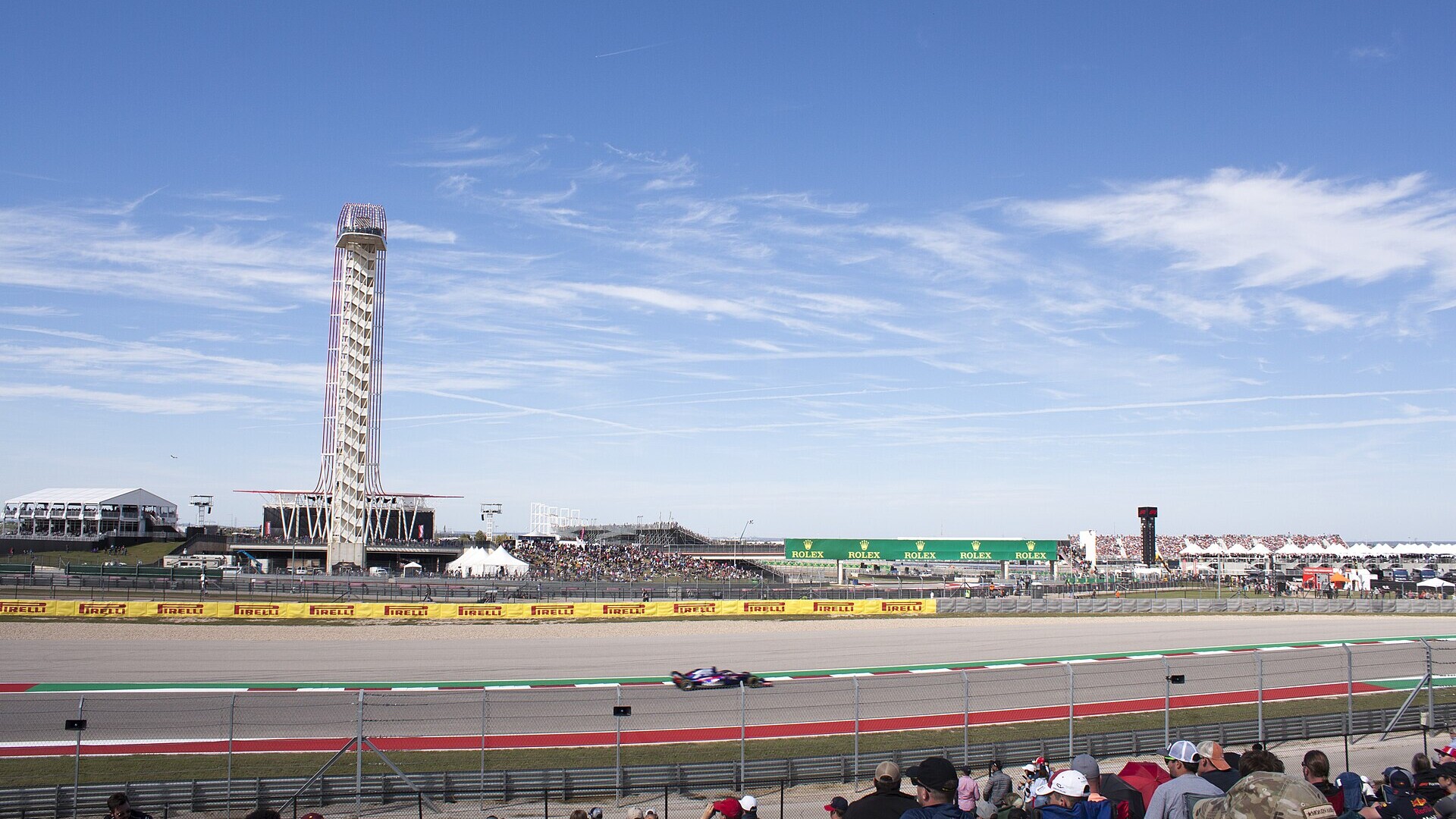
File photo of Circuit of the Americas during the 2018 U.S. Grand Prix. Photo: HoverVan / Wikimedia Commons, CC BY-SA 4.0
A chauffeur company in Austin, Texas, advertised Escalades, Lincoln Continentals and Mercedes-Benz Sprinter vans for the U.S. Grand Prix weekend and, at a price it did not disclose, “a private police escort to and from COTA,” KXAN reported. The Austin Police Department says it did not coordinate or manage the motorcades that showed up in social media video that weekend, and it is now talking with state agencies about changing Texas police escort law.
The video is easy to find. “Austin F1 traffic? Not today,” read one caption on a clip shot from inside a motorcade, per KXAN. KUT reported that its own reporter filmed three police escorts, all with lights and sirens, pass through East Austin minutes apart.
Who was behind the badges
KUT reported that neither APD nor the Travis County Sheriff’s Office provided escorts, and that event organizers hired officers from outside agencies. The owner of a company called Texas Police Escorts told KUT it supplied escorts that weekend, hires officers from across Texas, including Dallas and the Houston area, and charges prices that start at a few thousand dollars. APD told KUT an F1 representative coordinated the escorts. Williamson County told KUT that five off-duty deputies worked security and equipment moving at COTA, were not allowed to take part in escorts, and that COTA covered their costs.
Neither KXAN nor KUT says whether the company that advertised the Escalade package used Texas Police Escorts or anyone else, and neither reports a citation, charge or complaint against an officer or a company. KXAN said F1, the Texas Department of Public Safety and two companies advertising escorts had not responded when it published, and that it has filed public records requests. I have not seen a contract, an invoice or an officer roster.
What Section 546.002 says
Texas Transportation Code Section 546.001 lets the operator of an authorized emergency vehicle go through a red light or stop sign after slowing as needed for safe operation, exceed the speed limit as long as that does not endanger life or property, and disregard rules on direction of movement. Section 546.002(b) allows those three privileges in five situations: an emergency call, a pursuit, a fire alarm, directing or diverting traffic for public safety, and “conducting a police escort.”
Subsection (a) defines the term as “facilitating the movement of a funeral, oversized or hazardous load, or other traffic disruption for public safety purposes,” by a peace officer of the kinds listed in Article 2.12 of the Code of Criminal Procedure. The definition turns on purpose and on the officer’s license. It says nothing about who is paying. Everything rests on “other traffic disruption for public safety purposes,” and as I read the statute, whether a paid ride to a race fits is a call left to the officer and the department. Section 546.003 puts the use of lights and sirens at the operator’s discretion under the employing department’s policy.
The privileges are written for the operator of the emergency vehicle. As I read Section 546.001, it does not extend them to a van following behind. What that means for a chauffeur trailing an escort through a red light is a question for a Texas traffic lawyer, because the text does not answer it.
Two amendments, neither about buyers
S.B. 461 in 2003, captioned “relating to the operation of authorized emergency vehicles,” added the definition of “police escort” and made conducting one a trigger for the privileges. H.B. 64 in 2023, effective September 1, 2023, amended the definition again, and its caption reads “relating to the peace officers authorized to operate an authorized emergency vehicle used to conduct a police escort.” The 2023 change concerned which officers may escort. Nothing I read in either bill addresses who may hire one.
A Bugatti convoy behind police motorcycles on the Monterey Peninsula this August raised its own legal questions in California.
Jurisdiction and the call for oversight
Austin Police Association president Michael Bullock told KXAN the Transportation Code is “somewhat vague.” He said APD officers may work secondary jobs only in Austin, that every off-duty contract must be reviewed and approved under APD policy, and that the same limit should bind other agencies: “Any law enforcement work being done in Austin, including traffic assignments, I believe should only be by APD officers or an officer who has jurisdiction here.”
Council Member Vanessa Fuentes said on social media that security escorts are regulated and managed by the Texas Commission on Law Enforcement. “Texas law has left a gap in accountability,” she said, and she urged state leaders to work with APD on legislative oversight. Assistant Chief JJ Schmidt said, “We share concerns about these activities and are working with local and state agencies and appropriate stakeholders to discuss potential legislative changes.” APD has contacted TCOLE “to strengthen compliance and accountability in these situations,” he said. KXAN also asked TCOLE for comment, and its article does not include a response.
What happens next
For a driver at an Austin intersection, the siren sounds the same whether the motorcade belongs to a funeral, a hazardous-load move or a hospitality package, and the statute gives the officer, not the public, the call on which it is. The drivers stopped at those intersections are the ones who bear the interruption; the escort’s own price, per the owner quoted by KUT, starts at a few thousand dollars. No public document I found shows who paid whom.
Three things to watch: the results of KXAN’s records requests, TCOLE’s answer to APD, and the Legislature, which convenes its next regular session in January 2027 and is where any rewrite of Section 546.002 would have to start.
Should Texas bar officers from running paid police escorts for private rides, or is the “public safety purposes” standard enough as long as the officers are licensed and their departments approve the work?
Photo: HoverVan / Wikimedia Commons, CC BY-SA 4.0. File photo of Circuit of the Americas during the 2018 U.S. Grand Prix.
About the Author