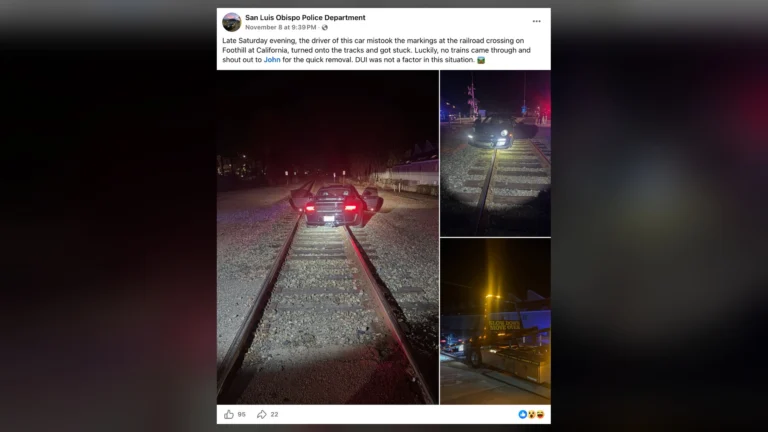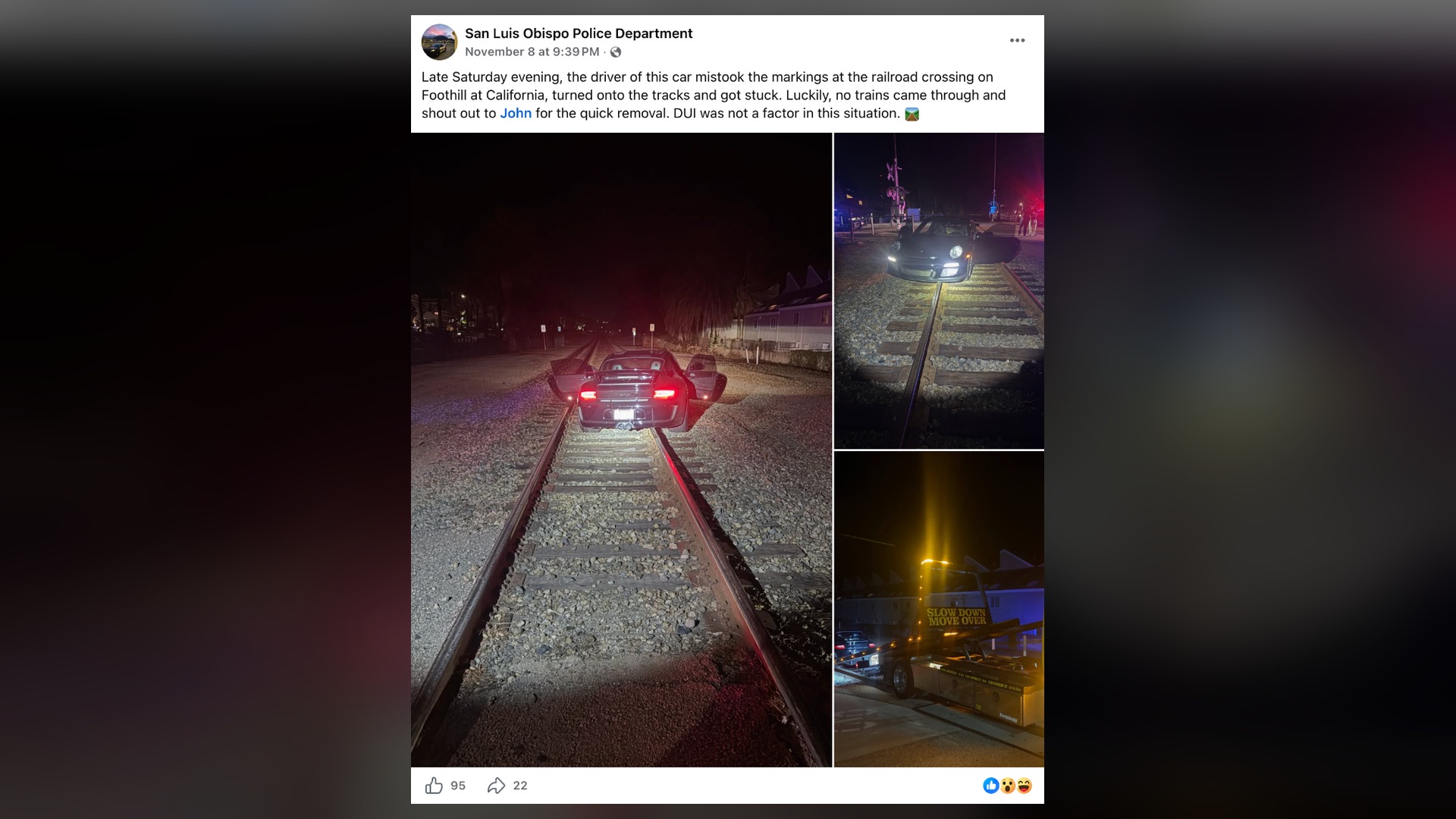
Screenshot of the San Luis Obispo Police Department’s Facebook post, Nov. 8, 2026.
A driver in San Luis Obispo, California, turned onto the tracks at the Foothill and California crossing late Saturday evening and ended up stuck, the San Luis Obispo Police Department said. In a Facebook post dated Nov. 8, the department said the driver “mistook the markings at the railroad crossing,” that no trains came through, and that DUI was not a factor.
Source: San Luis Obispo Police Department on Facebook, Nov. 8, 2026.
Three photos run with the post. One shows the car between the rails on gravel ballast with its doors open and its taillights lit. Another shows it from the front near the road crossing. The third shows a tow truck at the scene. The department credited a person it tagged by first name with the “quick removal” and did not say how long the car sat on the rails.
What the department’s post leaves out
The post does not say which markings the driver misread, who the driver is, what kind of car it was, or whether anyone was cited. I found no further statement from the department beyond the post. The department said no trains came through while the car was stuck on railroad tracks, and that is the fact every rule below is built around.
How California’s railroad trespass law treats a car on the tracks
California’s railroad trespass statute, Penal Code section 369i, makes it a misdemeanor to enter or remain on railroad property without permission when the person’s presence or conduct interferes with, interrupts or hinders the safe and efficient operation of a locomotive, railway car or train. The statute defines railroad property as land where a railroad has track, plus the land extending 20 feet on either side of the track when the railroad owns, leases or possesses it.
Two things in that text matter to a driver. A car does not have to be on the rails to be on railroad property, because the 20-foot margin counts. And the statute asks whether the presence interferes with train operations; it does not mention why the driver was there. A car wedged on a live line fits that description on its face. Whether an officer or prosecutor would apply it to a driver who misread a crossing is a separate question, and the department’s post does not say anyone tried.
What the state tells drivers stuck on railroad tracks
The California Public Utilities Commission’s rail safety page says, “If your vehicle becomes stuck on the tracks, get out immediately and move away from the tracks.” It also points drivers to the blue-and-white Emergency Notification System sign, which it says is typically on the crossing warning device and carries a direct phone number and the crossing’s identification number. The commission says to call that number and be ready to give the crossing ID.
California’s grade-crossing record
Operation Lifesaver’s state table, which cites preliminary 2025 Federal Railroad Administration data, lists 181 highway-rail grade crossing collisions in California last year, with 45 fatalities and 66 injuries. That is second among states for collisions. The same table shows 2,274 collisions, 284 fatalities and 773 injuries nationally.
By Backfire News’s math, about one California collision in four was fatal (45 of 181, or 24.9 percent), against about one in eight nationally (284 of 2,274, or 12.5 percent). The table counts collisions, so a stuck car that no train reached would not appear in it.
Cars stalled on rails have turned up in Backfire News’s coverage before, including a Jeep stranded on Houston Metrorail tracks and a Waymo that parked on light-rail tracks while its passenger bailed out.
What happens next in San Luis Obispo
The post lists no citation and no court date, and it gives no word on whether the department plans to refer the incident anywhere. For now the public record is the department’s post and its three photos.
When police say a driver mistook crossing markings and DUI was not a factor, should a car on the tracks be handled as a traffic mistake or as a possible misdemeanor?
About the Author