Photo: Thomas Wolf, www.foto-tw.de via Wikimedia Commons, CC BY-SA 3.0 de
Porsche built its first eight-cylinder boxer engine in 1962, bolted it into a Formula 1 car, and then spent the next six decades dropping variations of the idea into hill-climb specials and endurance prototypes. It has never sold one to a customer with license plates. Now there’s speculation that Stuttgart is cooking up a range-topping supercar with eight opposed cylinders behind the seats, which would end that streak.
Porsche hasn’t announced a name, a displacement or a price. What is on the company’s official calendar is a Capital Markets Day on 7 October, which Porsche AG scheduled to walk investors through its Strategy 2035 plan. That’s an investor event with slide decks, margin ladders and a Q&A, not a product launch with a turntable. So treat the rumored badge and the rumored half-million-euro sticker as unverified. The strategy behind the rumor, though, has been sitting in Porsche’s own press releases for more than a year.
Porsche already explained why it needs a car like this
Michael Leiters took over as chairman of Porsche AG’s board of management on 1 January 2026, and his Strategy 2035 rests on three pillars: brand and customer, products and technology, and company and operations. The first pillar is the one that matters here. Leiters has been blunt that the goal is no longer unit growth, telling shareholders in June that it is about “value, desirability and profitability.” He also settled the question hanging over the 911: there will be no fully electric version, and the performance hybrid is a permanent fixture rather than a bridge.
The product side of that plan is already in motion. In September 2025 Porsche confirmed that the new SUV series positioned above the Cayenne, originally planned as an EV, would launch with combustion and plug-in hybrid power only; that Panamera and Cayenne combustion models would stay on sale well into the 2030s; and that the all-new EV platform intended for the 2030s would be rescheduled and technically redesigned alongside other Volkswagen Group brands. That reversal cost real money, roughly 1.8 billion euros in depreciation and provisions, inside about 3.1 billion euros of extraordinary charges for the 2025 financial year. This year’s guidance is not much prettier: sales revenue of 35 to 36 billion euros, a group operating return on sales of 5.5 to 7.5 percent, around 700 million euros of tariff costs, 800 to 900 million euros of one-off expenses, and a dividend cut to 1.00 euro per ordinary share. A company in that position needs fewer model variants and more very profitable ones.
The engine Weissach keeps building and never selling
Porsche’s eight-cylinder boxer history starts with the Type 753, a 1.5-litre vertical-shaft Formula 1 engine from 1962 that was later enlarged to two litres and became a sports car powerplant. It went into the 904/8, the 910/8 and the 909 Bergspyder, the lightest racing car Porsche ever campaigned at 846 pounds, where 275 PS was enough for a 2.5-second sprint to 100 km/h. It powered the 908 prototype. None of it ever reached a showroom. Customers got flat-fours and flat-sixes, and when Porsche finally built a road-going V8 for the 928 it was water-cooled, banked at 90 degrees, and sitting up front.
The closest Weissach has come to a production mid-engine eight is a car Porsche itself eventually admitted to. The 2016 Le Mans Living Legend, revealed in the company’s Porsche Unseen archive dump, was a Boxster-based road sports car built as a full-size hard model, with trunk lids that opened in opposite directions, a central refuelling nozzle up front, and an eight-cylinder engine at the back. Porsche keeps this stuff. It has even started licensing its back catalogue, as it did with an 80-percent-scale 550 Spyder replica, which shows how much it now treats the archive as an asset.
Eight opposed cylinders is the hard way to do it
A 180-degree V8 and a true flat-eight are not the same engine. In a 180-degree V8, opposing pistons share a crankpin and move in the same direction, which keeps the crankshaft short and cheap but reintroduces the secondary shake a V8 normally cancels with a cross-plane crank. A real boxer gives each opposing pair its own crankpin so the pistons punch outward together, which is what produces the inherently balanced, low-vibration character Porsche owners associate with the layout. It also adds crank length, main bearings, friction and width.
Width is the enemy in a mid-engine two-seater. A flat engine spreads its heads outward exactly where the rear suspension pickup points, the turbo plumbing and the diffuser throat all want to live, and a boxer’s crankcase sits so low that a dry-sump system stops being an upgrade and becomes a requirement. In return, the crank centreline drops, the mass sits low and close to the car’s centre, and the polar moment falls. That’s the same reason Porsche’s hill-climb cars used the layout instead of a conventional V. A 90-degree V8 would be far cheaper, and Porsche already has one in the Panamera and Cayenne. But the second pillar of Strategy 2035 leans on Porsche’s sports car engineering, and a flagship running a parts-bin SUV engine would undercut that before the first deposit clears.
The flagship’s job description just flipped
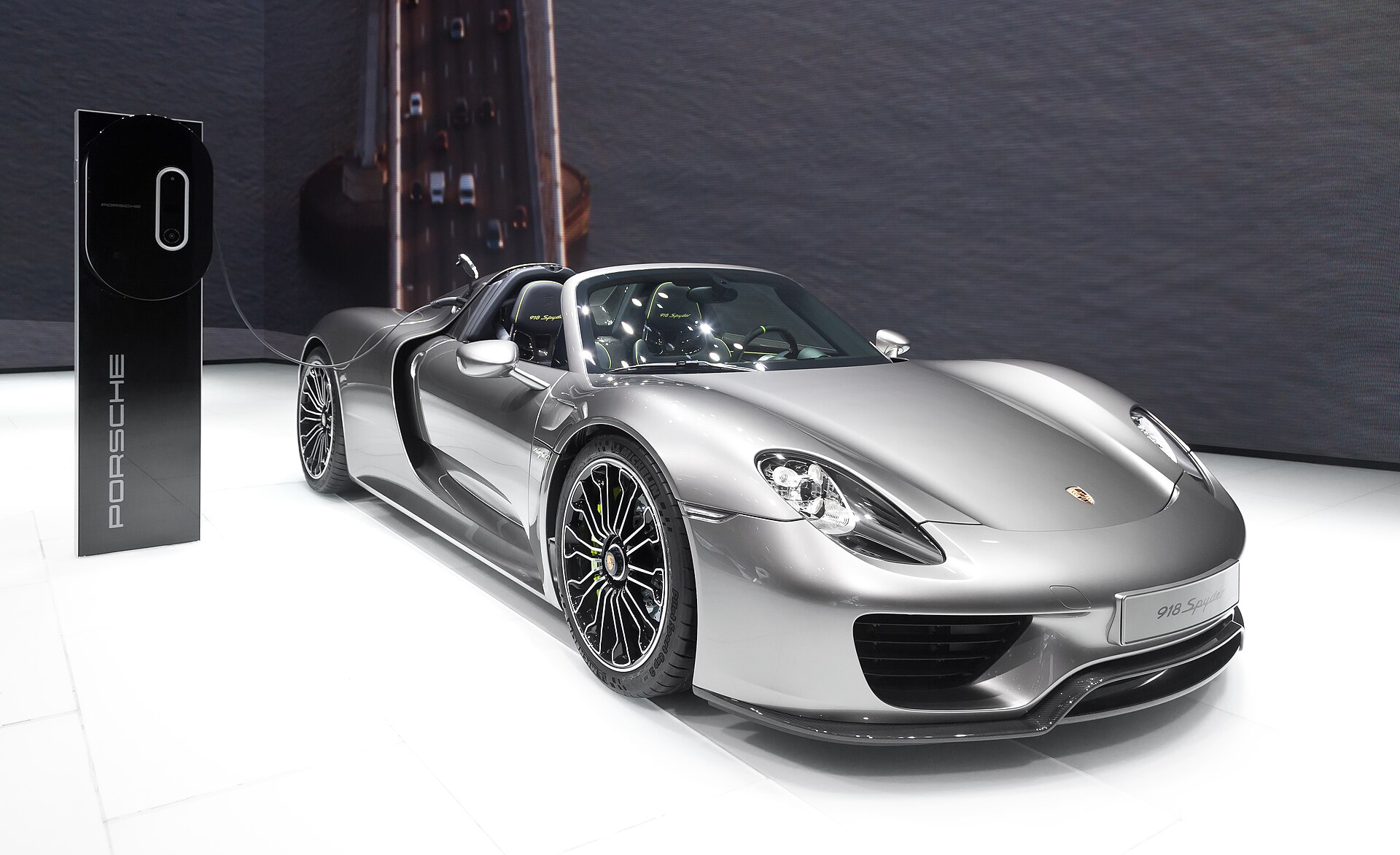
Every Porsche halo car so far has doubled as a test bed for technology that later trickled down the range. The 959 arrived in 1985 with a 450 PS twin-turbo flat-six and a 197 mph top speed, then handed its all-wheel-drive and aero lessons to the 964 Carrera 4. The Carrera GT, 1,270 of them built between 2003 and 2006 around a 612 PS 5.7-litre V10 and a 1,380 kg kerb weight, proved out carbon structures and dry-sump racing architecture for the road. The 918 Spyder paired a 4.6-litre V8 with two electric motors for 887 PS, cracked the seven-minute Nordschleife barrier at 6:57 in September 2013, and seeded the plug-in hybrid hardware that now runs through the Panamera, the Cayenne and, eventually, the T-Hybrid 911 Turbo S.
The Mission X concept was supposed to be the electric chapter of that same pipeline. Porsche published hard targets for it in 2023: the fastest road-legal lap of the Nordschleife, roughly one horsepower per 2.2 pounds, a 900-volt architecture charging about twice as quickly as a Taycan Turbo S, and a battery mounted behind the seats to mimic mid-engine mass distribution. A combustion flagship would do none of that. It wouldn’t pilot new technology or seed anything downstream; it would turn sixty years of engineering credibility straight into cash. For a company that just pushed its next EV platform back, that fits the plan.
Does the arithmetic work?
Take a hypothetical: a thousand cars at 500,000 euros is half a billion euros of revenue, which sounds enormous until you set it against this year’s guided 35 to 36 billion. It’s about 1.4 percent of the top line. A flagship earns its keep another way, by holding a pricing umbrella over the rest of the range. When the halo sits at half a million, a 270,300-dollar 911 Turbo S looks reasonable. Porsche has already tested how far customers will follow it up the ladder with a track-only 911 that costs more than the road car it is based on.
The other half of the financial story is what Porsche is no longer doing. It closed out its stake in Bugatti Rimac for roughly 1.2 billion dollars, and the destination of that money is less obvious than it looks. Stuttgart has also been pulling cost out of the back office, including handing chunks of its IT operation to an outside contractor. A company that stops financing somebody else’s hypercar programme and trims overhead has room for a halo project of its own. Meanwhile, McLaren has already laid out an 810-hp hybrid, a 2+2 GT and an SUV, and it’s also dangling a manual gearbox at the same buyers who would queue for a flat-eight Porsche.
The CO2 problem, and the e-fuel hedge
A large-displacement flagship is a regulatory liability in Europe, where fleet-average CO2 rules tighten toward the end of the decade and a 300-plus g/km two-seater drags the average in the wrong direction. Build a few hundred and the damage is manageable. Build a few thousand and the accountants start pricing the compliance offset into the sticker. That’s where Porsche’s synthetic fuel spending comes in: the company put 75 million dollars into HIF Global in 2022 and helped stand up the Haru Oni pilot plant in Punta Arenas, Chile, which produces e-fuel from Patagonian wind. If carbon-neutral fuels end up with a durable legal pathway, a high-revving flagship engine is a long-lived asset. If they don’t, the car becomes a deliberately short production run that ends at a regulatory cliff, which would make it collectible in its own right.
If you want one
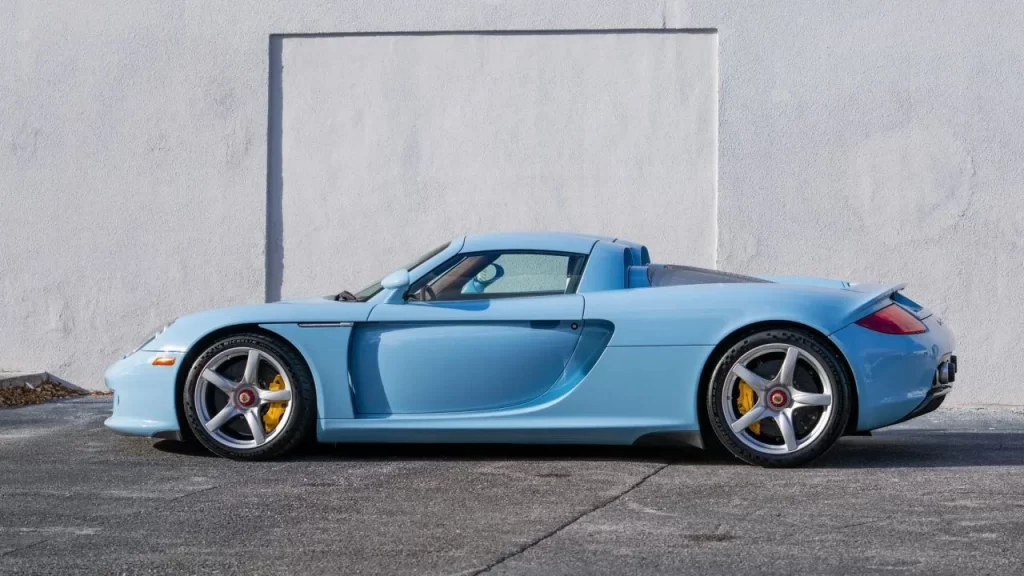
Allocation for a Porsche flagship has never been a first-come proposition, and it will not be this time. Dealers weight these lists toward customers with a documented history of buying difficult cars and specifying them through Porsche’s bespoke programmes, which means the qualifying purchases happen years before the order book opens. Spec discipline matters just as much. The 918 Spyder taught the market that a hard-core factory package and a coherent colour combination hold value while a six-figure options spree does not, and the Carrera GT market has made the same point louder: a one-off Gulf Blue example brought 6.7 million dollars while ordinary cars trade at a fraction of that, and a Schumacher-ordered car sells the story as much as the machine. Buy the provenance or buy the cheapest honest example. The middle of that market is where money goes to die.
A purely mechanical flagship would also be easier to live with long-term. Hybrid halo cars carry a high-voltage pack that ages whether the car is driven or not, and servicing one is a factory-only job with a bill to match. A dry-sumped combustion engine with no traction battery is a far simpler twenty-year hold: fluids, belts, seals, and a valve job a specialist can quote. On the insurance side, expect an agreed-value policy rather than a stated-value one, an underwriter who cares more about where the car sleeps than how fast it is, and a track-use exclusion unless you specifically buy it back. Declare any competition use honestly; a denied claim on a half-million-euro car costs far more than the premium you were trying to avoid.
What to watch on 7 October
Capital Markets Day is an investor event, so the useful signals will be financial rather than theatrical: how aggressively Porsche cuts model variants, how far it goes on shared Volkswagen Group architecture, where the medium-term margin target lands after last year’s reset from the high teens to a double-digit figure of up to 15 percent, and whether management talks about a top-of-range halo as a revenue line or a brand expense. Porsche has confirmed none of the specifics circulating about a flat-eight flagship. What it has done is spend a year building the strategic and financial case for exactly this kind of car without admitting the car exists. If one does appear, the engine won’t be what’s new. Porsche has been building flat-eights since 1962; it just hasn’t sold one.
About the Author