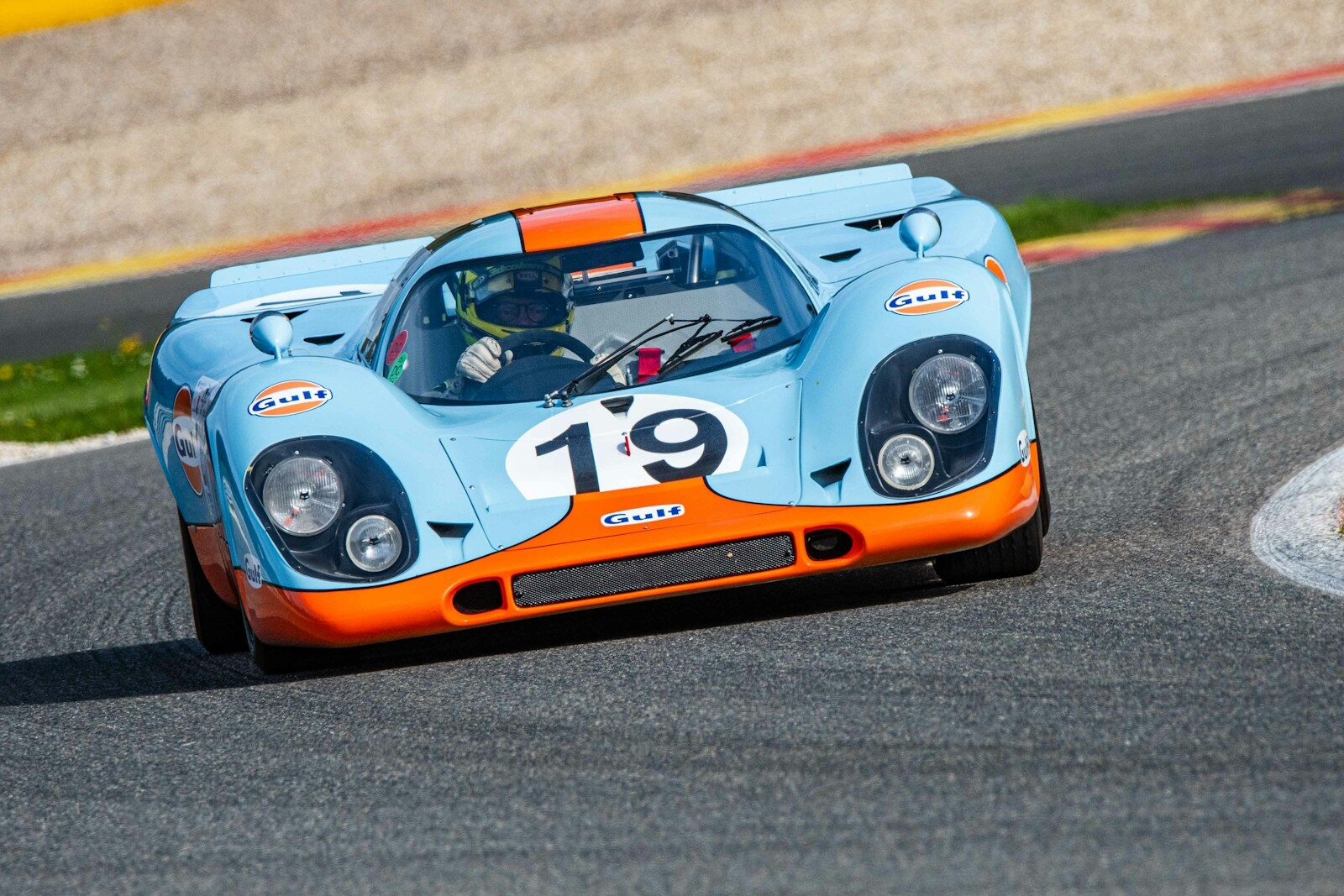
The rulebook allowed five litres if you built 25 cars. Porsche built 25 before it knew whether one of them worked.
In 1968, the CSI capped sports prototypes like Porsche’s 908 at three litres. It also allowed five litres in the Group 4 sports car class, first on the condition that 50 cars were built and later with the minimum cut to 25 (Porsche’s development history). Ferdinand Piëch saw an opening. The job was to design an all-new car and build 25 copies of it before anyone knew whether it worked.
Not quite a boxer
Hans Mezger’s Type 912 engine displaced 4,494 cc and borrowed pistons, cylinders and valves from the 908. Enthusiasts call it a flat-12. Porsche calls it a 180-degree V12, and the label matters. Porsche says the layout made the engine shorter and reduced friction because it needed fewer main crankshaft bearings than a boxer. The case was magnesium, gears from a central power takeoff drove the overhead cams, a horizontal fan did the cooling, and a Bosch pump handled mechanical injection.
The rest of the car was built around weight. The aluminium tube frame weighed 45 kg, and the fiberglass body was bonded directly to it. The hubs and coil springs were titanium, and the wheels and knuckles were cast magnesium. The rear section came off, so one homologated car could run as a Le Mans long-tail or as a short-tail. Flaps at both ends were linked to the suspension and tilted upward as downforce dropped.
The Geneva numbers were a guess, and a low one. The 520 PS and DM 140,000 price announced at Geneva were figures calculated from a 2.25-litre six-cylinder test engine, not the real 4.5. Mezger’s actual engine made 542 PS on its first run. Carmakers rarely understate power on a spec sheet, then or now.
Twenty-five cars and a rope
Inspectors came to Zuffenhausen on 21 April 1969, and Porsche announced homologation effective 1 May. Process planner Hermann Burst later recalled that the 25 cars were lined up perfectly straight for the inspectors using a rope (factory witnesses).
The harder part was making the car drivable. Its Spa debut ended after one lap with a broken valve spring. At Le Mans, privateer John Woolfe died in a first-lap crash, and the Elford/Attwood car was six laps ahead after 21 hours before its gearbox cracked. Hans Herrmann summed up the early car this way: “The 917 started out as a very difficult racing car.” After changes to the frame and body, Siffert and Ahrens won at the Österreichring on 10 August 1969.
Then it started winning
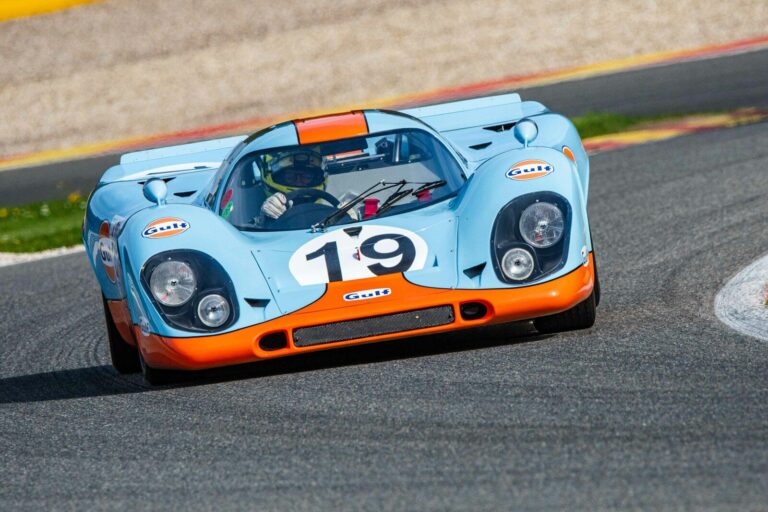
On 14 June 1970, Herrmann and Attwood gave Porsche its first overall Le Mans win in the #23 Porsche Salzburg 917 KH, covering 4,607.811 km in 343 laps (Porsche’s anniversary release). Porsche has since won the race overall 19 times. In 1971 the 5.0-litre, 630 PS 917 KH won eight races, and Porsche took the world sportscar title by a wide margin (1971 KH profile).
The Martini car driven by van Lennep and Marko averaged 222.3 km/h and covered 5,335 km, two records that lasted 39 years. It was also the first Porsche to race with a magnesium spaceframe, and it was so light that a 55-litre oil tank was needed to reach the 800 kg minimum weight (Porsche data sheet). That chassis was finished on 5 June and retired after the race it won.
Exiled to America, then turbocharged
The regulators changed the rules again. Porsche notes that the capacity limit dropped to three litres (Porsche history). Can-Am was the next target. There, Porsche judged the 4.5-litre engine’s 580 PS too little to win.
Turbocharging an air-cooled race engine was mostly a heat problem. Porsche says the 917’s exhaust reached 1,100°C, compared with about 350°C in the American methanol engines (turbo press kit). The 917/30’s 5.4-litre turbo engine made 1,100 PS, and Penske won six of eight races, with Donohue taking the title. Can-Am then imposed a fuel-consumption limit on turbo engines. In 1975, running 1,230 hp, Donohue reached 355.85 km/h at Talladega (Porsche Latin America).
The 917’s influence reached road cars directly. The 1978 model-year 911 Turbo used brakes very similar to the system developed for the 917 (museum exhibition).
What owning one actually involves
Gooding sold chassis 917-024 for $14,080,000 in 2017. The listing named engine 917-021 and said the car was sold on a bill of sale (auction listing). Its history includes ownership by Jo Siffert, use in filming McQueen’s Le Mans, and rediscovery in 2001 in a warehouse outside Paris (Gooding release).
The bill of sale is the part buyers should notice. A pure race car has no road title. Its legal identity comes from documentation: chassis records, factory paperwork and continuous history. A chassis paired with a different-numbered engine is common on these cars, and that pairing shapes how the car is valued, insured and eventually resold.
Then there’s upkeep. Magnesium frame and engine castings, titanium springs and hubs, and a 1969 racing engine with gear-driven cams all call for specialist care. Ask what a rebuild of a gear-driven-cam 180-degree V12 costs before you ask about the paint.
Porsche found its gap between a displacement cap and a homologation minimum. Where would you look for the next one in today’s rules: Balance of Performance, hybrid limits, or somewhere nobody’s checked yet?
Lead image: Xavier Praillet on Unsplash
About the Author