Ettore Bugatti is getting a movie. Whoever wrote the announcement should probably read a book first.
Camille Delamarre has been attached to direct Bugatti: The Final Race, an English-language feature from The Andrea Iervolino American Company, with Iervolino himself co-writing — his first screenwriting credit — alongside Alberto Ferrari. The film is set in Paris in 1947, during the last months of Ettore Bugatti’s life, in an apartment where past and present blur together.
That framing is, historically, exactly right. Ettore Bugatti died in Paris on August 21, 1947. So the setting checks out.
What doesn’t check out is the description of Bugatti as a race car driver, which has been attached to the announcement and which is going to make anyone who has spent an afternoon in the Cité de l’Automobile wince. Ettore Bugatti was an engineer, a manufacturer, an obsessive designer, a prolific patent filer and one of the shrewdest marketers the industry has produced. He was not a racing driver in any meaningful sense. The men who actually drove his cars to glory have names — Jean-Pierre Wimille, Robert Benoist, Pierre Veyron, Raymond Sommer — and those names are the reason the marque means anything.
Related Articles
- Land Rover’s Putting A Dakar Race Truck, A Rare ’90s Defender, And A Mystery Reveal On The Same Lawn At The Quail
- 2027 Kawasaki ZX-6R Returns Unchanged — And That’s the Story
This matters more than pedantry. Bugatti’s genius was in outsourcing the racing. He built cars good enough that wealthy privateers bought them and won with them, generating publicity he never had to fund. Get that wrong and you get a film about a man chasing checkered flags, when the real story is a man in a workshop who understood that other people’s victories sold his cars.
So what is “the final race”?
If the title is meant literally, the answer is 1939 — and it’s a better story than anything a screenwriter needs to invent.
Bugatti took its first outright Le Mans victory in 1937 with Wimille and Benoist in a Type 57G Tank. Two years later the marque came back and did it again. Per Bugatti’s own account of that race, Wimille and Veyron covered 248 laps and 3,354 kilometres at an average of 139 km/h, beating the runner-up by three laps out of a 42-car field where only 20 finished. Ettore later liked to point out the mechanics never once opened the bonnet.
Bugatti calls that win the last great motorsport success in the company’s history. Two months later the war started. Production stopped, the factory was evacuated, and the marque only restarted afterwards with enormous difficulty.
And here’s the gut punch the film will presumably build around: on August 11, 1939, weeks after that victory, Ettore’s son Jean died in a car accident near the Bugatti factory. He was 30. Jean was the designer responsible for the shapes that made the marque immortal — he was the future of the company, and the company effectively ended when he did. Iervolino’s own statement leans on exactly this, describing a man who paid for his dream with the loss of his son.
The eight years nobody films
What makes the 1947 setting genuinely interesting is the wilderness period between Jean’s death and Ettore’s own. Alsace was occupied. Molsheim was gone. Bugatti’s newsroom notes that when the Germans took Alsace, Ettore moved his very first car, the Type 10, down to his boatyard near Bordeaux, where he spent his time designing speedboats. After his death that car sat neglected until a French racing driver dug it out at the end of the decade.
That’s the movie. A man who built the most beautiful cars in Europe, stripped of his factory, his heir and his country’s confidence in him, drawing boats in a shed. Whether a production company that markets itself on Italian speed romance has any interest in telling that version is another question entirely.
What car people should actually watch for
Forget casting. The only question worth asking about a prewar Bugatti film is what appears on screen and how.
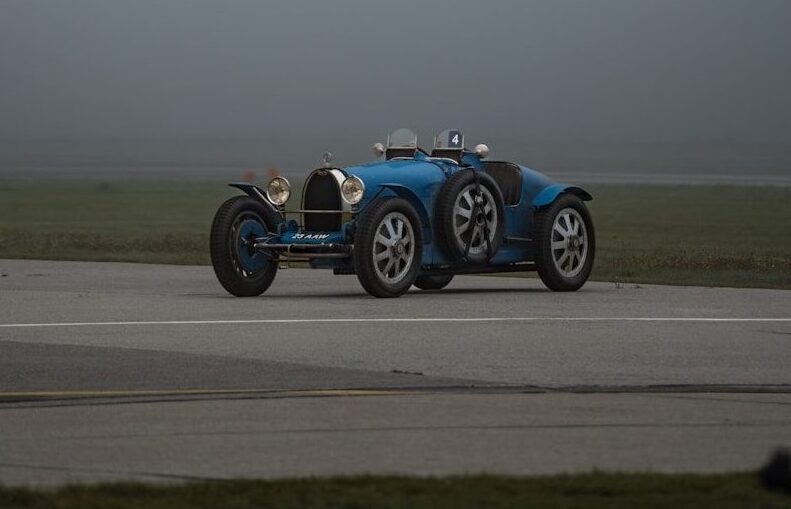
There is no realistic scenario where a production gets meaningful track time in a genuine Type 57 Tank or a competition Type 35. The insurance alone kills it — film production cover on an eight-figure prewar competition car with irreplaceable coachwork, running hard on camera, prices out somewhere between “no” and “absolutely not,” and no serious owner is handing over a car whose value rests entirely on originality so a stunt driver can slide it for a wide shot.
Related Articles
- Hand-Built Widebody Ferrari F355 Rolls Into Las Vegas With No Reserve
- Bugatti Destrier: The Bolide-Based One-Off Nobody Has Confirmed Is Road Legal
Which means replicas, tool-room copies, tribute builds, or CGI. That’s not a criticism — it’s just how these films get made, and it’s worth knowing before you go looking for chassis numbers in the credits. The tell will be the sound. A supercharged 3.3-litre straight-eight has a very specific character, and productions that cheat it with a generic dubbed engine note are telling you what they think of the audience.
The market angle
Biopics move metal. Expect renewed attention on Type 35s, Type 57s and anything with documented period competition history — and expect the usual consequence, which is that thin provenance suddenly gets described more confidently than the paperwork supports. Prewar Bugatti is already a category where rebodied cars, replacement chassis and decades-old “restorations” of questionable identity circulate freely. If a film raises the temperature, verify through the marque registries and original factory records, not the seller’s enthusiasm.
Delamarre, whose credits run through Brick Mansions, The Transporter Refueled and Assassin Club, said he grew up a few kilometres from the Bugatti legend and that Molsheim is where impossible objects were built. He’s not wrong about the place.
Let’s hope somebody on the production tells him his protagonist wasn’t a driver.
About the Author