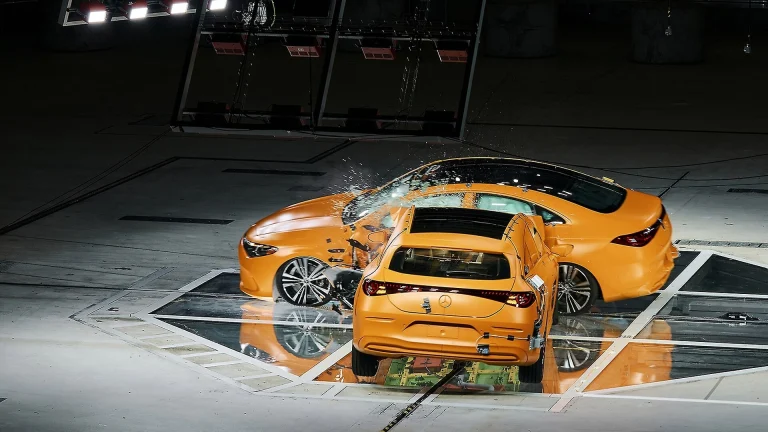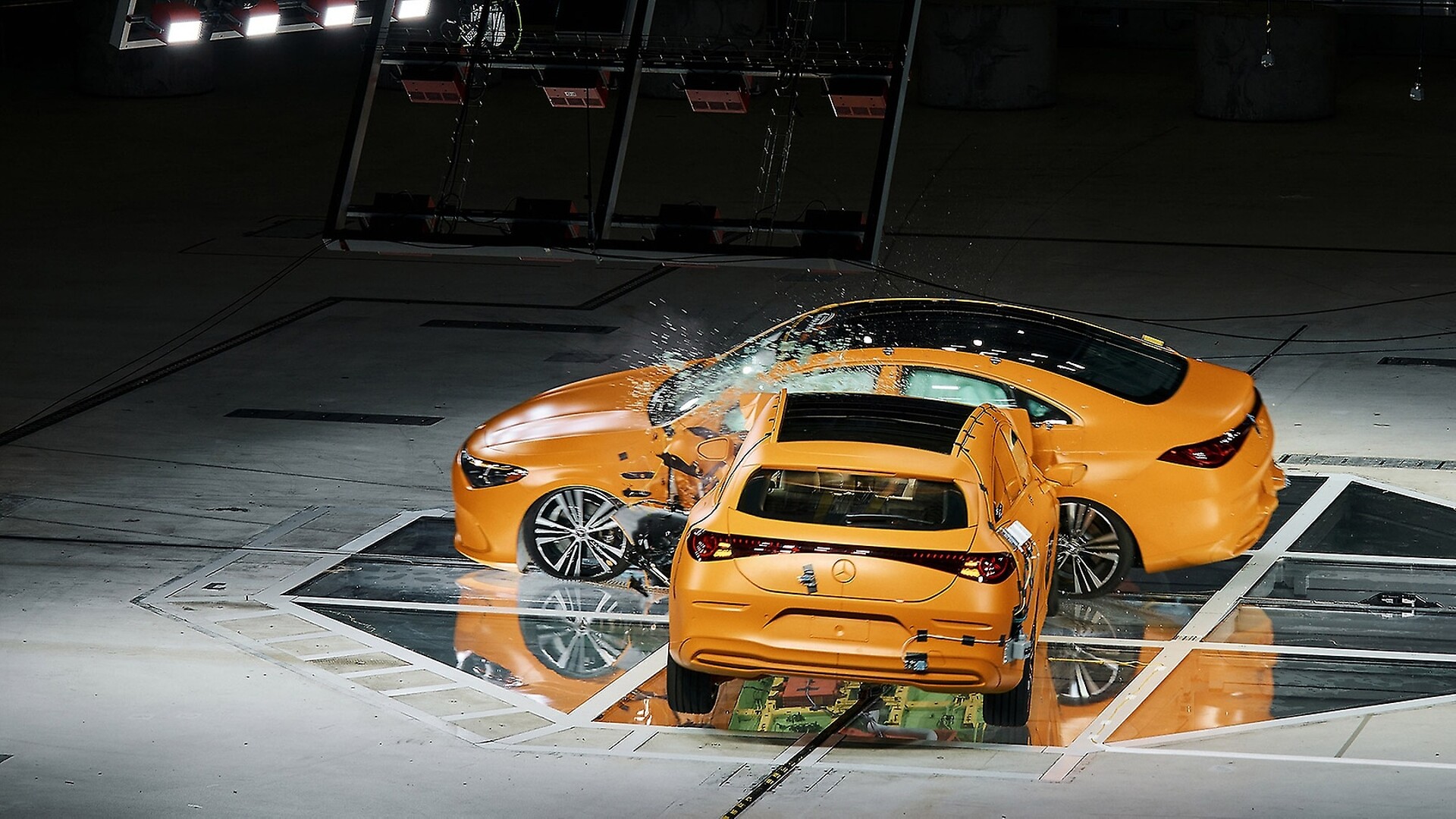
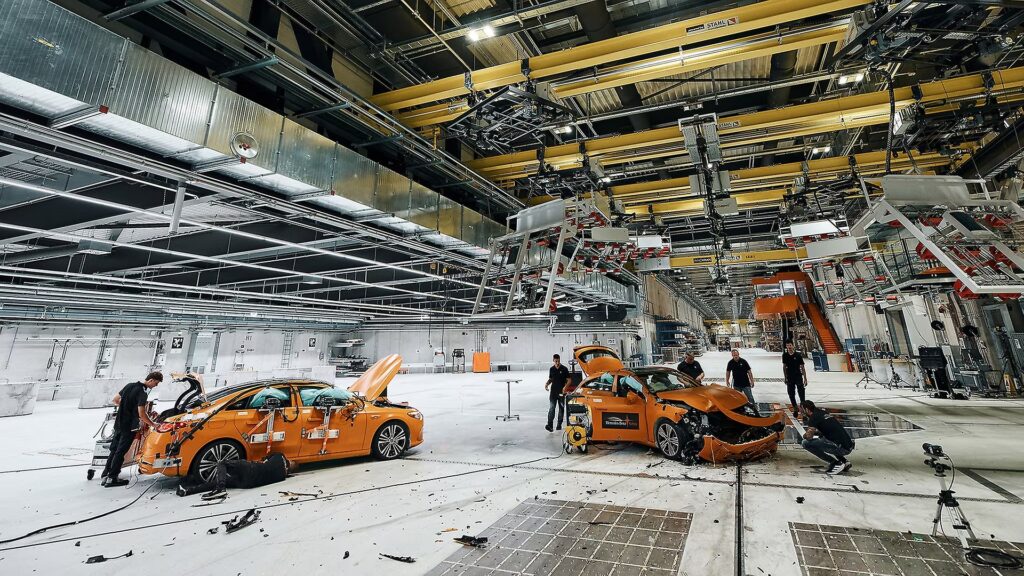
The CLA Shooting Brake hybrid at the moment it hits the driver’s side of the electric CLA. Both cars were travelling at 56 km/h. Photo: Mercedes-Benz Group AG (press image)
Mercedes-Benz drove a CLA Shooting Brake hybrid into the driver’s door of an all-electric CLA sedan with both cars doing 56 km/h (35 mph), no braking, and eight crash dummies on board. Mercedes-Benz Group published the result on October 20 and calls it the world’s first live high-speed side-impact crash test with two production vehicles.
According to the release, both passenger compartments stayed intact, every dummy reading stayed below the relevant biomechanical limits, and the high-voltage battery in the electric car’s floor “remained intact and undamaged.” The dummies represented four adults and four children, each instrumented with up to 150 measurement points.
None of those measurements are in the release. There are no head or rib values, no intrusion figures for the door or B-pillar, no seating plan for the dummies and no trim names for either car. Mercedes says each car weighed more than two tonnes but doesn’t give either test mass.
Live, but where
The English release says “live.” The German version is more specific: the crash was staged “vor Publikum,” in front of an audience. Chief technology officer Jörg Burzer’s quote calls it “the world’s first public intersection crash test conducted in this configuration,” and that last clause shrinks the record considerably.
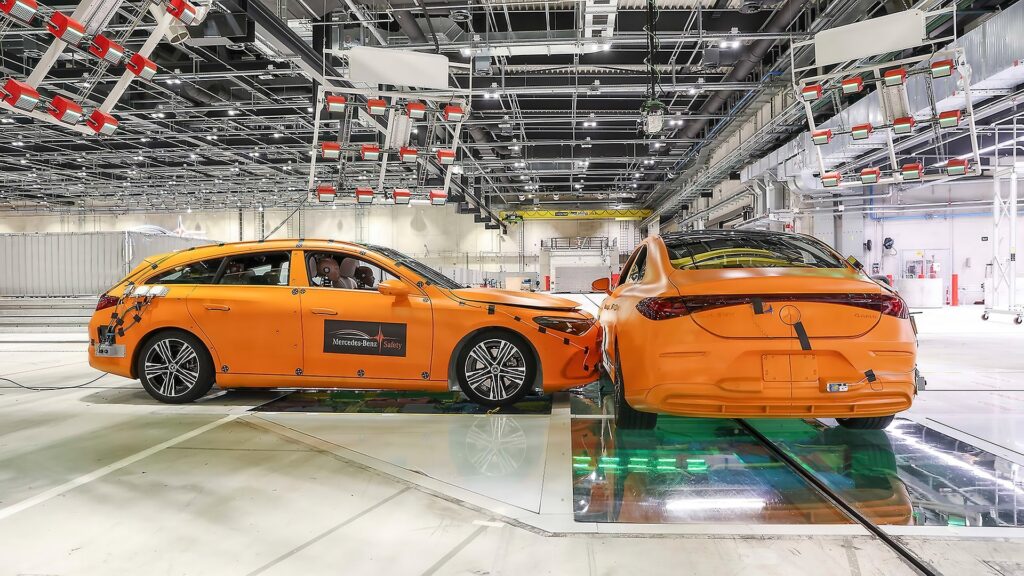
Neither version names the venue or who was watching. The photos show an indoor hall with camera gantries overhead, and the same Mercedes page links to its crash test centre in Sindelfingen, but the release never says that’s where the cars met.
Mercedes also posted the footage to Instagram the same day. The caption talks about “the impact” and the company’s safety engineers. It doesn’t mention the CLA, the speed or the test setup.
Against the rating tests
Mercedes’s case for the stunt is that “no law and no safety rating requires a side-impact crash test involving two real vehicles.” That’s accurate. The Euro NCAP side protocol runs a 1,400 kg deformable trolley into the side of the car at 60 km/h. The IIHS version uses a 4,200-pound (about 1,905 kg) barrier at 37 mph, which is also about 60 km/h. In both, the car being hit isn’t moving.
That changes what “56 km/h each” means. The struck CLA’s own speed runs along its length, not into its door. The load its side structure has to take comes from the Shooting Brake’s 56 km/h, which is slower than either rating test. The two speeds don’t add up to 112 km/h, and Mercedes doesn’t claim they do. The closing speed between the cars is about 79 km/h, on a diagonal. What the moving target adds is sideways travel during the hit: the striking car’s nose is dragged along the door rather than punching straight in, and both cars rotate.
Mass is where Mercedes has the stronger argument. A Shooting Brake of just over 2,000 kg at 56 km/h carries roughly 240 kJ of kinetic energy. Euro NCAP’s trolley carries about 195 kJ and the IIHS barrier about 260 kJ. So the energy sits between the two consumer tests, delivered by a real car’s bumper beam, crash boxes and engine bay instead of a deformable barrier face.
The company says around a quarter of crashes involving injuries are side impacts, and that 56 km/h is at the top of the range for serious junction crashes in its own accident data. It has been reconstructing real crashes since 1969, about 6,000 of them across teams in Germany, China and India, and says each new model goes through about 15,000 simulated crashes and around 150 physical ones.
What Euro NCAP already found
The electric CLA already has independent side-impact results. Euro NCAP rated the CLA 250+, at a 2,056 kg kerb weight, five stars in December 2025, with 94 percent for adult occupant protection and 89 percent for child occupants. It scored maximum points in the side barrier test.
Where it lost points was the side pole test, in which Euro NCAP rated chest protection marginal because of rib compression readings. A car into a door is a different load case from a door into a tree or a utility pole, and Mercedes didn’t stage the second one. This test adds a scenario, not a rating.
The battery claim
For an EV, a hit to the side is the one the battery cares about. The pack sits in the floor, and the sill and floor structure are what keep an incoming bumper away from it. Mercedes says the pack was undamaged. It doesn’t say whether it checked cell temperatures or insulation resistance afterward, or how long it watched the car for a delayed thermal event.
Rescue Intelligence
The same release introduced Mercedes-Benz Rescue Intelligence, which links a crashed car directly to emergency services so firefighters can see data while they’re on the way. Depending on “technical availability,” that includes the number of occupants, airbag and seatbelt status, which doors are open, battery temperature and the state of the high-voltage system. Mercedes says it will roll out gradually from 2027 and hasn’t named the models, markets or emergency services involved.
Would you trust a manufacturer’s own car-into-car crash with unpublished dummy data over a standardized barrier test, or is Euro NCAP’s number the only one that counts?
Sources: Mercedes-Benz Group release, October 20, 2026 (English and German); Mercedes-Benz Instagram post, October 20, 2026; Euro NCAP CLA result, 2025; Euro NCAP side impact (AE-MDB) protocol; IIHS side test description. Images: Mercedes-Benz Group AG press photos.
About the Author