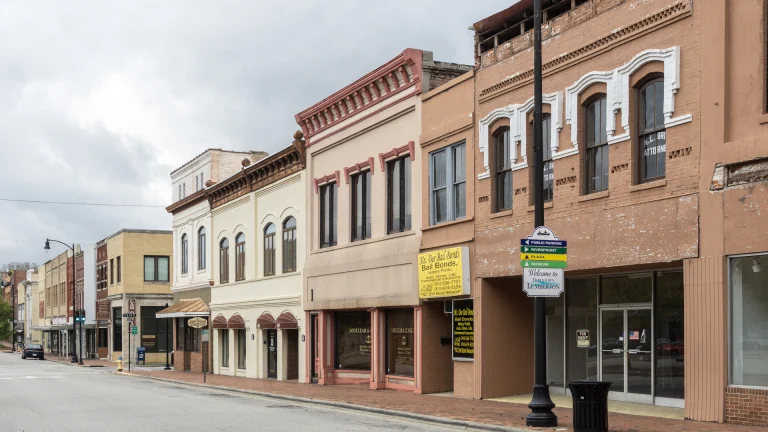
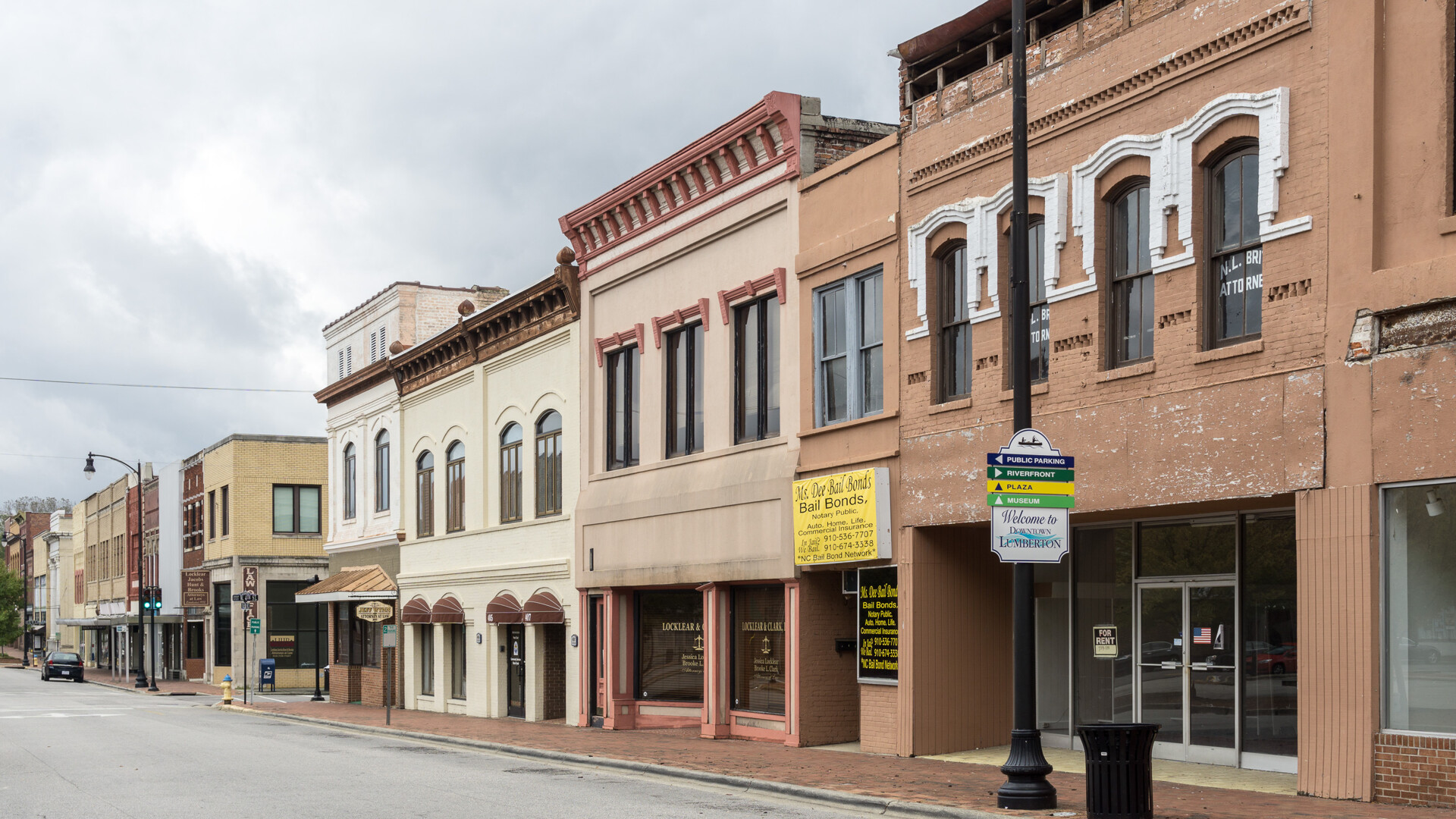
North Elm Street in downtown Lumberton, N.C. Photo: Kenneth C. Zirkel via <a href="https://commons.wikimedia.org/wiki/File:Downtown_Lumberton_North_Carolina.jpg">Wikimedia Commons</a> (<a href="https://creativecommons.org/licenses/by-sa/4.0/">CC BY-SA 4.0</a>)
Joshua Oxendine, 44, a former Lumberton, N.C., police officer, was charged Nov. 19 by the State Bureau of Investigation with accessing computers, a misdemeanor, over his alleged use of the department’s Flock license plate reader system. He is the latest in a string of North Carolina officers charged this year over plate reader searches.
The SBI said Lumberton police asked it on Aug. 19 to look into an allegation that an officer had used Flock improperly, and that “After a thorough investigation, SBI agents charged Oxendine under N.C. General Statute 14-454(b),” according to WECT. The charge is an accusation. Neither the SBI nor the department has said whose plates were run or why, and local reports have not identified a lawyer for Oxendine or carried any statement from him.
A day later, in a statement signed by Sgt. David B. Harrell and published by WMBF, the department said, “Officer Oxendine is no longer employed by the City of Lumberton.” It did not say whether he resigned or was fired. The statement also said Lumberton has used Flock cameras since June 2024 and has found no other Flock violations by its officers.
Feb. 18 to Aug. 19: the gap in Lumberton’s timeline
The Robesonian, citing court documents, reported that the alleged offenses took place between Dec. 31, 2025, and Feb. 18, 2026, and that Oxendine faces five misdemeanor counts, not the single count described in the SBI’s announcement. The Robeson County court file will settle the count.
If those dates hold, six months separate the last alleged offense from the department’s Aug. 19 request to the SBI, and the charge came three months after that. The department has not said how the allegation surfaced or when it first learned of it.
Charlotte’s case moved on a different clock. According to a Charlotte-Mecklenburg Police Department release, officer Seth Elliott allegedly ran one improper Flock and CJLEADS lookup on June 16, 2026. The SBI, which came across it during an unrelated investigation, told CMPD on June 18, and Elliott was cut off from the systems and moved to paid administrative assignment on June 22. He was arrested July 29 on a charge CMPD described as illegally accessing a government computer, a Class 1 misdemeanor.
Three North Carolina laws reach a personal plate search
Oxendine’s charge comes from G.S. 14-454(b), a general computer-crime law first enacted in 1979. It makes willfully accessing a computer, system or network without authorization a Class 1 misdemeanor. The definition in G.S. 14-453 does the work: authorization means consent from the owner, used “in a manner not exceeding the consent or permission.” An officer with a valid Flock login has permission to run plates for police work. Under that wording, a search outside that permission counts as unauthorized even though the password was his own.
North Carolina also has a crime written for plate readers. Since 2023, G.S. 20-183.33 has made it a Class 1 misdemeanor to obtain, access, preserve or disclose plate reader data in a way the state’s ALPR law doesn’t allow. That law, G.S. 20-183.30, recognizes four law enforcement purposes: criminal investigations and the prosecutions and supervision that follow, catching someone with an outstanding felony warrant, finding a missing or endangered person, and finding a lost or stolen vehicle. A companion section bars using the data to enforce traffic violations.
The heaviest option is G.S. 14-454.1(b), which makes unauthorized access to a government computer a Class H felony. The state defines a government computer as one “owned, operated, or used by any State or local governmental entity.” A Harnett County grand jury returned that felony count against former sheriff’s detective Jayne L. Holland, along with plate reader misdemeanor counts, according to reports on her case. The SBI’s Lumberton announcement cites only the general misdemeanor, and nothing in the public record explains the difference.
For a Class 1 misdemeanor, North Carolina’s sentencing chart allows 1 to 45 days for a defendant with fewer than five prior convictions, and only community punishment for someone with none. The size of any fine is left to the judge.
What a driver in Lumberton can and can’t see
State law controls what happens to every plate the Lumberton cameras capture. G.S. 20-183.32 says captured plate data can’t be kept more than 90 days unless it is held under a preservation request or a search warrant. It makes the data confidential and not a public record, available only to criminal justice officials for a legitimate law enforcement purpose, and it bars selling it.
The same rule keeps drivers from seeing who looked them up. A driver who suspects an officer ran his plate for personal reasons has no public-records route to the search history, and nothing in that section requires an agency to tell a driver his plate was searched. The check on misuse sits inside the department. G.S. 20-183.31 requires every agency to adopt a written policy before its system goes live, covering operator training, supervisory oversight, data security and access, and auditing at least once a year with a report to the agency head.
Lumberton’s department says it already audits the system and tells every officer with access that it “is for law enforcement purposes only.” In its first statement on Nov. 19, the department said, as quoted by The Robesonian, that it is adopting a policy that “limits access to authorized users, who must complete training and document their searches.” The 90-day limit applies to captured plate data. It says nothing about the logs of which user ran which search, and those logs are what an audit reads.
Lumberton joins a 2026 list of North Carolina Flock cases
Lumberton is at least the fourth North Carolina department this year with an officer charged over Flock use. In Mooresville, Police Chief Ron Campurciani said an audit found officer Elizabeth Snowman had accessed the system 31 times for personal use to track her boyfriend’s ex-wife, and that she listed most of those searches as motor vehicle infractions, ABC News reported in August. Elliott was charged in Charlotte in July, and Holland was fired in Harnett County on Sept. 15 and indicted in November. Each case is an allegation.
Outside the state, a St. Petersburg, Fla., officer who police say ran a woman he had dated through Flock and two other databases resigned, and prosecutors declined to charge him.
Oxendine’s Jan. 25 court date
Oxendine is scheduled to appear in court Jan. 25, 2027. The department says its internal investigation and the SBI’s criminal investigation are continuing and that it can’t release details. By that date, the court file should show how many counts he faces. It may not show whose plates were searched, or how a department that says it audits its cameras learned of offenses that court documents date to last winter only in August.
A North Carolina driver whose plate gets run for personal reasons has no records request that will reveal it. If an audit caught an officer searching your plate, would you want a letter, and what would you do with it?
About the Author