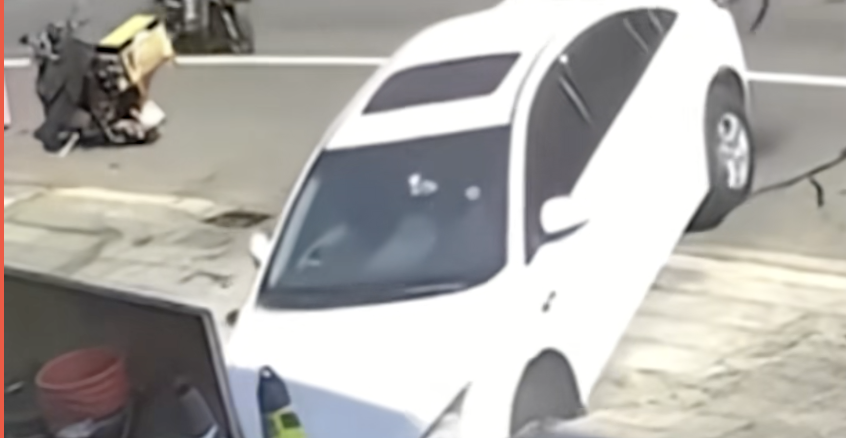
Somewhere between “this looks like the way in” and “why is the dashboard pointing at the ground,” a driver in Kaili City, in southwest China’s Guizhou province, realized he had made a navigational error. By then the car was already on the stairs.
Surveillance footage released by CGTN, the international arm of China’s state broadcaster, shows the result: a white sedan wearing a Volkswagen badge, nose pointed down a wide concrete staircase, with people in high-visibility vests and white helmets working alongside civilians to push it back up the way it came. According to CGTN, the driver mistook the entrance to a residential compound for a car park, drove down the staircase and got stuck, until police and passersby shoved the car back up the steps.
What the footage shows, and what it doesn’t
This isn’t breaking news. CGTN posted the clip on Nov. 3, 2019, saying the incident happened “on Monday.” The video carries an on-screen label reading 监控视频, Chinese for “surveillance video,” which means this came from a fixed security camera rather than a bystander with a phone and a sense of humor.
What’s visible: the car, the stairs and a crowd of helpers leaning into the front end. What isn’t: the driver’s identity, how far down the car traveled, whether anyone was cited, and what the underside of that sedan looked like afterward. CGTN didn’t report injuries or charges, and we won’t guess at either. We also won’t pretend to read a model year, trim or damage report off a grainy CCTV frame.
Why stairs eat ordinary cars
A staircase and a parking ramp can look alike through a windshield, especially when the top step sits flush with the pavement and the rest of the drop is hidden below the hood line. Geometrically, they aren’t related. A common stair design rises about 7 inches for every 11 inches of tread. That’s a slope of roughly 30 degrees, close to a 60 percent grade. No parking ramp meant for ordinary cars comes anywhere near that.
Then there are the edges. A ramp is one smooth plane; a staircase is a row of hard concrete corners. Three numbers decide how a car deals with that: approach angle, or how steep a slope the front bumper can meet before it hits; breakover angle, or how sharp a crest the car can straddle before the middle of the floor touches down; and departure angle, the same idea at the rear. Everyday sedans are built low for aerodynamics and handling, with front fascias that hang close to the road. None of those angles is designed for a 30-degree drop lined with step noses.
@thesun This is the shocking moment a driver mistakes a narrow staircase for a parking bay. #viral #driver #shockingmoment ♬ original sound – The Sun
Once a bumper or the underbody settles onto a step, part of the car’s weight is resting on its own belly, and the tires may not have a solid grip on anything. That’s why muscle is often a smarter recovery tool than the throttle. Spinning tires on concrete edges accomplish little, and a car that suddenly finds traction on a staircase can lurch toward everyone standing around it.
The bill nobody films
Even a slow, short trip down stairs puts concrete where engineers never expected it. If you ever pull this stunt, or buy a car from someone who did, get it on a lift before assuming it survived. On a typical low-slung sedan, these are the usual suspects:
- Front bumper cover, lower grille and the plastic splash shield underneath, usually the first parts to make contact
- Oil pan and transmission pan, which sit low and don’t forgive a direct hit
- Exhaust pipes, hangers and heat shields
- Brake and fuel lines routed along the floor
- Tires and wheels, particularly sidewall cuts and bent rim lips from step edges
- Alignment and suspension components after the car has been dropped off a step or shoved sideways
For U.S. readers wondering who pays: damage to your own car from a single-vehicle mishap like this generally falls under collision coverage, minus your deductible, and insurers typically treat it as an at-fault claim. Damage to the steps, railings or anything else on someone’s property would usually land on the property-damage liability side of your policy. Details vary by state and insurer, so the time to read your declarations page is before you need it. Physical repairs are only part of the cost, too, since an at-fault claim can follow you into your next renewal.
Kaili’s driver has company
Stairs keep attracting cars that have no business on them. Backfire News has covered an elderly driver in Rome who took a little hatchback partway down the Spanish Steps, someone who drove a car along the I-90 floating bridge’s bike path in Washington, and a car that wound up balanced on an Atlanta overpass beam. The common thread isn’t horsepower or bad luck. It’s a driver who trusted the path ahead more than the evidence in front of the bumper.
The takeaway
If an “entrance” has handrails, it isn’t an entrance. In an unfamiliar compound, garage or campus, if the path ahead drops out of sight below the hood, stop, get out and look. It takes 20 seconds. And if you’d like a record of your own driving before your insurer asks for one, a dash cam is among the car essentials that actually earn their keep.
Video: CGTN, surveillance footage via YouTube.
About the Author