Nissan has spent years convincing people the Skyline was dying. Now it needs to convince them it’s coming back.
The company’s CEO, Ivan Espinosa, has been saying publicly that the 14th-generation Skyline, internally designated V38, gets a launch event this December. That’s what an executive has said in interviews, though, not what Nissan has put in writing. As of this writing, none of Nissan’s official news releases puts a date on the reveal, so treat December as a target, and remember that executive timelines have a way of sliding.
What Nissan has committed to
The Skyline’s return became official in April, when Nissan published its long-term corporate plan. Buried among the AI talk and crossover news was a single line calling the Skyline a “Heartbeat” model for Japan, “delivering performance, precision and driver-focused character.”
Related Articles
- Shawn Langdon Just Ran 346.95 MPH in 1,000 Feet, and Top Fuel Isn’t Done Getting Faster
- The Banned Dodge Daytona That Went to Bonneville and Came Home With 28 Records
That wording matters because of how Nissan now sorts its lineup. The same document splits the company’s products into four roles:
- Heartbeat: cars that carry the brand’s identity and emotional appeal
- Core: high-volume models that pay the bills
- Growth: models aimed at emerging markets
- Partner: models built with other automakers
The Skyline and the revived Xterra are the only two nameplates Nissan explicitly called Heartbeat models. The Skyline isn’t expected to carry Nissan’s balance sheet; its job is to remind people why they used to care about Nissan. That’s flattering, but halo cars are also the first thing a struggling automaker cancels when money gets tight.
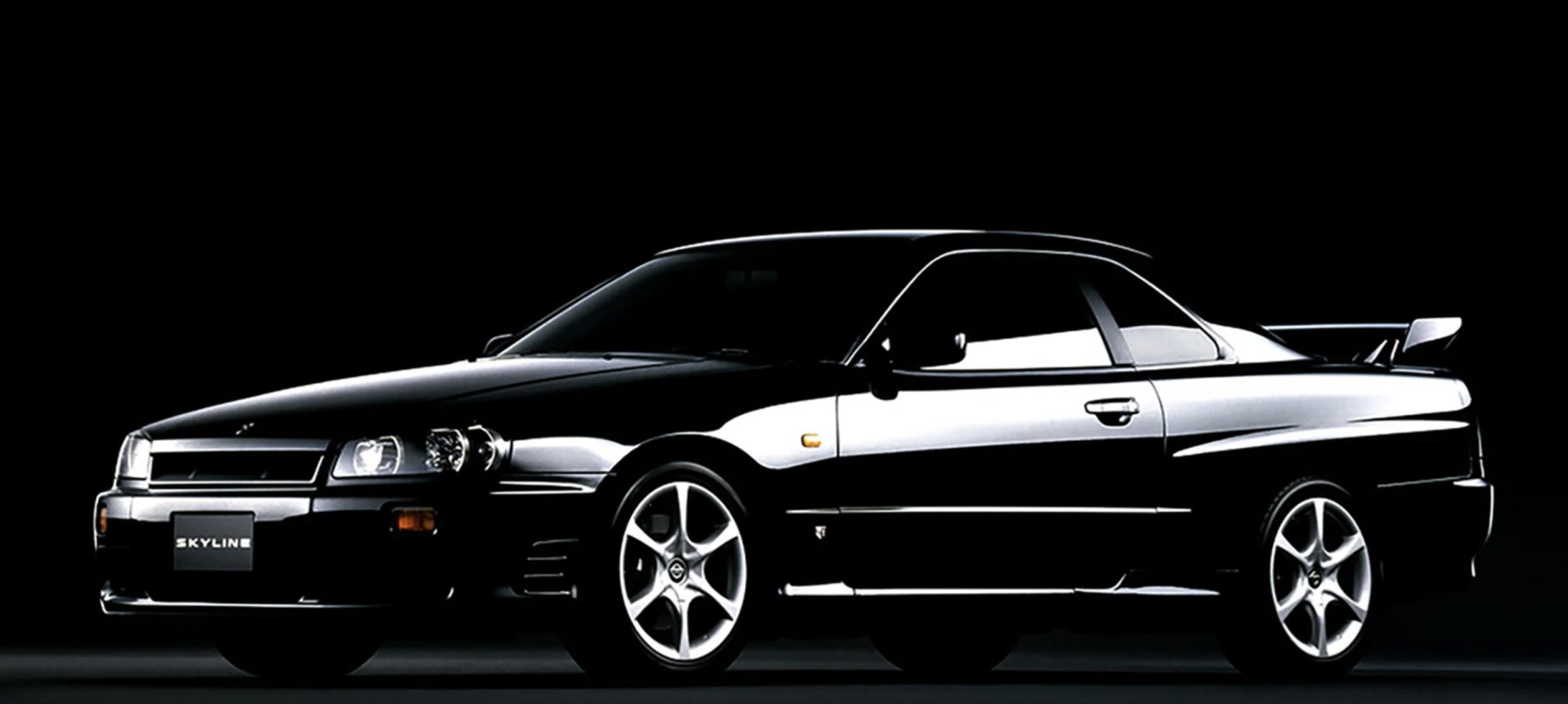
The teaser that came with the April plan was brief. Nissan’s own description of the image is a black Skyline in profile against a dark background with red lamps glowing at the rear. That’s about all the company has shown of the car.
The factory tells you more than the teaser
The most revealing detail came on September 10, when Nissan announced a restructuring of its Japanese manufacturing. Tochigi Plant 1 will serve as Nissan’s dedicated sports car production hub, building the Fairlady Z and the Skyline.
Nissan hasn’t released platform or powertrain specs for the V38, and nothing in its official materials confirms a V6, a manual gearbox or a particular chassis. Still, putting the new Skyline on the same line as the Z is a strong hint. You don’t build a sedan alongside a rear-drive sports car unless the two share tooling, processes and at least some underlying architecture. Whether that means a shared platform and engine is speculation until Nissan publishes a spec sheet, but it’s a better basis for guessing than any rendering.
The same release frames Tochigi as a “High Tech Hub” for sports cars, electrified vehicles and minivans, supporting both domestic sales and exports. Note the word exports. Nissan wants Japanese plants to build cars that sell abroad, and it’s aiming for roughly a million vehicles of annual production in Japan.
Development speed
Nissan’s official documents focus less on horsepower than on how fast it can now develop a car. In the April plan, Nissan says it is concentrating on three product families that will make up more than 80 percent of global volume. The company expects that to raise volume per model by more than 30 percent while speeding up development. It is also trimming its lineup from 56 models to 45.
That makes the Skyline more than a nostalgia project. It’s the car Nissan will use to prove its faster development process works. If the V38 arrives on time, feels properly engineered and doesn’t have obvious corners cut, that’s evidence the turnaround plan is real. If it’s late, or feels like a reskin with a nice press kit, enthusiasts will notice immediately.
Fast development usually means leaning on existing hardware. That isn’t automatically bad, and plenty of great cars were built on carryover parts, but a quickly developed Skyline built alongside the Z is more likely an evolution than a clean-sheet design.
The Infiniti question
Nissan’s April plan lists a V6 sedan among four upcoming Infiniti models, described as “performance-oriented.” Nissan hasn’t officially said whether that Infiniti shares its underpinnings with the V38 Skyline. With a Skyline already on the way and Nissan openly pushing shared architectures, it would be surprising if the two weren’t closely related. For now, though, that’s an educated guess, not something Nissan has announced.
Why you can’t just import a JDM one
If you’re thinking about skipping the Infiniti and bringing in a real Skyline, federal law is the problem. NHTSA’s import guidance singles out the Skyline by name. It says the Skyline wasn’t built to comply with U.S. safety standards, so a Skyline under 25 years old can only be imported if NHTSA rules that model eligible and a registered importer brings it into compliance within 120 days of entry.
Related Articles
- A Seatbelt Stop in Lake Geneva Ended 100 Feet Into Lake Como
- BRABUS Cuts the Roof Off the G 63 and Gives It 900 HP
The 25-year exemption itself is written into the statute: vehicles at least that old, counted from the month of manufacture, are exempt from the conformity requirement. For a V38 built in 2027, that means the early 2050s. A registered-importer conversion is theoretically possible, but it’s expensive and slow, and insurers tend to be cautious about modified gray-market cars. For almost every American enthusiast, the realistic ways to own some version of this car are a U.S.-certified Infiniti relative, if one arrives, or a lot of patience.
Seventy years of Skyline
The timing works out neatly. Nissan’s heritage archive dates the first Skyline to April 1957, when Prince Motor Company launched it with a 1.5-liter four-cylinder making 60 PS. With a top speed of 125 km/h, it was the fastest domestically built car in Japan at the time. A December 2026 reveal would put the new car on sale around the nameplate’s 70th birthday.
That’s a lot of history for one sedan to carry, and a lot of pressure on a company that has promised a comeback before. December needs to bring hard specifications: platform, engine, transmission, weight and a production timeline. Until then, Nissan’s own documents confirm only that the car exists, that it’s a Heartbeat model and that it will be built next to the Z.
Images Via: Nissan USA
About the Author