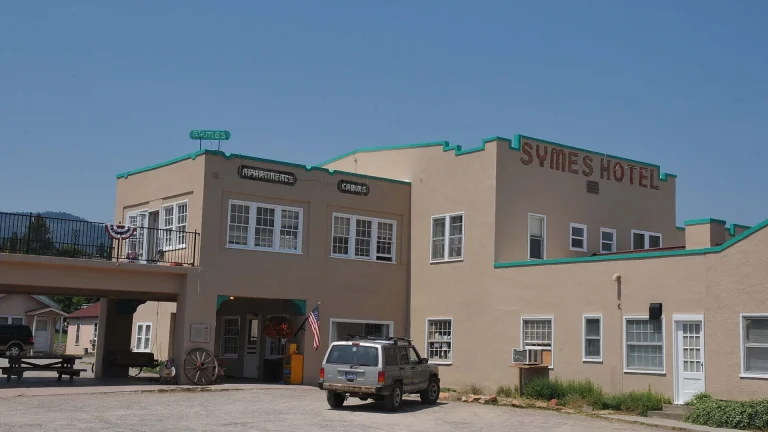
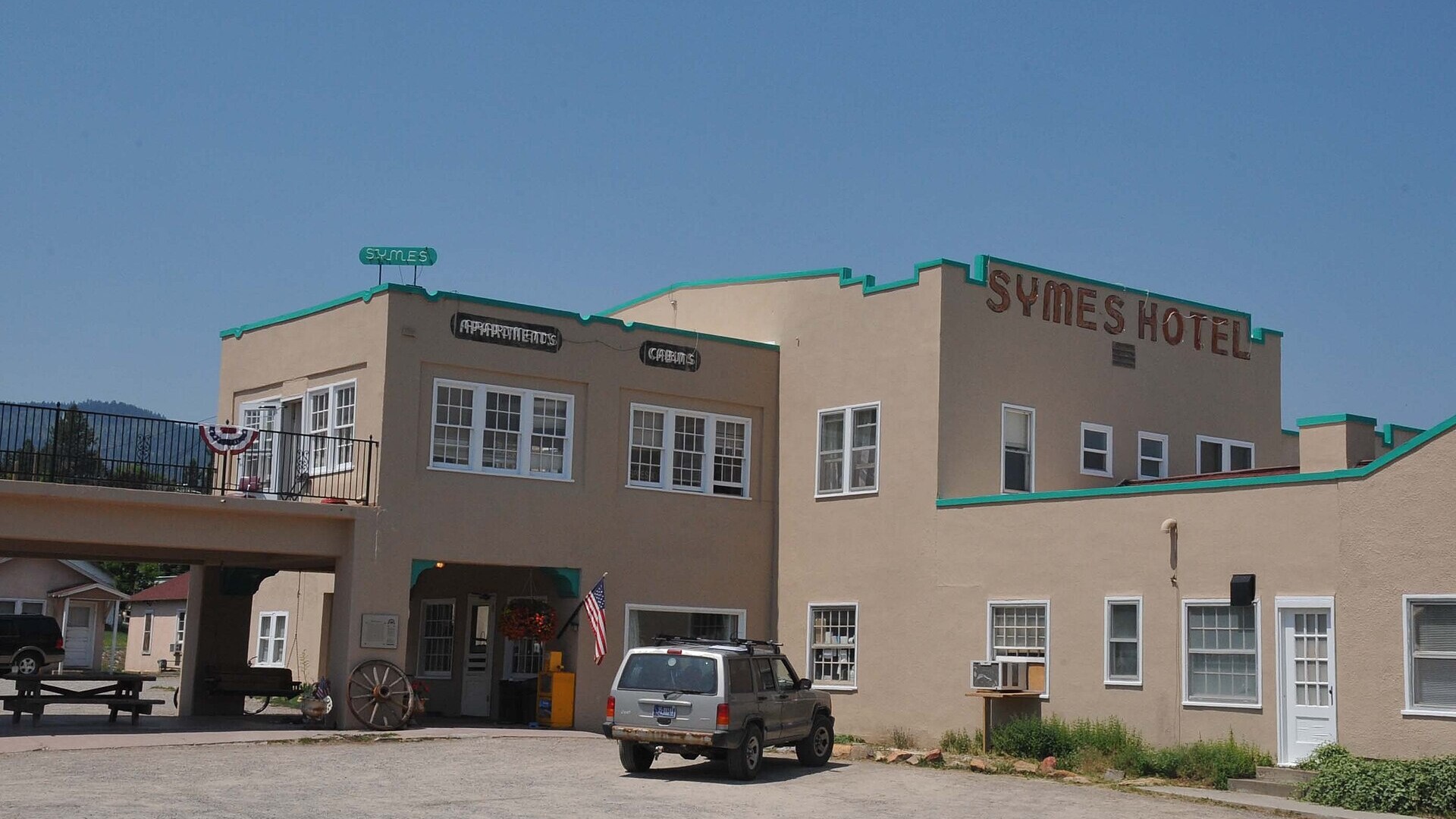
The Symes Hotel in Hot Springs, Mont., a town of roughly 600 on the Flathead Indian Reservation in Sanders County. Photo: Jerrye and Roy Klotz MD via Wikimedia Commons (CC BY-SA 3.0)
Hot Springs, Mont., Police Chief Eric Larson is the latest police chief caught on body-camera video, and his own camera’s recording from Nov. 15 begins at a bar whose operator told KPAX she had refused to serve him earlier that evening because her landlord didn’t want him there.
She told the station Larson came back 45 to 50 minutes later in uniform. A few minutes after 7 p.m., according to timestamps the Flathead Beacon read from the footage, he had pulled over that landlord’s silver van, told the driver it had no license plate light, pepper-sprayed the people inside and used his Taser on the driver.
Mayor Randy Woods put Larson on administrative leave for 30 days, he told the Beacon, and the town posted nearly 32 minutes of the chief’s body-camera video to its Facebook page. Woods has also said he saw nothing wrong with the stop itself, and under Montana law he may be right about that part. A dark plate bulb gave Larson legal grounds to pull the van over whatever his reason for choosing it. That leaves the town and Sanders County prosecutors with two narrower questions: what happened during the minutes his camera wasn’t recording, and whether pepper spray and a Taser were a reasonable response to an equipment violation that carries a $10 to $100 fine.
Body-camera footage of the Nov. 15 stop, released by the Town of Hot Springs. The video contains profanity. Video: Town of Hot Springs via Facebook
What the Hot Springs chief’s bodycam recorded at the Sassy Saddle
The video opens on the street outside the Sassy Saddle Beer Parlor. The on-screen overlay reads 18:46:56 on Nov. 15, 2026, although the town’s post labels the footage 1746hrs. As Larson walks up in uniform, someone remarks on the uniform, and the chief replies that this is a different situation.
He tells the bar’s operator that on his earlier visit he saw people who were overly intoxicated and smelled marijuana, and that the marijuana has to stop. The conversation turns to her landlord, who owns the property. “I’m in a very sticky situation of him being in there, obviously not wanting you there,” she tells Larson, according to the Daily Inter Lake. “But ultimately this is his property.” Larson calls it a quagmire that will have to be worked out.
Then the recording stops. KPAX reported that Larson’s camera shut off after he left the bar and came back on at the van, and that Woods believes the gap was accidental because officers can switch the cameras on and off. The town hasn’t said how long the camera was off. The stretch of the evening in which Larson spotted the van and decided to stop it isn’t on the recording.
When the video resumes, Larson is at the van. “I pulled you over for not having a license plate light,” he says, as KPAX reported. The driver shoots back that Larson had just been in the bar in civilian clothes trying to order a beer. Larson says he didn’t know whose van it was when he stopped it.
What follows runs about 10 minutes, based on the descriptions published by the Beacon, the Daily Inter Lake and Cowboy State Daily. Larson asks for a license, registration and proof of insurance, and the Beacon reported he accused the driver of being intoxicated. The driver refuses a field sobriety test, refuses to hand over his license and registration, and argues that he’s on private property and that the chief has no authority to hold him. Larson orders him out of the van over and over. “You’re gonna get tased. I need you to step out,” Larson says, according to Cowboy State Daily.
Larson then uses pepper spray on the people inside the van and deploys his Taser on the driver more than once, according to those accounts, before ordering him to the ground. A woman in the passenger seat was recording on her phone. People can be heard shouting that they can’t see, and voices on the recording mention children being nearby. Bystanders bring water, towels and milk, and Larson pours water over the driver’s face as he lies on the ground. Someone says a tribal officer is on the way. Hot Springs sits on the Flathead Indian Reservation, and Woods told the Daily Inter Lake that Flathead Tribal Police officers later escorted the driver away.
Larson’s suspicion that the driver had been drinking was never tested on camera, because the driver refused. No sobriety result appears in any published account of the footage, and neither the town’s statements nor the local reports say whether the driver was cited or charged with anything. He declined to comment to KPAX and the Daily Inter Lake. Larson declined to comment to the Daily Inter Lake, citing the investigation. An officer’s belief that a driver is impaired is not proof of it, which is how a sober Nashville driver’s DUI arrest ended with Tennessee paying him $70,000.
Why a dark plate bulb is enough for a traffic stop in Montana
Montana’s lighting law, section 61-9-204 of the state code, requires a white light that makes the rear plate legible from 50 feet. Breaking a rule in that chapter is a misdemeanor, and section 61-9-511 sets the fine for a first conviction at $10 to $100.
That small violation carries a lot of legal weight. Under section 46-5-401, an officer may stop a vehicle when what he observes creates a “particularized suspicion” of an offense. He has to tell the driver the reason promptly, which Larson did, and he may then demand a driver’s license, registration and proof of insurance.
The Montana Supreme Court has signed off on plate-light stops of cars leaving bars. In State v. Murphy, a 2020 memorandum opinion, a deputy in Lewistown stopped a car pulling away from a bar because its plate wasn’t lit with a white light. The driver argued his red taillights lit the plate well enough. The court held that the plate has to be lit by a white light and affirmed the refusal to throw out the evidence, including a blood test that put his alcohol concentration at .26. Memorandum opinions can’t be cited as precedent, but the court reached the same result on a 2015 Billings plate-light stop in State v. Bennick. In Montana, a missing plate light is a routine way into a DUI investigation.
Federal law doesn’t care much about the officer’s motive, either. In Whren v. United States, a unanimous U.S. Supreme Court ruled in 1996 that “Subjective intentions play no role in ordinary, probable-cause Fourth Amendment analysis.” If the light was out, the stop holds up in court even if the driver is right that Larson chose his van because of what happened at the bar. And once a car is lawfully stopped, the court held in Pennsylvania v. Mimms in 1977 that an officer may order the driver out, calling that added intrusion minor next to the officer’s interest in his own safety.
That’s why the driver’s two roadside arguments, that the chief was targeting him and that he was on private property, didn’t change what Larson was allowed to ask for. The published descriptions of the footage don’t settle whether the van was on a public street or private ground when Larson pulled in behind it, and the town hasn’t said. Motive still matters, but it matters to the mayor, the county attorney and the state agency that certifies police officers, not to whether the stop was legal.
A $10 equipment violation, pepper spray and a Taser
A lawful stop doesn’t settle whether the force was lawful. The Supreme Court’s test comes from Graham v. Connor, decided in 1989. Courts weigh the severity of the crime at issue, whether the person poses an immediate threat to the officer or others, and whether he is actively resisting arrest or trying to flee, all judged from “the perspective of a reasonable officer on the scene” rather than with hindsight.
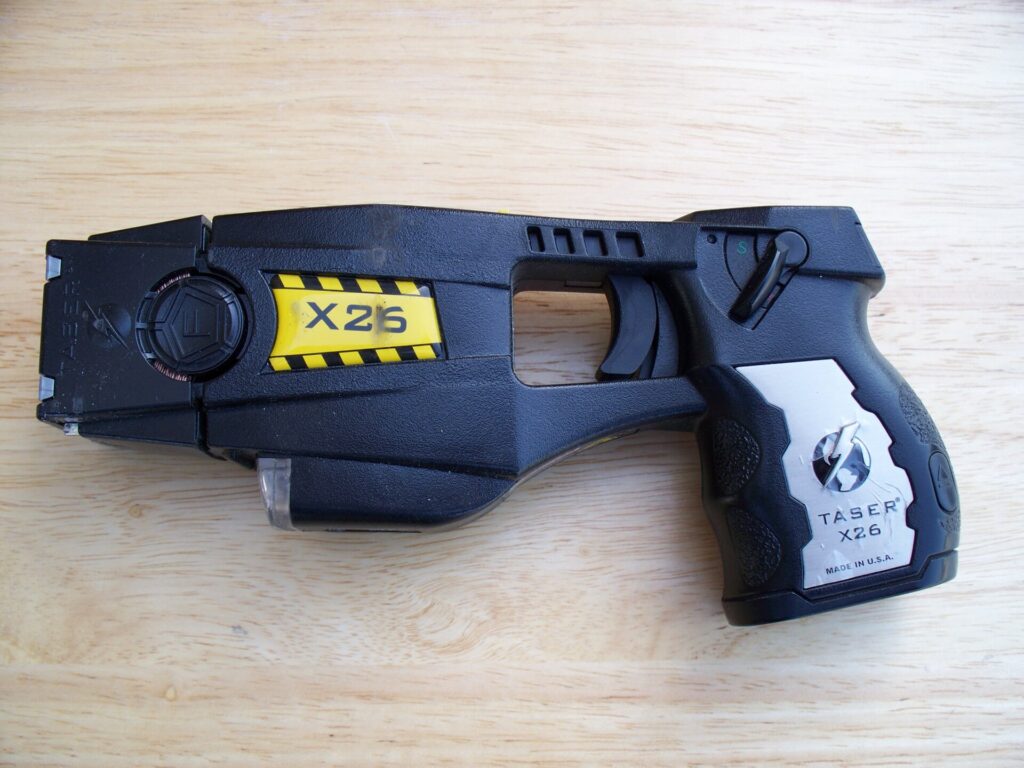
The resistance factor is the chief’s strongest ground. The driver refused repeated orders to get out, refused the sobriety test and refused to produce his license, and Woods described him to the Daily Inter Lake as uncooperative. Woods told KPAX that, from what he reviewed, Larson handled the stop the way a law enforcement academy would train an officer to, and told NBC Montana, “I did not see anything wrong with the traffic stop.”
The severity factor cuts the other way. The offense Larson named was a plate bulb with a fine that starts at $10, plus an untested suspicion of drinking. The pepper spray hit a passenger who wasn’t the one refusing orders. None of the published descriptions of the footage mention a weapon, a threat to the chief or an attempt to drive away. Montana and federal law gave Larson the stop and the order to get out of the van. Whether they also gave him pepper spray and repeated Taser cycles against a man sitting in a stopped van is the question Graham puts in front of the county attorney, and the recording that might explain how the chief came to stop that van has a gap right where the van first appears.
Who reviews the Hot Springs police chief, and when
Hot Springs has about 600 residents, and Woods, who hired Larson in 2024, has run the town for 19 years, the Beacon reported. The town’s website lists three people in its police department: Larson, one peace officer, and a part-time officer who also coordinates reserves. Woods told KPAX he is the chief’s supervisor. The Daily Inter Lake reported that Woods opened the town’s review with the town attorney and a contracted human resources service and that the case will go to the Sanders County Sheriff’s Office and County Attorney’s Office.
The town’s Nov. 20 statement on Facebook said the leave “should not be viewed as a determination or conclusion regarding the incident or anyone involved.” Woods told KPAX the leave isn’t discipline and was meant to keep Larson out of the investigation. He told the Beacon he can’t take disciplinary action unless the man who was tased files a complaint the town attorney can review, and that none had been filed with the town as of Nov. 19. According to Woods, the county attorney’s office has received a complaint, but officials haven’t confirmed opening an investigation, the Beacon reported. The office didn’t respond to KPAX or Cowboy State Daily.
The town isn’t the only place a complaint can go. Montana’s Public Safety Officer Standards and Training Council certifies officers in the state and can sanction, suspend or revoke that certification. Under its complaint rule, allegations have to be in writing, but the rule doesn’t limit who can file one. Complaints normally go to the officer’s employer first, with an exception when the officer is the agency’s highest-ranking member, which in Hot Springs is Larson. The council can also pause its own case while a court or another agency reviews the same conduct.
The 30-day leave Woods described runs out in mid-December. Before then, the county attorney has to decide whether anything that happened at the van was a crime, the town has to decide whether Larson comes back to a three-person department, and nobody has said publicly how long the chief’s camera was off between the Sassy Saddle and the traffic stop.
A driver stopped over a plate bulb that carries a $10 fine won’t step out of his van. Is that the moment for pepper spray and a Taser, or for writing the ticket, waiting for backup and letting a judge sort it out?
About the Author