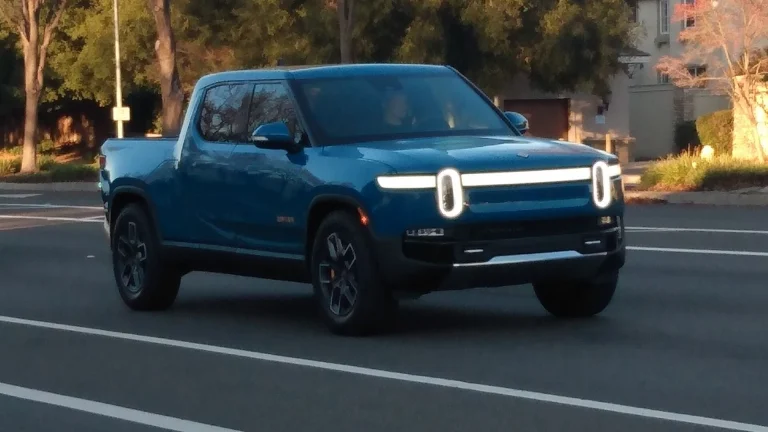
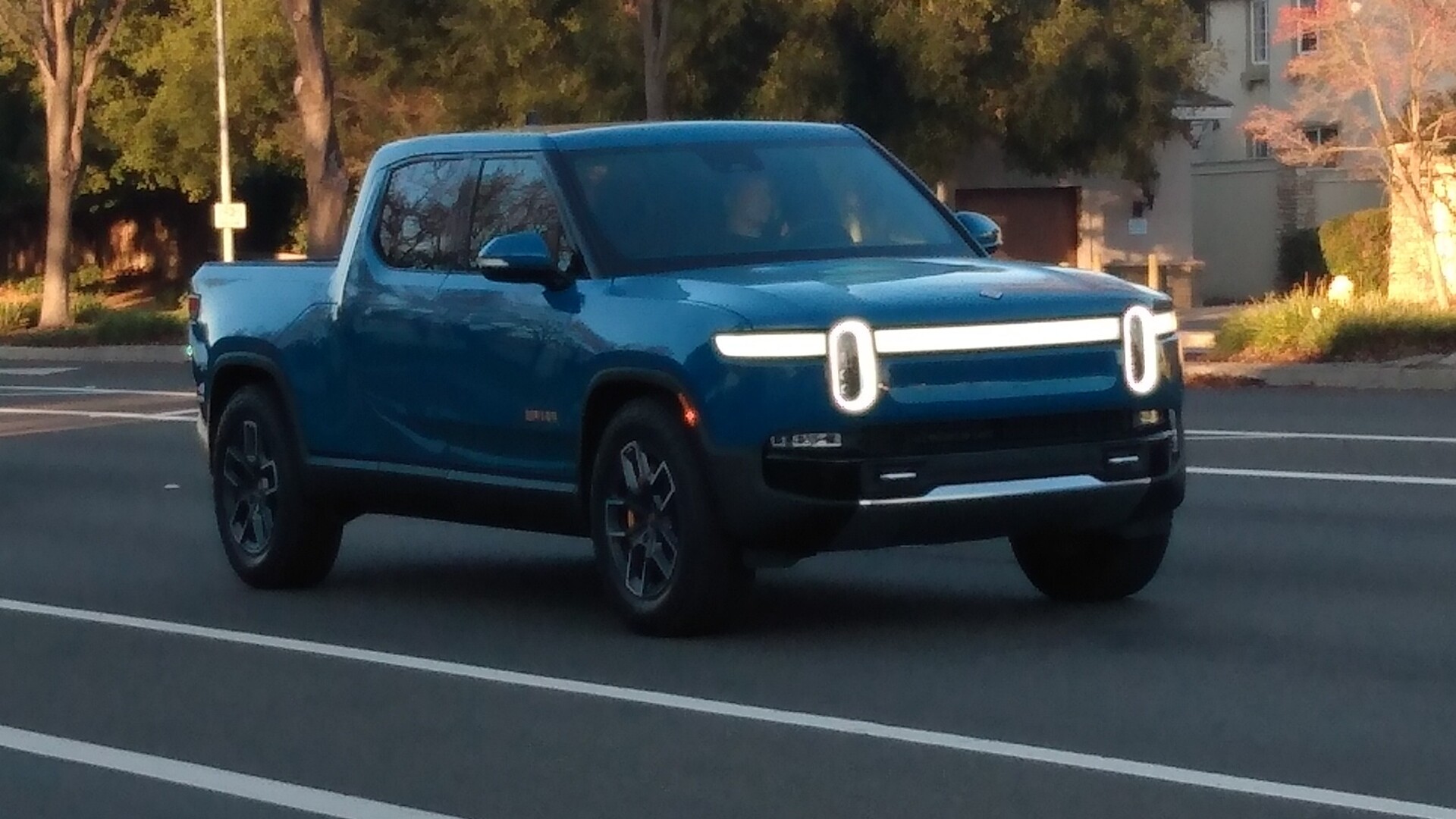
File photo of a 2022 Rivian R1T, not the truck in the Elser case. Photo: DestinationFearFan via Wikimedia Commons, CC BY-SA 4.0
Six Flock Safety cameras cover the three roads into Bow Mar, Colorado, and by late September 2025 they had photographed Chrisanna Elser’s Rivian pickup about 20 times in a month. On Sept. 22, they logged it entering at about 11:52 a.m. and leaving at about 12:09 p.m. Shortly before noon that day, someone took a package worth $25 or less from a porch on Ridge Trail.
Those plate reads were most of the case a Columbine Valley police sergeant brought against her, according to her lawsuit. The theft charge was dropped. Now Elser is suing in federal court, and she has named the camera company alongside two towns and two officers. Her lawyers want a judge to decide a question Colorado lawmakers left open this spring: whether a month of a car’s trips past roadside cameras, stored and searchable without a warrant, is a search under the Fourth Amendment.
What the complaint says happened at her door
The 64-page class-action complaint, Civil Action No. 26-cv-04977 in the U.S. District Court for the District of Colorado, was filed Oct. 5. It names Flock Group Inc., which does business as Flock Safety; the towns of Columbine Valley and Bow Mar; Sgt. Jamie Milliman; and Columbine Valley Police Chief Bret Cottrell. According to the complaint, Bow Mar pays Columbine Valley more than $300,000 a year for police and court services, which is why a Columbine Valley sergeant was working a Bow Mar porch theft.
The homeowner’s doorbell camera recorded the theft. The complaint describes a young woman who walks up, takes the package and runs off, and says the video does not show her getting into any vehicle and does not show a Rivian or any other truck. It alleges Milliman never identified the woman or canvassed for witnesses. What he had was a Flock search showing Elser’s truck in town around the time of the theft, plus a month of earlier trips through the same entrances.
On Sept. 27, 2025, Milliman went to Elser’s home in Denver with a summons. In body-camera footage obtained by Denver7, he tells her, “We have cameras everywhere in that town.” The complaint says she offered to show him video from her Rivian’s onboard cameras and he refused, telling her she could bring it to court.
She built her own defense over the next two weeks. The complaint says her truck’s video and GPS show a drive to a noon appointment with her tailor and then straight home, with no stop on Ridge Trail. Her tailor confirmed the appointment, and her home security cameras recorded the truck leaving and returning. Cottrell voided the summons by email on Oct. 15, 2025. Columbine Valley later issued a statement saying Milliman had a reasonable belief when he issued the summons and that the clearing evidence reached the department about two weeks later. The complaint calls that statement false. Both towns declined to comment to Denver7.
Why the suit names the camera company
The complaint describes Flock as a company that “designs, manufactures, installs, owns, and operates” its license plate readers and runs the cloud software that stores and searches what they capture. Two of the six claims are against Flock alone, for invasion of privacy and negligence. Flock is also a defendant on the lead claim, a Fourth Amendment unreasonable-search count under 42 U.S.C. § 1983. That’s the hardest claim to win against a private company, because Section 1983 reaches people acting under color of state law, so the complaint spends pages on Flock’s relationship with Columbine Valley, alleging the company trained the chief and sergeant and helped the chief pitch seven cameras to the town board in 2021.
Flock told Denver7 its technology is “an investigative tool used alongside other evidence to help law enforcement solve crimes,” that its system “accurately identified the location of Ms. Elser’s vehicle,” and that it “intends to vigorously defend itself in this litigation.” Nobody disputes that the cameras read the plate correctly. Elser’s lawyers say that’s the point: the photos placed her truck on Sheridan Boulevard about 17 minutes apart, never on Ridge Trail, and never showed who was driving.
Covering a plate doesn’t take a car out of the system, either. On its license plate reader page, Flock says its Vehicle Signature feature “can recognize thousands of unique vehicle characteristics.” The complaint says Columbine Valley’s participation in Flock’s sharing network gave its officers access to more than one billion additional plate reads each month, and alleges that for most of the period it covers, searches required no case number and no stated reason.
Two Supreme Court rulings frame the warrant question
In United States v. Jones in 2012, police put a GPS tracker on a Jeep Grand Cherokee and followed it for 28 days. The Supreme Court held that was a search, resting the majority opinion on the physical trespass onto the Jeep. Justice Samuel Alito, joined by three colleagues, wrote that “the use of longer term GPS monitoring in investigations of most offenses impinges on expectations of privacy.” Elser’s month of plate reads is about the same length, but nobody touched her truck. Her case depends on Alito’s reasoning.
In Carpenter v. United States in 2018, the Court said police generally need a warrant for historical cell-phone location records, while saying the ruling doesn’t “call into question conventional surveillance techniques and tools, such as security cameras.” Flock’s defense will likely live inside that sentence. Elser’s lawyers will argue a networked, searchable archive of where cars have been looks a lot more like the phone records in Carpenter than a camera over a shop door.
Colorado let a warrant bill die, but a 2020 law exposes the officers
Colorado’s Senate Bill 26-070 would have barred government entities, with exceptions, from accessing a database that reveals the historical location of a person or vehicle without a warrant. It cleared two Senate committees, then the Senate laid it over to July 4, after the session ended, and it died without a floor vote.
An older law gives Elser’s claims against the officers more weight. Senate Bill 20-217, passed in 2020, lets people sue police officers for violating rights under the Colorado Constitution and says “Qualified immunity is not a defense to liability pursuant to this section.” If an officer’s employer decides the officer didn’t act in good faith, the officer personally owes 5% of a judgment or $25,000, whichever is less. Elser’s claims against Milliman and Cottrell are brought under that statute.
What her truck recorded, and what’s next in court
Elser’s alibi came from her own vehicle. Rivian’s Road Cam feature, added in a 2023 software update, records drives to a USB drive the owner supplies. Most cars with surround-view cameras use them for parking and save nothing while driving. A driver without a recording feature switched on, or a dashcam, would have had a much harder time disproving a month of plate reads.
The court docket shows the case is assigned to U.S. District Judge Nina Y. Wang. A magistrate judge extended Flock’s deadline to answer or otherwise respond to Dec. 7, the same date Bow Mar’s answer is due, and set a telephonic scheduling conference for Jan. 6, 2027. Flock’s first filing will show whether it argues a private vendor can’t be sued under Section 1983 at all.
Elser beat a month of plate reads because her Rivian happened to be recording. If a camera network put your car near a crime tomorrow, what in your car or on your phone could prove where you actually were?
About the Author