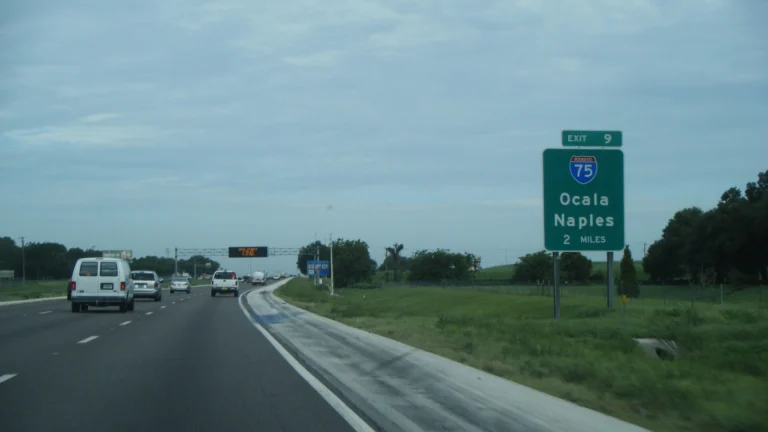
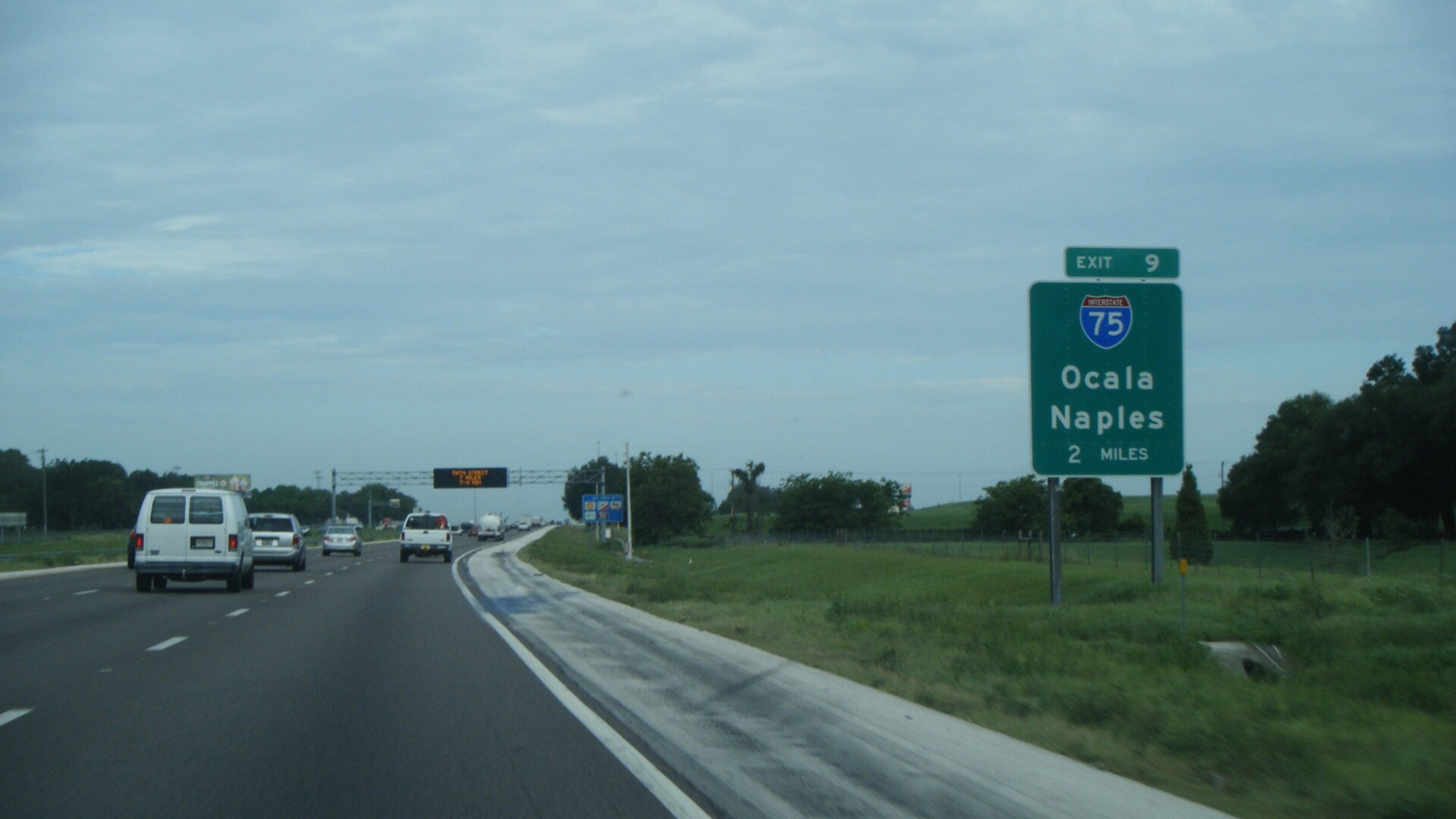
Interstate 4 westbound, two miles from the I-75 interchange in Mango, Florida. Dough4872/Wikimedia Commons (public domain, 2012 file photo)
A Florida Highway Patrol trooper parked in the median of I-75 near Tampa saw two gray sedans go by in the northbound lanes at about 2:24 a.m. Friday, Oct. 30. By the time it ended, a trooper had spun one of them off the road at the I-4 interchange, and the other had been stopped at the entrance to the Seminole Hard Rock Casino. A 19-year-old and an 18-year-old, both from Hillsborough County, were arrested and charged with racing on the highway and fleeing to elude, WFLA reported, citing the arrest report.
What the arrest report says happened
The trooper tried to pull the sedans over as they approached US-301, according to the report. The drivers instead lined up their front ends and accelerated together, “engaging in a drag race.” The trooper’s own vehicle reached 140 mph, the report says, and the sedans were believed to be going faster while changing lanes aggressively to get around other motorists.
At the I-4 interchange, the trooper used a PIT maneuver on the 19-year-old’s car, which rotated off the road and stopped on the shoulder. A second trooper stayed with the 18-year-old.

WFLA’s account doesn’t name the sedans’ makes or models, report injuries, or give bond amounts or court dates. Backfire News hasn’t been able to pull the arrest report or a court docket, so the degree of each charge is unconfirmed. Arrest charges can also change once prosecutors decide what to file.
Racing is a misdemeanor; eluding is a felony
The racing charge falls under Section 316.191 of the Florida Statutes. A first conviction is a first-degree misdemeanor with a fine of $500 to $2,000 and a one-year driver license revocation. The statute defines a race as a competition that grows out of a challenge, and the challenge can be prearranged or an immediate response to another driver’s conduct. Two cars that line up and go can qualify without any planning.
The fleeing charge falls under Section 316.1935, and that is where the stakes change. Willfully fleeing after an order to stop is a third-degree felony, and so is fleeing a marked patrol car with its lights and siren on. Doing it at high speed or with wanton disregard for safety makes it a second-degree felony. WFLA’s report doesn’t say which subsection the drivers were charged under, so I’m not assigning a degree. On a conviction, the court must revoke the license for one to five years, may not withhold adjudication or suspend the sentence, and the vehicle is treated as contraband that can be seized and forfeited under the Florida Contraband Forfeiture Act.
A racing-only case is a misdemeanor with a one-year revocation on a first conviction. The decision not to stop is what moves it to felony territory, with up to five years off the road and a car that can be taken.
The tow bill and the car
The racing statute also lets the arresting officer impound a vehicle for 30 business days when its criteria are met, and the owner pays the costs. Florida’s highway safety department estimates towing and impound fees at $300 to $1,600 in Hillsborough, Broward and Miami-Dade counties and says each county sets its own rates. WFLA doesn’t say whether either car was impounded or seized, or who owns them.
Young drivers, and the policy behind the PIT
The same department’s street racing page counts 6,641 citations statewide from 2018 to 2022 for racing, stunt driving or spectating, most of them to people between 16 and 29. Backfire News covered another FHP case in the same county on Oct. 19, when the patrol said an ex-FSU cornerback ran a Durango past 150 mph near Tampa. In Iowa last month, an 18-year-old was accused of taking a relative’s Corvette to 140 mph on I-80.
How the trooper ended this one is a separate question. WUSF reported in 2024 that FHP loosened its pursuit policy in December 2023, leaving PIT maneuvers to a trooper’s discretion where a supervisor’s permission had been required. Dave Kerner, executive director of the Department of Highway Safety and Motor Vehicles, defended the change and said a PIT should be carried out as soon as practical after a vehicle flees. Roy Taylor, a former police chief quoted by WUSF, called a high-speed PIT deadly force. WFLA’s account doesn’t give the sedan’s speed at the moment of contact at the I-4 interchange.
What happens next
Prosecutors will decide what to file. Until then, the racing and fleeing charges are accusations from an arrest report, and neither driver’s side of the case appears in WFLA’s coverage.
A trooper chased two street racers at 140 mph, then spun one off the road at the I-4 interchange. Right call, or should he have backed off and made the arrest later?
About the Author