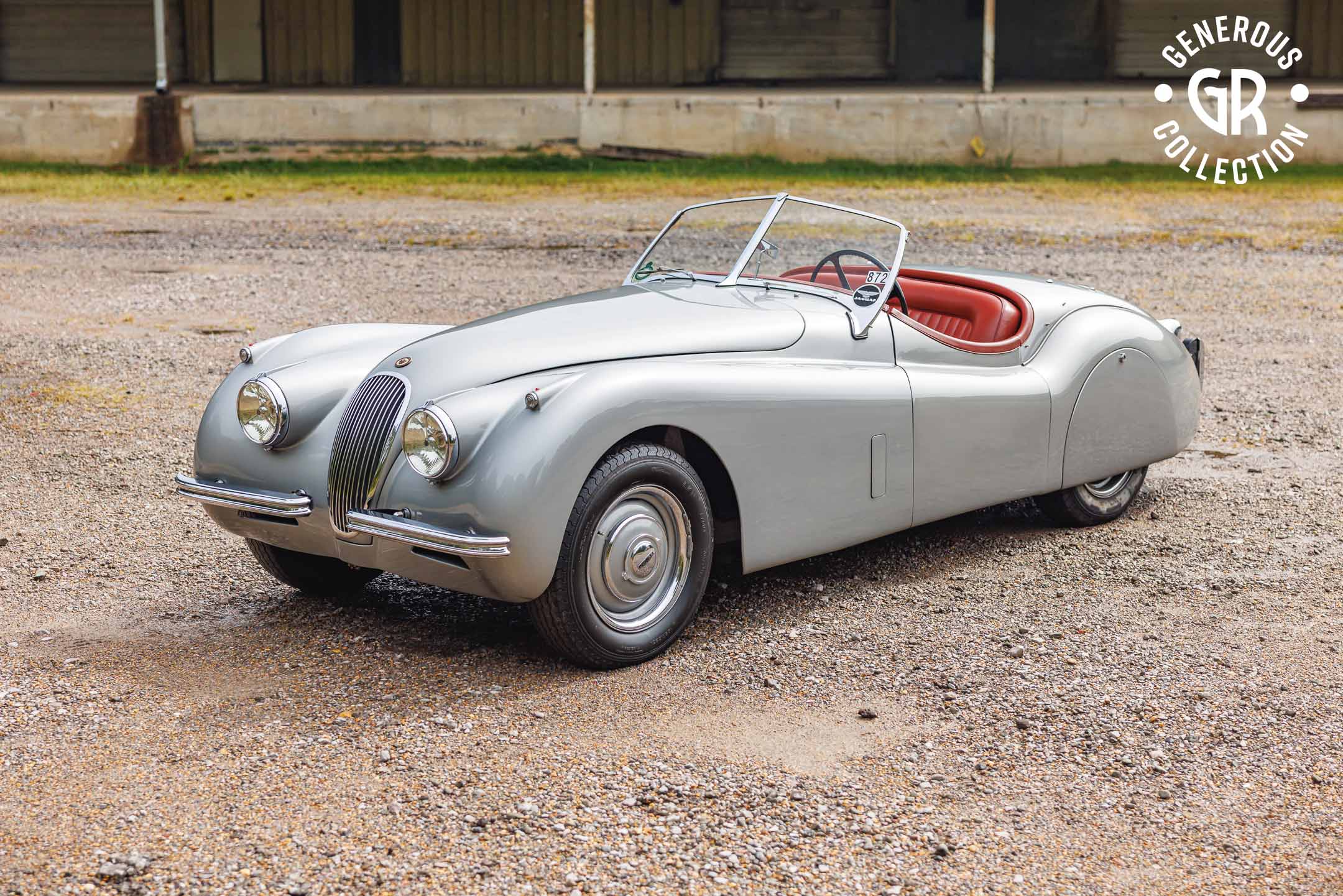
The 1953 Jaguar XK120 roadster from the Generous Collection, sold for $101,650. Photo: Hagerty Marketplace
Last October, Tom Cotter took Hagerty’s Barn Find Hunter cameras to rural Alabama and walked through six buildings holding roughly 1,300 vehicles, all of them belonging to one man. The episode has done close to a million views. The tally he reads out at the top of it is worth repeating: 259 Chevrolets, 109 Fords, 105 Cadillacs, 96 Pontiacs, 55 Mopars, 48 Lincolns, 35 Buicks, 24 Oldsmobiles, 12 Volkswagen Beetles, plus the usual strays including Alfas and Porsches.
Almost a year later, the interesting part is no longer the pile. It is the receipts. The cars have been going out the door at no reserve through Hagerty Marketplace, and the numbers are a better education in the collector market than any price guide.
Who built it, and why it is called the Generous Collection
The owner is Greg Rusk, president and CEO of Rusken Packaging, a corrugated box company headquartered in Cullman, Alabama that he has run since 1992. He knows most of his roughly 1,200 employees by name, and a large share of the collection came from those employees, plus friends and family, when they needed money. The recurring story is that Rusk’s opening question was not what do you want for it, but what do you need.
Roughly half the collection was acquired that way, frequently above market. That is where the name came from, and it is also why the sale has a different character than a typical estate liquidation. The seller was never buying to flip.
What the cars actually brought
Here is the hard data, from completed Hagerty Marketplace listings.
The headline car of the first round was a 1953 Jaguar XK120 roadster with a five-speed conversion. That chassis has a public paper trail: $80,640 at Amelia Island in 2018, $103,600 at RM Sotheby’s in Arizona in 2020, then $165,000 at Barrett-Jackson Scottsdale in 2022, which is when it entered the collection. Out of the collection, at no reserve, it made $101,650. That is roughly a 38 percent haircut against its most recent public sale, on the same car, three and a half years later.
The rest of the results rhyme:
- 1995 Pontiac Firebird SLP Firehawk, 26,000 miles, Firehawk number 510 of the run: $16,318
- 1987 Chevrolet Monte Carlo SS Aerocoupe, 68,233 miles shown: $19,795
- 1977 Pontiac LeMans Can Am, 400-cube V8: $35,310
- LS1-swapped 1987 Mazda RX-7, six-speed: $19,535
- LS1-swapped 1989 Mazda RX-7 Turbo II, six-speed: $13,215
- 1957 Chevrolet Bel Air project: $20,598
- 1996 Chevrolet Impala SS: $21,936
The Can Am is the one to look at twice. Pontiac built fewer than 1,400 of them against a planned 5,000 before the program collapsed, making it one of the genuinely rare cars of the malaise era, and it cleared $35,000 in a market where a good one is usually a conversation starter rather than a bargain. Rarity still pays. Low miles on a common car, as the Firehawk demonstrates at $16,318, mostly does not.
What no reserve actually does
No reserve is a promise to the seller that everything moves and a warning to the seller that nothing is protected. When you combine it with volume, you get exactly what happened here.
Round one was described as over 200 cars in October 2025. Round two was billed as over 250 cars and ran through August into early September 2026, with the final lots closing September 4. That is roughly 450-plus vehicles into the same buyer pool inside eleven months, from one seller, in one place, all online.
Every one of those factors pushes the same direction. Bidders who lose one car know another is coming next week, so nobody bids like it is their last chance. Buyers have to solve transport from a single rural Alabama site, which quietly prices in a few hundred to a few thousand dollars per car and comes straight off the bid. And online-only means no room full of people talking each other into one more increment.
The counterexample worth keeping in mind is RM Sotheby’s Rudi Klein sale in Los Angeles in October 2024, a hoard auction that totaled $29,616,400 with everything sold and drew bidders from 39 countries. That was a curated, single-event, live sale with a Mercedes-Benz 300SL Alloy Gullwing at the top of it. Concentration and theater are worth real money. Spreading inventory across rounds protects against flooding, but it does not recreate the room.
If you bought one, the clock is running right now
This is the practical part, and it is live as of today. Every round-two listing carried the same retrieval terms: lots must be collected while a representative is on site, 9 a.m. to 6 p.m. local, beginning Monday, September 14 and running through Wednesday, September 30. Nothing could be picked up before the 14th, and anything still there after the 30th gets relocated outside to the parking lot for the buyer to deal with.
If you won a car that has been sitting inside a building for twenty years, the difference between collecting it this month and collecting it in November is the difference between a dry car and one that has been rained on. Hagerty Marketplace’s buyer’s premium is 7 percent of the final sale price with a $500 minimum, so budget that plus transport before you decide what a lot is really costing you.
Alabama titles: the thing nobody checks first
Buying out of a long-dormant collection means buying paperwork problems, and Alabama’s rules are unusually forgiving if you know them.
Under Alabama Code section 32-8-31, a motor vehicle more than 35 model years old is exempt from the state’s certificate of title requirement, and the cutoff is recalculated every January 1. As of January 1, 2026, that means model year 1991 and older needs no Alabama title at all. Trailers and campers are exempt at more than 20 model years; off-road vehicles at more than 10.
That covers a large share of a collection like this one. For anything newer arriving without a title, the route is a surety bond: application through Alabama’s online bond portal using form MVT 10-1A, and once the state approves it, a Certificate of Title Surety Bond that has to be completed with a surety company and filed through a designated agent within 90 days of the bond’s execution date. Miss the 90 days and you start over.
Check your own state’s rules before you tow, too. A car that needs no title in Alabama may still need one where you are registering it.
The mechanical reality of a cheap car that has not run since Clinton
A $16,000 Firehawk sounds like a deal until you price getting it to move. The honest sequence, in order, and none of these steps can be skipped:
Getting it to start requires an engine that turns freely, compression, clean oil, clean fuel, fresh filters, working fuel delivery and ignition, timing that is close enough, a charged battery and a starter that spins. On a car stored two decades, the fuel is varnish, the tank likely has scale, and injectors or carburetor passages are gummed.
Getting it to move under its own power requires brakes that are not seized and, on a manual car, clutch hydraulics that still hold pressure. Rust-welded calipers and wheel cylinders are the norm, not the exception.
Getting it to highway speed requires tires that are actually safe. Tread depth is irrelevant; rubber that old is dry-rotted regardless of how it looks, and it will come apart. Assume a full set on every car you buy from long storage.
Getting it to survive a trip requires a cooling system in better than factory condition and fuel and coolant lines that are not hardened, cracked or gone soft. Rubber is the thing that quietly kills revived cars.
That is a four-figure bill on a good day and a five-figure one on a car with a seized engine, which is how a cheap barn find stops being cheap. If you have never done it, the evaluation checklist is worth reading before you bid, not after.
What is left
Between round one and round two, something north of 450 cars have sold out of a collection reported at roughly 1,300. Hagerty has not published a running total, has not said how many remain, and has not announced a third round. The dedicated collection page on Hagerty Marketplace no longer resolves to the Generous Collection at all.
Which means there may be 800 or so cars still sitting in those buildings in Cullman with no announced plan. If you missed the first two rounds and you have been watching long-stored cars come out of storage all year, this is the one to keep a tab open on.
Photography: Hagerty Marketplace. Sale results via completed Hagerty Marketplace auction listings.
Your Turn: Would you have taken a chance bidding on a hoard like this sight unseen? Tell us in the comments.
About the Author