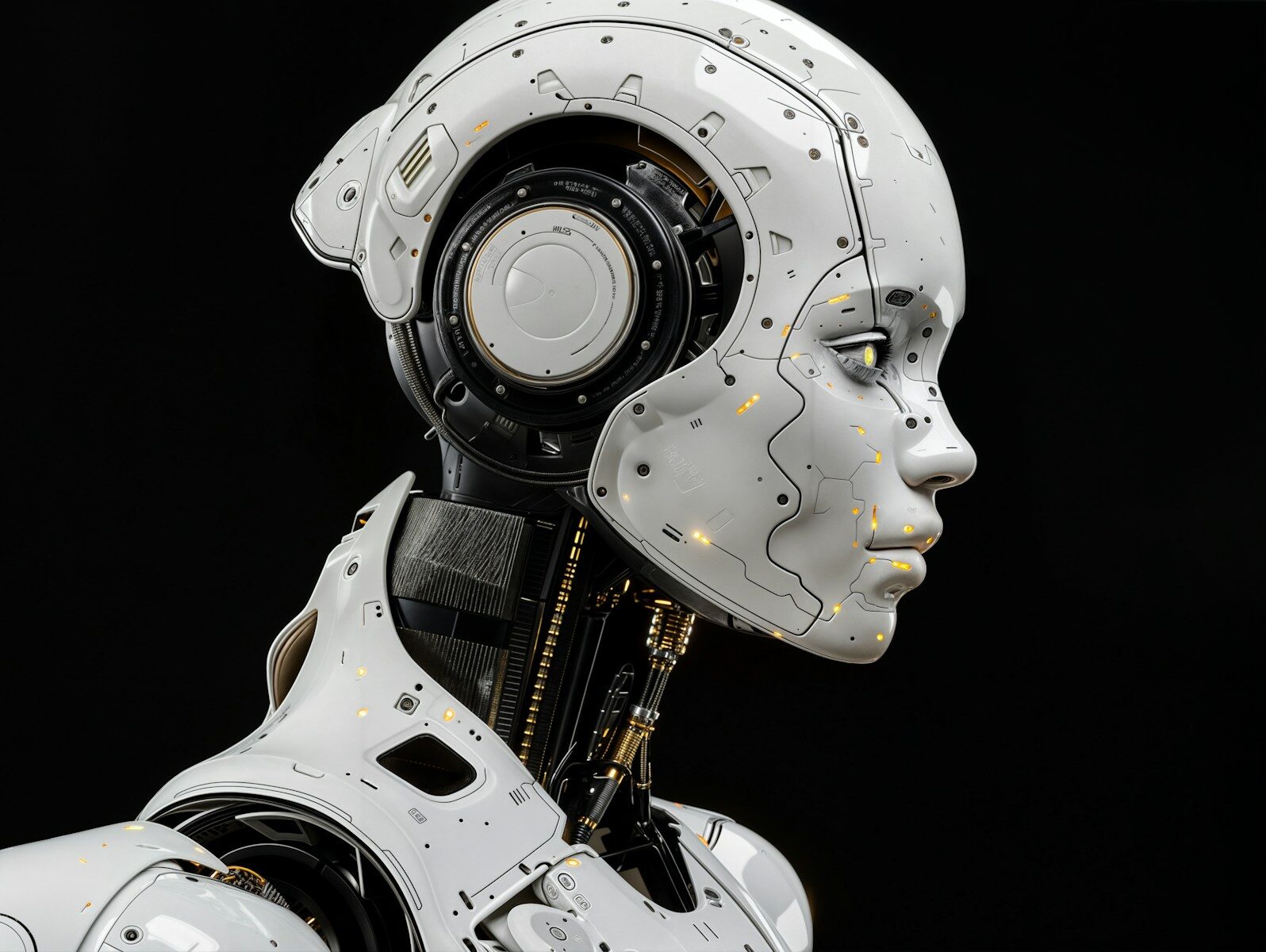
Somewhere in Zhengzhou this month, a machine with two arms and two legs is going to walk out in front of a crowd of people who came to look at cars. It will wave. It will probably say something. And a large number of people will conclude that BYD is now a robotics company.
Slow down. What BYD has actually committed to is narrower and, if you care about how things are engineered, considerably more interesting than the headline suggests.
What’s confirmed, and what BYD already shot down
The company’s own Di Space Zhengzhou account put out a teaser on 25 July — a humanoid silhouette and a line about a new friend wanting to meet you in early August — and BYD subsequently confirmed the August timing at its Di Space venues. Di Space isn’t a dealership. It’s BYD’s network of walk-in technology and science-education centres, which is a meaningful distinction: this is a public demonstration space, not a sales floor with a quota.
Just as important is what BYD has publicly refused to confirm. When a wave of specifics circulated in June — an internal project codename, a seventh-generation prototype, roughly 150 units already working in plants, a target of 20,000 units deployed internally this year — the company knocked all of it down as inaccurate. It did not deny developing a humanoid. It denied the numbers.
Related Articles
- He Got Ten Dealerships for Free, Then Spent Ford’s Trust Money on His Brother’s MMA League. Now He Owes $30 Million.
- Honda Beat This Paint-Peeling Lawsuit Once. It’s Back, and Honda’s Already Fighting It Again
So calibrate accordingly. August is a first physical showing of a working prototype in a controlled environment. It is not a product launch, there is no price, and anyone quoting you a units-per-year figure is quoting something the manufacturer has already disowned.
Why a battery company can plausibly build a robot
Here’s the part worth understanding, because the component overlap between an EV and a humanoid is real but not as total as the pitch implies.
The genuine crossover is in power electronics and energy. A humanoid’s joints are driven by motor controllers that are, architecturally, small traction inverters — the same silicon carbide and IGBT switching logic, the same current-sensing and thermal-derating problems, just scaled down and multiplied by forty. BYD is one of very few carmakers that designs and fabricates its own automotive-grade power semiconductors rather than buying them, and it builds its own cells and battery management. Its interim results describe a group whose segments span batteries, electronics and semiconductors alongside vehicles. That vertical stack is the actual argument for BYD in robotics, not the fact that it happens to build cars.
The scale is not the constraint either. BYD discloses monthly battery installations to the Hong Kong exchange, and its April battery installations alone came to roughly 21 GWh, with more than 81 GWh cumulative for the year at that point. A humanoid’s pack is a rounding error against that.
Where the crossover breaks down is duty cycle, and this is the bit nobody puts on a slide. A car’s electric drive spends most of its life at low load with a torrent of air moving over the cooling circuit. A humanoid standing upright in a climate-controlled showroom is a continuous-torque machine with essentially no airflow — its hip and knee actuators are holding load even when nothing is moving. That’s a thermal problem car engineers rarely have to solve, and it’s why joint actuators lean on harmonic and planetary reduction rather than the single-speed reducers in an e-axle. Cell chemistry has to answer a different question too: a car pack optimises for energy density and fast charge, a robot pack for high sustained discharge in a small, mass-critical volume that’s strapped to a thing that might fall over.
None of that is unsolvable. It’s just not free, and it’s not a copy-paste from the parts bin.
Beijing has already written the deployment plan
This is the context most coverage skips. In June, MIIT and the state assets regulator SASAC issued a joint notice launching a 2026 programme to push humanoids and embodied AI into real working environments. It names ten provinces and municipalities, requires each to nominate no fewer than 20 genuine operational scenario units covering at least two of the industrial, service and specialised categories, and sets a floor of ten scenarios per participating central SOE, with plans filed by the end of June. The stated targets for the end of 2026 are normalised deployment in representative settings, more than 100 high-value application scenarios, and the industrial capacity to field robots at ten-thousand-unit scale.
Read the list of priority scenarios and you’ll find retail and catering sitting alongside warehousing, inspection and maintenance. A robot greeting customers and explaining a car in a showroom is not a stunt as far as Chinese industrial policy is concerned — it is precisely the kind of standardised, economically viable, low-risk scenario the programme is asking companies to nominate. That follows the 2023 policy that first set humanoids up as a strategic industry with mass-production and cluster-building targets.
Related Articles
- Harley-Davidson Just Locked Up Two New Nameplates, RMCR and RMXR — Here’s What The Paperwork Reveals
- Backfire News Weekly Wrap-Up: July 27–31, 2026
The commercial logic underneath is data. Every conversation a showroom robot has is labelled training material, gathered in a repeatable environment, from members of the public, for free.
The timing is not a coincidence
BYD is doing this from a position of technical strength and commercial pressure at once. Its own June filing to the Hong Kong exchange shows first-half NEV sales of 1,808,511 units against 2,145,954 a year earlier — a decline of 15.72% — even as June itself came in above 400,000 with a record 175,349 vehicles exported. The domestic market has gone backwards; exports are doing the lifting. A company in that position has every incentive to give investors a second story to look at.
That doesn’t make the robot fake. It does mean you should watch what gets demonstrated rather than what gets promised.
What this actually means if you’re standing in the showroom
Treat the August unit as an exhibit, not a product. Nobody will sell you one, nobody will quote you a service interval, and the promotional material has deliberately avoided specifications.
If you want to judge whether it’s real engineering, ignore the walking and the waving. Watch the hands — dexterous manipulation is where prototypes fall apart. Watch whether it does anything unscripted when a visitor interrupts it. And watch how long it stays on its feet between breaks, because thermal duty cycle is the honest measure of whether those actuators are production hardware or a demo rig.
The rest is theatre, and there will be plenty of it.
About the Author