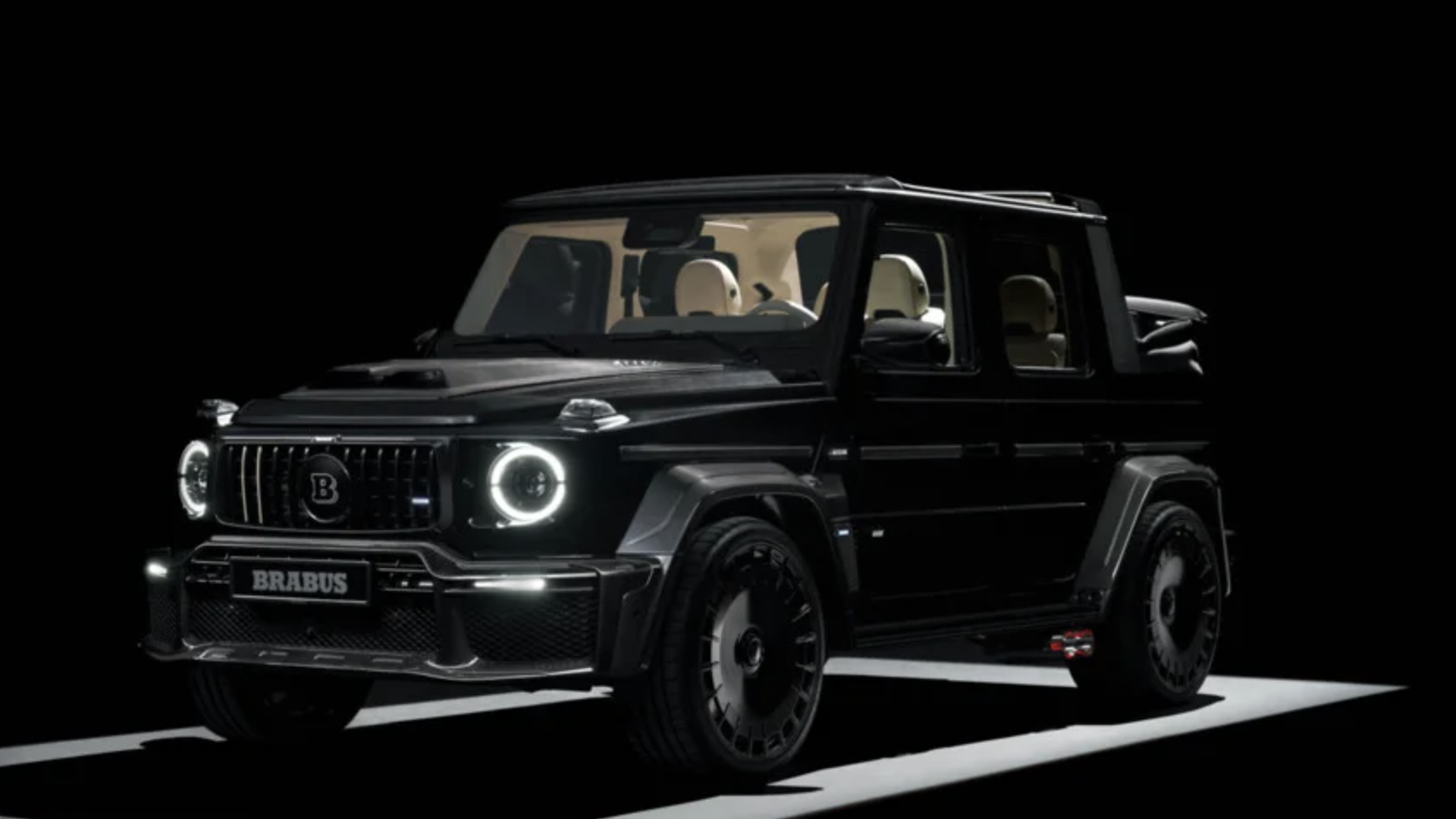
There’s a certain logic to Brabus’s latest creation, if you squint. The Mercedes-AMG G 63 is already too loud, too tall, too fast and too expensive for any rational purpose, so Brabus took the roof off and went further. The 900 Rocket Edition Cabrio is, according to Brabus’s official announcement, the first open-top Rocket in the company’s history, built on the current W 465 G 63, with production capped at 10 cars worldwide.
You may have seen a figure of 50 floating around. Brabus’s own documents say 10.
“900 hp” needs a footnote
Brabus quotes 662 kW / 900 hp. That “hp” is metric horsepower, the German PS. Converted to the mechanical horsepower American buyers see on window stickers, 662 kW works out to about 888 hp. It’s still ridiculous, just about 12 horses less ridiculous than the headline suggests.
Related Articles
- Inside the Twerk Horse: T-Pain’s 910-HP RTR Mustang Gift to Hert
- Your Puma Defender Can Now Get a Factory V8: What It Costs, What Changes
The more useful number is the gap. On its model page, Brabus says the engine makes 231 kW / 315 hp (PS) more than the standard G 63’s, which is more than three-quarters of a base 911 Carrera’s output, added to an engine that was never short of it.
How they got there
The engine work goes well beyond a tune and an exhaust. Brabus increases displacement from 3,982 cc to 4,407 cc by opening the bores to 84 mm with matching forged pistons. A billet crankshaft, machined from solid stock and balanced, extends the stroke to 100 mm, paired with high-performance connecting rods. (Run the math on an 84 mm bore and 100 mm stroke across eight cylinders and you get about 4,433 cc, so one of Brabus’s published figures is slightly off.) Two special turbochargers with larger compressors and reinforced axial bearings push up to 1.4 bar of boost.
Brabus’s equipment list fills in the fueling side. It adds two uprated high-pressure fuel pumps and a booster pump kit for the low-pressure circuit. Fuel supply is usually the first wall a tuner hits, so none of that is a surprise at this power level. The exhaust gets 76 mm downpipes and metal-substrate catalysts to reduce backpressure, while keeping a particulate filter so the car stays legal in Europe.
The payoff is 1,250 Nm (922 lb-ft) at 2,900 rpm and peak power at 6,200 rpm, though torque is electronically limited to 1,050 Nm (774 lb-ft) in the car. Brabus doesn’t explain why in public. But the car keeps the factory AMG Speedshift Plus 9G-Tronic automatic, according to the equipment list on Brabus’s sale listing, so the likely reason is protecting the gearbox and driveline rather than the engine. An engine that can make 200 Nm more than the car is allowed to use has healthy margin, and for an owner, headroom usually means longevity.
Brabus claims 0–100 km/h in 3.7 seconds. Top speed is electronically limited to 240 km/h (149 mph), explicitly to protect the tires. Given that those tires are hauling a small apartment building around, that seems wise.
A roof with 500 parts and a 10-hour shower
Turning a four-door box into a convertible without it flexing like wet cardboard is the hard part. Brabus says the two-piece soft top uses more than 500 components built to OEM-quality standards and opens or closes in 20 seconds, with a heated safety-glass rear window.
When closed, the top locks into a reinforced windshield frame. A wide carbon-fiber bow at the front of the roof holds its shape at speed and reduces cabin noise. Behind the rear doors, a steel “C-BOW” roll bar integrated into the modified body secures the rear section, which folds away behind the back seats under a tonneau cover.
Every car also spends more than 10 hours in continuous water testing in a climate chamber before delivery. Aftermarket convertible conversions have a reputation for turning footwells into aquariums, and Brabus is clearly trying to get ahead of that. A fabric roof on a vehicle this tall and this fast will have to cope with serious aerodynamic loads, and seals are always the first thing to complain.
A nice historical touch: an inverted “77” is woven into the fabric above the rear window, a nod to the year Brabus was founded.
Wheels, tires and a discrepancy
The widened fenders hold 24-inch “Platinum Edition” wheels. Brabus describes them as an evolution of its Monoblock II three-spoke design first introduced in the late 1980s, with exposed-carbon aero blades. The fronts are 10Jx24 on 295/30 ZR 24 tires. Brabus’s prose says the 12-inch-wide rears wear 345/25 ZR 24 tires. The equipment list on Brabus’s sale listing gives 355/25 ZR 24.
That’s the kind of thing a buyer should settle before signing. Tires in this size are a niche item, and knowing exactly which spec your car was homologated on matters when it comes to replacements, insurance claims and registration paperwork.
Suspension is Brabus’s RideControl aluminum coilover system, developed with KW. The dampers are machined from solid stock with integrated cooling elements, and ride height can drop by up to 45 mm. Damping stays adjustable through the car’s stock Drive Select controller.
What it costs, and what it costs to run
Brabus’s sale listing puts the car shown at €857,373.60 net and €1,020,274.58 gross, ex works Bottrop. That gross figure is exactly the net price plus Germany’s 19% VAT. Export buyers who can legally avoid German VAT will pay the lower number before their own country’s duties and taxes. And since Brabus sells “Masterpiece” cars built to customer specs, treat the listing as a reference point rather than a fixed price.
As you’d expect, it’s thirsty. Brabus lists WLTP combined consumption of 14.8 l/100 km and CO2 emissions of 338 g/km, putting it in Germany’s worst CO2 class, G, according to the official consumption label. That’s roughly 16 mpg in U.S. terms, under a lab cycle. Nobody buying one will drive it that gently.
For the ten people who can buy one
Service will be bespoke. An engine with a billet crank, custom rods, forged pistons, bigger turbos and Brabus’s own ECU calibration isn’t something your local Mercedes dealer will diagnose from a stock parts catalog. Budget for maintenance through Brabus or its dealer network, and get a clear written answer on how any remaining factory Mercedes warranty applies to the modified powertrain before the car ships.
Related Articles
- Renault’s 270-HP R8 Gordini Concept Keeps the Motor Where the Original Had It: Out Back
- BMW Built Nine Nürburgring Tribute Models, and Only Three of Them Are Actually Rare
Insure it on agreed value. A 10-unit, million-euro conversion has no real market comparables, so an actual-cash-value policy could be a disaster after a total loss. Document the build spec. Brabus says every car carries a blockchain-based Digital Product Passport on a spec plate in the luggage compartment, developed with the Aura Blockchain Consortium, recording authenticity, ownership and specifications. Hand that record to your insurer.
Check registration before you commit. Brabus’s website notes that, depending on the part, its modifications may require TÜV approval and entry in the vehicle registration documents in Germany. Buyers outside Europe should ask how their specific car will be certified and registered where it will actually be driven. That’s especially true in markets with strict federal compliance rules, such as the U.S.
Mind the roof. Fabric tops age, even ones attached to a million-euro price tag. Ask what the maintenance schedule for the seals and mechanism looks like, and what replacement parts cost, before you’re parked outside a Monaco café in a sudden downpour.
Is a roofless, 888-hp G-Class the most pointless thing Brabus has built, or the kind of excess the car world could use more of? Let us know below.
Images Via: Brabus
About the Author