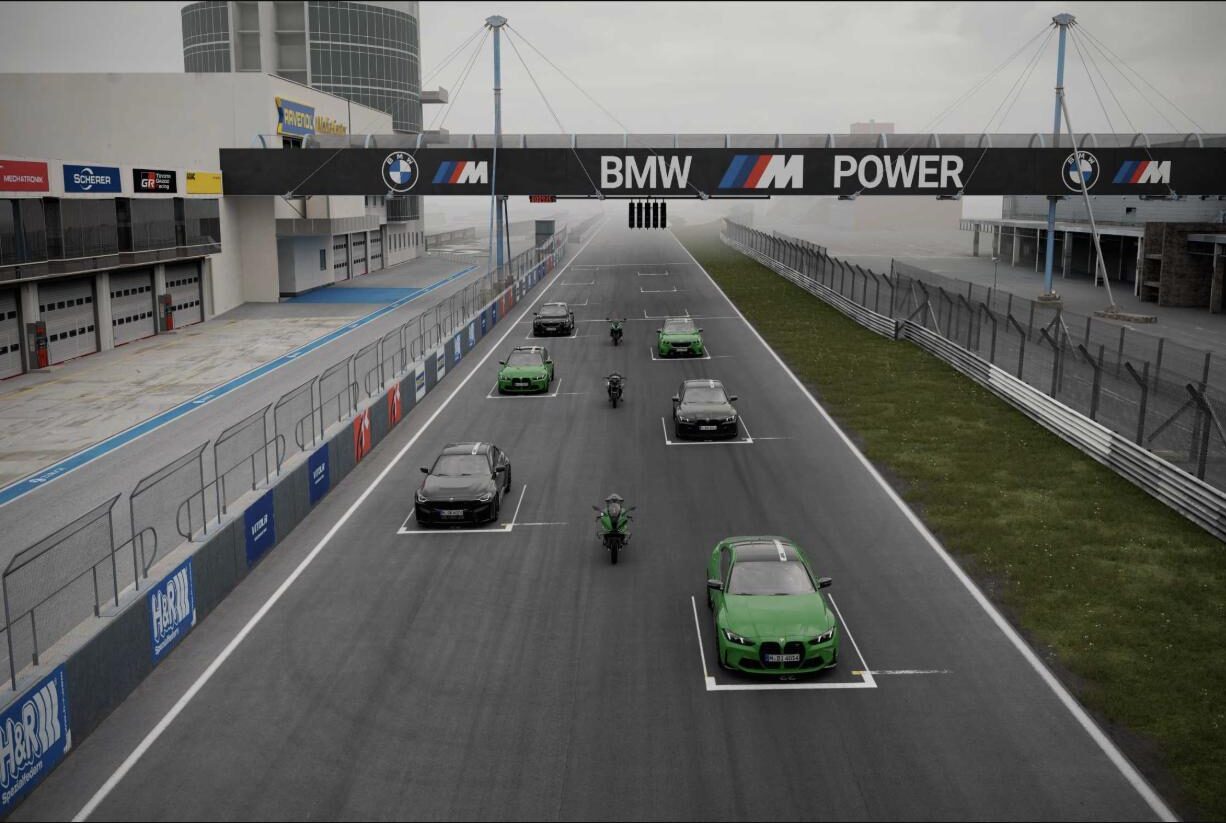
BMW's Edition 100 Jahre Nürburgring covers six M cars and three M motorcycles. Photo: BMW
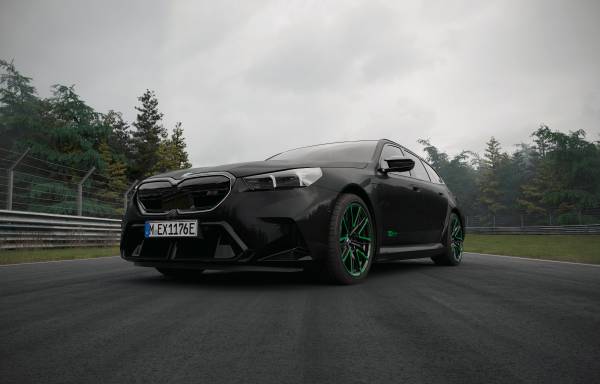
BMW M GmbH and BMW Motorrad have gone in together on a birthday present for a racetrack. The Edition 100 Jahre Nürburgring covers nine vehicles, six cars and three motorcycles, all finished in a bespoke colour BMW calls historical Nürburgring Green and all carrying the outline of the Nordschleife somewhere on or inside them.
The three bikes (the M 1000 RR, M 1000 R and M 1000 XR) are capped at 100 units each worldwide, and each one ships with a certificate of authenticity and an airbox cover marked one of 100. The six cars have no announced build cap at all. If you’re buying either as a future asset rather than a toy, that difference matters more than anything else here.
The cars are an options package wearing a badge
The automotive half covers the M2, M3 Sedan, M3 Touring, M4 Coupé, M5 Sedan and M5 Touring. Cosmetically BMW went deep: circuit graphics on the front doors, C-pillars and rear quarter panels depending on the model, a 100 Years logo, Nürburgring since 1927 lettering, roof stripes drawn specifically for this run, and green accents on the wheels and kidney frames. Even the wheels are model-coded: Styling 930 M in high-gloss black on the M2, Styling 826 M with Nürburgring Green accents on the M3 and M4, Styling 951 M with green accents on both M5s. Anyone who would rather not be the brightest object in the paddock can order Black Sapphire metallic instead and keep the green trim.
Inside, the cabin is black with green and white contrast stitching and a Nordschleife silhouette embroidered into the front headrests, in green thread on the six-cylinder cars and black on the M5s. The straight-six models get an M Alcantara wheel with a 12 o’clock marker, while the M5s get an M wheel in the same design language. The M2 goes furthest, adding carbon bucket seats and a carbon roof finished specifically for the edition, which is fitting for the car that will be last to market.

Check the roof before you fall for the stripes
Four of the six cars carry the stripes across an M carbon roof: M2, M3 Sedan, M4 Coupé and M5 Sedan. The M3 Touring and M5 Touring carry them across steel, and BMW does list the steel roof as a characteristic of the M5 Touring. The difference shows up in repair bills. Stripes on painted steel are a paint job. Stripes on an exposed carbon panel are a paint job on a lacquered composite weave, and the two don’t behave the same way after hail, a garage pillar or a mediocre respray. Get a written estimate for a carbon roof refinish before you assume those two cars are equivalent to insure or repair. Buyers have paid serious money for far stranger M4 bodywork, so the market isn’t exactly rational about panels, but repair bills are.
Pre-chamber ignition
Under the vinyl, the inline-six cars come with BMW M Ignite, the pre-chamber ignition system BMW patented in 2024 and slotted into M2, M3 and M4 engines during July and August 2026. This edition is one of the first retail packages where the technology is on the order sheet rather than in a technology briefing.
A small pre-chamber sits inside the cylinder head, connected to the main combustion chamber by overflow openings, and it carries its own spark plug and ignition coil. Each cylinder therefore runs two ignition systems. At low and medium revs the conventional plug in the main chamber fires first. Push the engine into high revs and heavy load and the pre-chamber takes the lead: part of the fuel-air charge is pushed through the openings and lit inside the chamber, and the resulting flames exit at roughly the speed of sound to ignite the main charge at several points simultaneously.
The payoff is a much faster burn, far better resistance to detonation, and lower exhaust gas temperatures. BMW pairs it with a higher compression ratio and turbochargers using variable turbine geometry, which remains an uncommon sight on a production petrol engine. Fuel consumption falls most sharply under sustained high load, which is a polite way of describing a track day: the same tank buys more laps. The cooler exhaust is arguably the bigger win for anyone who actually uses a circuit, because heat is what erodes turbine hardware, catalytic converters and third-lap consistency.
There’s a regulatory deadline behind all of it. Euro 7 takes effect in November 2026, and M Ignite is how BMW keeps a turbocharged straight-six legal in Europe without giving anything up: displacement and power figures are unchanged from the outgoing engines.
The M5 Sedan and M5 Touring don’t get it, since they run the M Hybrid V8 drivetrain. The M2 is the outlier on timing, too: BMW describes its edition specification as preliminary, with ordering not expected to open until January 2027.
The motorcycles are the collector play
The bikes are properly limited: 100 each of the M 1000 RR superbike, the M 1000 R naked bike and the M 1000 XR crossover, worldwide, with the M Track Package fitted as standard rather than ticked as an option. Every example gets carbon wheels with Nürburgring Green accent stripes, a painted tank carrying Nordschleife artwork, an Alcantara-look seat embroidered with 100, a black rear swingarm and rear frame, and the numbered airbox cover. BMW also includes an M Cover Kit on the RR and R, a branded paddock mat and a rear paddock stand with swingarm mounts.
A few practical notes for anyone chasing one. The carbon wheels are the most valuable performance component in the package and also the least forgiving, because carbon wheels are generally not repairable; kerb or pothole damage means replacement, and replacement at this level is not a weekend purchase. Insure the bike on an agreed-value policy rather than a book-value one, since the numbered hardware is precisely what separates it from a standard S 1000 RR family machine. And keep the original airbox cover, certificate and cover kit even if you fit track bodywork, because a 1-of-100 bike missing its numbering is just a green motorcycle.
Hundred-unit circuit tributes are having a moment, and they do not always travel well. Porsche built exactly 100 Nürburgring tribute GT3s that American buyers cannot legally register for decades, which is worth remembering before you chase a European-market anniversary model on the assumption that scarcity alone makes it importable.

The calendar, and a bit of history
The Nürburgring opened on 18 June 1927, which puts the centenary in 2027 and makes a 2026 launch look premature until you remember that cars have to be ordered, built and delivered before anyone can arrive at the party in one. Orders for the M3 Sedan, M3 Touring, M4 Coupé, M5 Sedan and M5 Touring open from September 2026, the M2 follows in January 2027, and BMW Motorrad says ordering and availability for the bikes will be announced separately. No prices have been published for anything.
BMW’s ties to the place are real. Frank van Meel, who runs BMW M GmbH, calls the circuit “a second home for BMW M,” and every M production car is signed off there: 20.8 kilometres and 73 corners, with elevation changes and surface transitions that no purpose-built proving ground replicates. BMW Motorrad’s association reaches back to the opening year itself, with a win at the circuit in 1927. The company still uses the place as a competitive venue as well as a development tool, most visibly when it sent the M2 Racing to the 24 Hours of Nürburgring. That history is also why old M hardware holds its value; the competition-spec E30 M3 market exists because the badge was earned on circuits like this one.
Which half to buy
The cars are a paint-and-trim package bolted to the most interesting new combustion technology BMW has shipped in years. That’s a great reason to buy one and a poor reason to expect a rarity premium; the used market rewards weird and irreplaceable, which is how a chopped M4 ute cleared $93,000 while ordinary special editions depreciate. The bikes are 100-unit machines with numbered hardware and paperwork, which is how collectible motorcycles have always been made. And for a company cutting costs in Munich, BMW still found the budget for a patented combustion chamber and a bespoke green.
About the Author