Photo: Renault (via Newspress)
The original Renault 8 Gordini was a boxy four-door family sedan with its engine hung out behind the rear axle, a pair of white stripes painted down the middle, and a reputation for turning ordinary French kids into proper drivers the hard way. Sixty-two years after it launched, Renault has built a new one. It has two doors instead of four, a 270-hp electric motor instead of a tuned four-cylinder, and it still drives the rear wheels.
The Renault 8 Gordini Concept broke cover at the Renault Carwalk on September 24, 2026, and it moves to the Renault stand at the Paris Motor Show from October 12 to 18. Before anyone starts clearing garage space, Renault says this is an exploratory concept and an exercise in style, not a production car. It does show why a rear-drive EV may be the most faithful way to bring this particular nameplate back.
Why “La Gorde” Was Hard Work
Renault launched the R8 Gordini in 1964 with a 95-hp engine mounted in the tail and power going to the rear wheels. Renault itself describes the car as efficient but demanding, and that is a polite way of describing what a heavy lump behind the rear axle does to a small car’s handling.
Hanging the engine out back puts plenty of weight over the driven wheels, which is great for traction coming out of a slow corner. The catch is inertia. Once the tail starts to swing, all that mass wants to keep swinging, and a driver who lifts off the throttle mid-corner can find the car rotating faster than they expected. You learned to be smooth, to keep the power on, and to catch slides early, or you learned about ditches. Renault credits the car as a training ground for a generation of drivers, among them future rally star Jean Ragnotti.
The other half of the legend is price. By putting the Gordini name on a sporty version of an everyday model, Renault sold real performance to people who couldn’t afford an exotic. Volkswagen’s Golf GTI, the car usually credited with inventing the affordable hot hatch, didn’t arrive until 1976, a dozen years later.
Electric Power Suits This Layout Better Than Gas Ever Did
Rear-drive was a packaging headache in the 1960s because the engine had to sit behind the axle. An electric drive unit is compact enough to sit at the rear axle, and EV batteries typically ride low in the floor. In principle, that lets Renault keep the rear-drive character that defined the Gordini without the pendulum effect that made the original such a handful.
That is theory, not a road test. Renault has not published weight, battery capacity, range or acceleration figures, and a show car built for the Paris stand does not need any of them. The only hard number is 270 hp, which is nearly three times what the 1964 car made.
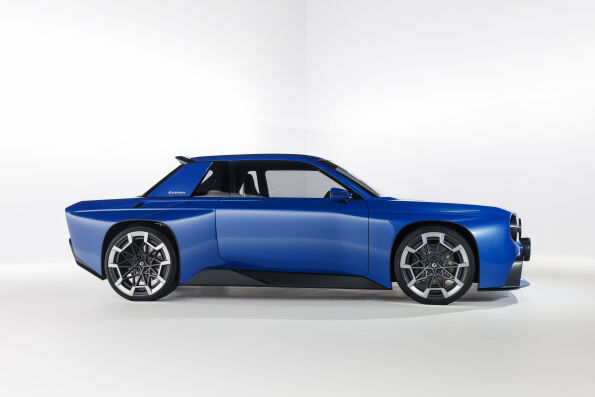
The concept measures about 162.2 inches long, 74.0 inches wide and just 50.0 inches tall (4.12 m by 1.88 m by 1.27 m). It rides on 19-inch wheels up front and 20-inch wheels at the rear, with the bigger rear rolling stock deliberately signaling where the power goes. The rear deck also carries a slight rake that the original never had.
A Car Designed Like a Custom Motorcycle
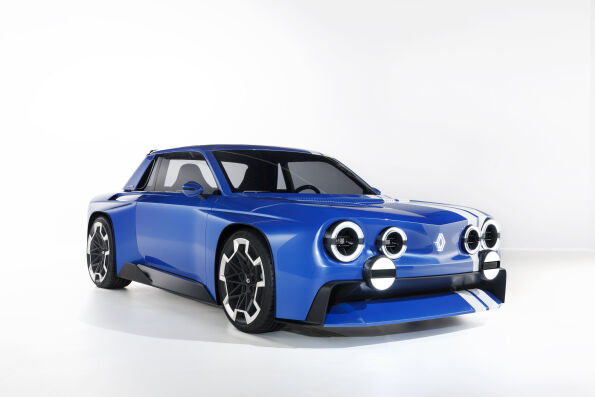
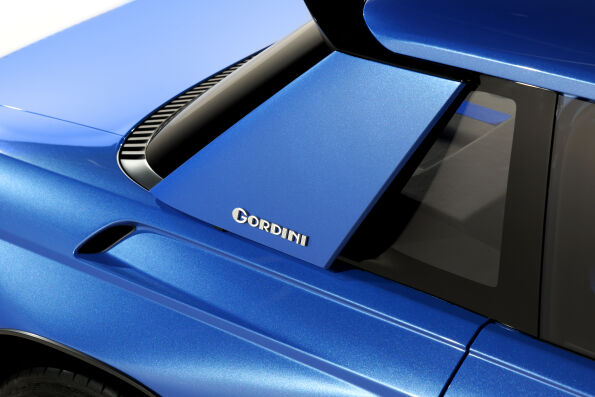
Renault’s designers borrowed their brief from the café racer scene, where builders take an old motorcycle and strip away everything that is not essential. On the R8 Gordini Concept, that means fewer panel gaps and fewer add-on parts. The old chrome side trim is now a feature line pressed into the bodywork. The nose has no hood shut line at all; the entire front section lifts off in one piece, race-car style. The body itself is carbon.
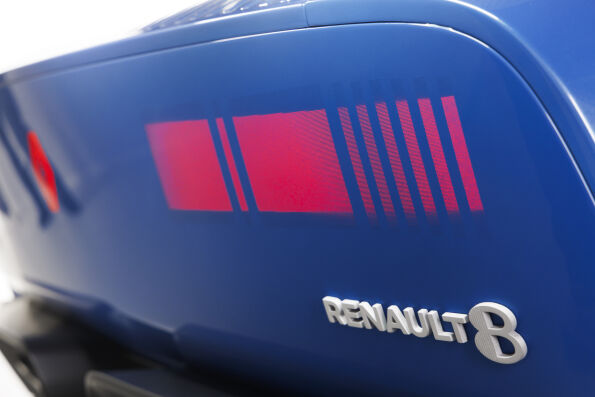
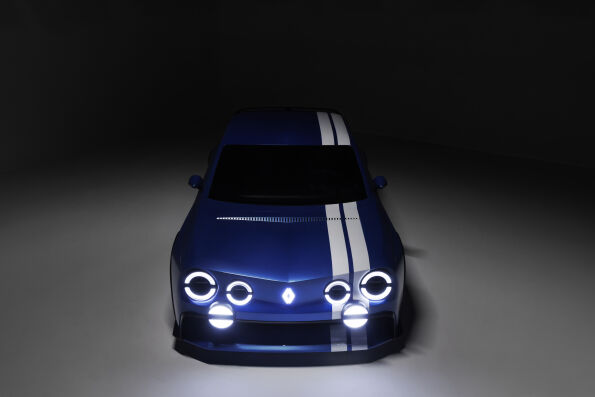
The double white stripe gets promoted from paint to architecture. The grille at the base of the windshield lines up with it, the lighted graphic inside the taillights lines up with it, and it continues into the cabin across the top of the dashboard, shifting from white to blue. Six round headlights sit in the pattern of the rally-spec original’s extra lamps, and the rear lights are mounted so flush they nearly vanish when switched off.
Even the retro details earn their keep. The recessed embossing along the waistline, a signature of the old car, now channels air toward a new vent. The paint takes its cue from Bleu de France, the historic Gordini color, built up in three layers with a pearl effect so the classic shade shows at the edges of the body.
Living With It
Show cars don’t have to survive parking lots. If any of this design reaches production, though, owners will notice a few things.
Start with the wheels. A staggered setup with different front and rear diameters means tires cannot be rotated front to rear. On a rear-drive car, especially an electric one with instant torque, the rear pair usually wears faster, so budget for replacing tires in pairs rather than stretching a set of four across one schedule.
The one-piece front clamshell is brilliant for access and terrible for minor accidents. On a normal car, a low-speed nudge means a bumper cover. On a car whose entire nose is one removable panel, the same tap can mean replacing a much larger, costlier part, and carbon bodywork requires specialist repair. Add integrated headlight pods and flush-mounted lamps and you have exactly the kind of parts list that pushes collision estimates and insurance premiums up. That’s the price of clean, gap-free surfaces.
Inside: Aluminum, Alcantara and Corduroy
The cabin reworks the original dashboard layout. The metal panel with round dials is turned into a horizontal strip of brushed aluminum, and the round instruments floating on top are digital screens. Plastic is largely swapped for brushed aluminum on the controls and larger surfaces, set against Alcantara trim. The carbon used in the bodywork does not appear inside.
The bucket seats nod to the flat, headrest-free seats of the original with blue corduroy centers against black. The door panel stitching mimics the painted curbing of a race track, and the only splash of color on the dash is a red dot on a stopwatch button in the center.
300 Sketches, One Car
Unlike the R17 electric restomod, which Renault developed with designer Ora Ïto, this one is entirely in-house. It started as an internal competition at Renault Design that drew more than 300 sketches, spanning straight retro, full futurism and GT-flavored ideas. Two were built as 2:5-scale models, and the final car merges the best of both. Design VP Alexandre Malval says the goal is emotion, adding, “I’m not talking about nostalgia, but real passion for cars.”
Why Renault Keeps Building These
The R8 Gordini is the latest in a run of heritage one-offs that includes the R17 restomod and the Renault 5 Diamant art car. They share a destination: Renault Collections, a museum the company is preparing at Flins that it expects to open to the public in roughly 15 months. It is part of the same heritage push that saw Renault auction off dozens of its historic Formula 1 cars.
These projects don’t always stay concepts. The café racer approach Renault applied here was first used on the Renault 5 Turbo 3E, which made the jump to a limited production run. Renault’s performance arm has been happy to get weird with electric cars, too, as when Alpine let Lacoste design its wildest electric hot hatch.
The Man Behind the Stripes
None of this exists without Amédée Gordini, the tuner Renault first partnered with in 1957 on the Dauphine Gordini, raising output from 32 to 37 hp. His nickname was “the wizard,” earned by turning humble engines into thoroughbreds. Renault’s own telling says he skipped the drawing board entirely, standing beside the machinist and describing the part to be cut, then handing the finished piece to a draftsman to document afterward.
Shopping for an Original
You cannot buy the concept, and Renault is not promising a production version. If this car has you shopping for a real R8 Gordini instead, remember that two white stripes are the easiest part of the recipe to fake. Plenty of standard Renault 8s have been dressed up over the decades, so authenticity checks on the engine, documentation and Gordini-specific hardware matter more than paint. The same logic applies to the broader restomod boom: the value lives in what is underneath, and knowing what a restomod actually is helps you pay for the right thing.
For everyone else, the Paris Motor Show runs October 12 to 18, 2026. That is your chance to see a 270-hp, rear-drive, carbon-bodied Gordini that behaves itself on paper, which is more than anyone ever said about the original.
Images: Renault, via Newspress. Editorial use.
About the Author