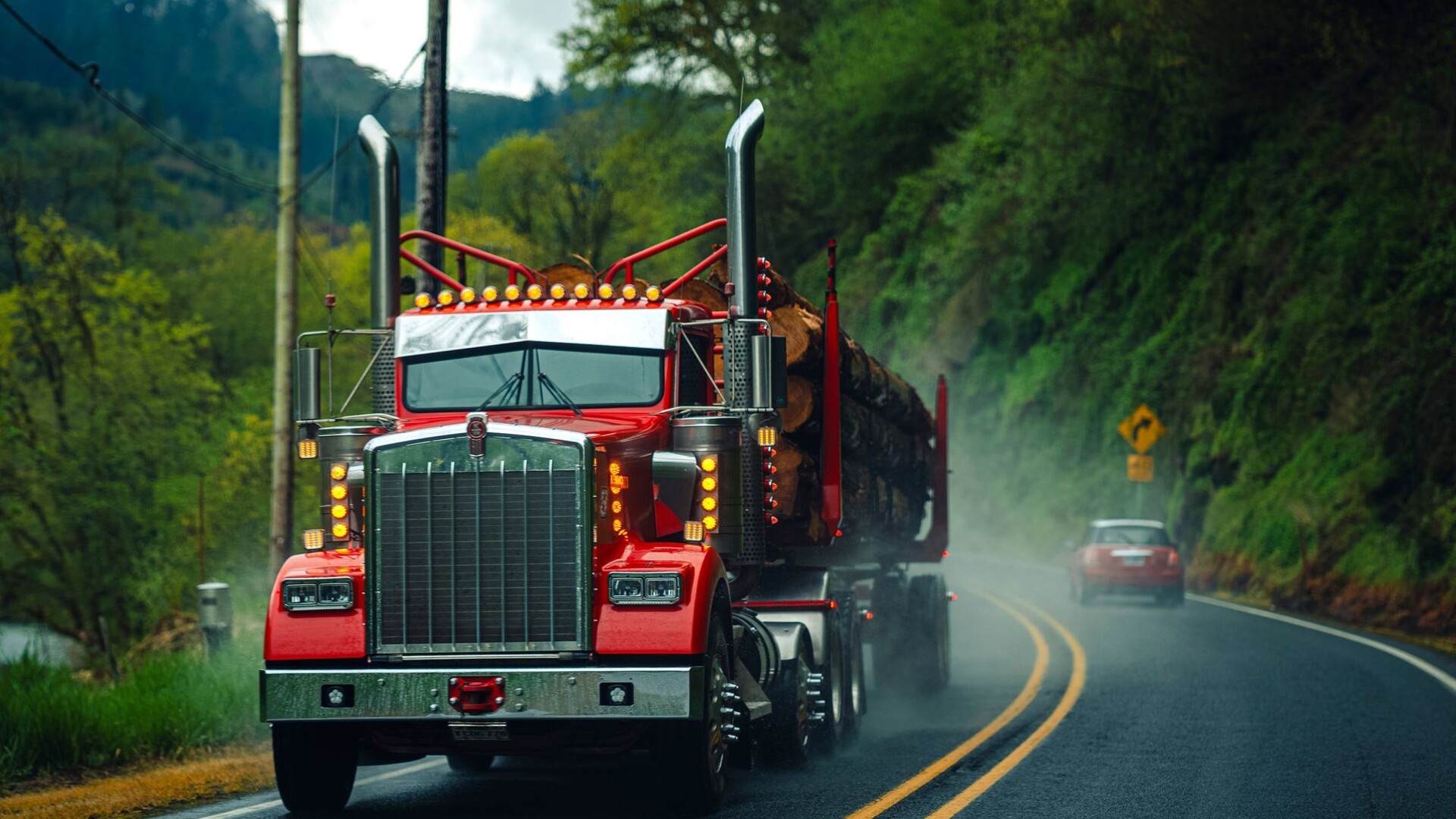
A loaded log truck on a two-lane highway. Photo: <a href="https://www.pexels.com/photo/red-semi-truck-on-scenic-oregon-highway-37538286/">Alex Kovshovik/Pexels</a>
Gene Breeden turned his loaded log truck onto U.S. 301 North from Route 213 on Maryland’s Eastern Shore, lifted a can to his mouth, and started choking. He made it about a mile, according to Rob Carpenter, a trucking safety consultant and expert witness who posted Breeden’s in-cab video on LinkedIn and on X on Sept. 27. Breeden doesn’t drive anymore.
Carpenter shared the clip as a warning, and he says Breeden did nothing wrong. The federal rules bear that out. They will fine a trucker up to $2,750 for holding a phone, and they have nothing specific to say about the drink that, by Carpenter’s account, left an 80,000-pound truck with nobody in control.
What Breeden’s cab camera recorded on U.S. 301
The clip runs 29 seconds and was shot by a driver-facing camera mounted beside the steering column. The date stamp in the corner of the frame reads Oct. 29, 2024, a little before 8:49 a.m.; Carpenter’s posts don’t give a date. The GPS readout on the same overlay puts the truck on the Eastern Shore, consistent with Carpenter’s account of the route.
Breeden takes a long pull from the can with his right hand, his left on the wheel. Within a few seconds he is coughing and gasping, mouth open. His face goes slack, and his head slumps to one side. Then the cab begins to pitch hard, as if the truck has left the pavement, and he is thrown against his seat belt. By the end of the clip he is upright again, head tilted back, mouth open.
Neither post says whether Breeden was hurt, whether police came, or what became of the truck and its load, and I found no public crash report tied to the video. Carpenter wrote that Breeden now lives in Havre de Grace and that he’ll tell anyone he “didn’t do anything wrong, and there was nothing he could have done once it started.” On X, Carpenter was blunter about the aftermath: “This is why he finally hung it up.”
The 1970 federal rule that covers a choking driver
One regulation fits what happened in that cab. Section 392.3 of the Federal Motor Carrier Safety Regulations, on the books since 1970, bars anyone from driving a commercial truck while the driver’s ability or alertness is “so impaired, or so likely to become impaired, through fatigue, illness, or any other cause,” that it’s unsafe to start or keep driving. It binds carriers too: a company may not “require or permit” a driver to run in that condition.
The rule is written for a driver who is already sick or worn out when he climbs into the seat. It names no food, no drink, and no act. A driver who feels fine at the on-ramp and chokes a mile later wasn’t impaired when he started, and once the coughing begins, the rule’s only instruction, stop driving, is the thing his body won’t let him do.
Phones carry a $2,750 fine; the can in Breeden’s hand carries none
The same agency handles phones differently. Under Sections 392.80 and 392.82, a truck driver caught texting or holding a phone while driving faces penalties of up to $2,750, and an employer that allows or requires it faces up to $11,000, according to the Federal Motor Carrier Safety Administration. Repeat violations can cost a driver his commercial license.
There is no counterpart for eating or drinking, even though the FMCSA’s own driver-distraction guidance warns that eating always takes at least one hand off the wheel and cites research finding that eating while driving was riskier than talking on a cell phone. The same page recounts a May 23, 2008, crash in which a truck driver distracted by a soda hit a school bus; 14 children went to the hospital, four of them seriously hurt. The agency treats food and drink as a safety tip and phones as a violation.
There’s a practical reason for the gap. A handheld phone is something an officer can see and a roadside inspector can write up. A coffee cup in a cup holder is harder to police, and a ban would sweep in every driver who takes a sip at a red light. The result is that the one habit Carpenter says drivers fully control is governed by nothing but the driver’s own discipline and whatever the carrier puts in its handbook.
What the federal crash causation study found about sick drivers
Carpenter leaned on one number: 12%. It comes from the Large Truck Crash Causation Study, which the FMCSA and NHTSA built from a nationally representative sample of 963 crashes between April 2001 and December 2003, involving 1,123 large trucks, 249 deaths, and 1,654 injuries. Investigators assigned a “critical reason,” the immediate failure that made the crash unavoidable, to one vehicle or driver in each crash. Of all the trucks in the study, 55% drew it.
Among those trucks, the study’s July 2007 analysis brief put 12% under “non-performance,” meaning the driver fell asleep, was disabled by a heart attack or seizure, or was otherwise physically impaired. Projected nationally, that’s about 9,000 trucks. Decision errors such as speeding or following too closely were the biggest group at 38%, followed by inattention at 28%.
Illness gets its own line in the study’s table of associated factors. It showed up in only 3% of trucks, about 4,000, but it carried a relative risk of 34.0. The brief defines that as the rate at which trucks coded with a factor were assigned the critical reason, compared with trucks without it. By that measure, a truck whose driver was coded as ill was 34 times as likely to be assigned the critical reason. Fatigue, a factor the federal hours-of-service rules are built around, came in at 8.0. The brief cautions that relative risk should be read alongside how often a factor appears, and illness is rare.
A 2013 choking crash on I-80 near Davis, California
Carpenter’s post also pointed to a case that ended the way Breeden’s could have. At about 10:35 a.m. on March 28, 2013, an eastbound big rig on Interstate 80 near Old Davis Road, by the Solano-Yolo County line, drifted right and then cut across every eastbound lane and the center divider, CBS San Francisco reported that day. California Highway Patrol Officer Chris Parker told the station the driver had been “eating as he drove” and “choked on food and lost consciousness.” The truck hit a westbound BMW, killing both people inside. The driver came to when the rig hit the divider and survived.
Choking crashes aren’t limited to big rigs, either. Backfire News covered a driver who crashed into a gas station while choking on a French fry and a Colorado Corvette crash in which the driver reported a possible medical episode. The stakes rise with the weight: the Davis crash showed what a tractor-trailer can do to oncoming traffic once it crosses a median.
Where the medical card and the break rule stop short
Truckers do face a health screen. To hold a medical certificate, a driver must have, under Section 391.41(b)(8), “no established medical history or clinical diagnosis of epilepsy or any other condition which is likely to cause loss of consciousness or any loss of ability to control a commercial motor vehicle.” That standard screens for conditions a doctor can find in an exam room. A mouthful of soda going down the wrong way isn’t one, so a driver can pass every physical and still land in the study’s non-performance column one swallow later.
The hours-of-service rules don’t help either. Section 395.3 requires a 30-minute break once a driver has logged 8 hours behind the wheel, unless a short-haul exception applies. That break targets fatigue, not meals, and Breeden was one mile into his run. Nothing in the federal rules schedules a stop to eat or drink.
What Carpenter wants drivers and carriers to take from Breeden’s video
Carpenter’s advice to truckers is short: “eat parked. Drink parked if you can.” For everyone else sharing the road, he asks them to give a drifting truck room, because “You don’t know what’s happening in that cab.” His X post of Breeden’s clip had about 2.8 million views as of Sept. 29.
The lever Section 392.3 already gives carriers is the word “permit.” A fleet can write an eat-parked policy into its driver handbook today and back it with the same in-cab cameras that recorded Breeden, without waiting for Washington. Whether fleets do that, and whether the FMCSA ever moves food and drink from its safety-tips page into its rulebook, are the things to watch. Breeden, by Carpenter’s account, has already made his own decision: he no longer drives.
Should eating and drinking behind the wheel of a big rig be written into federal rules alongside handheld phones, or should that call stay with drivers and the companies they work for?
About the Author