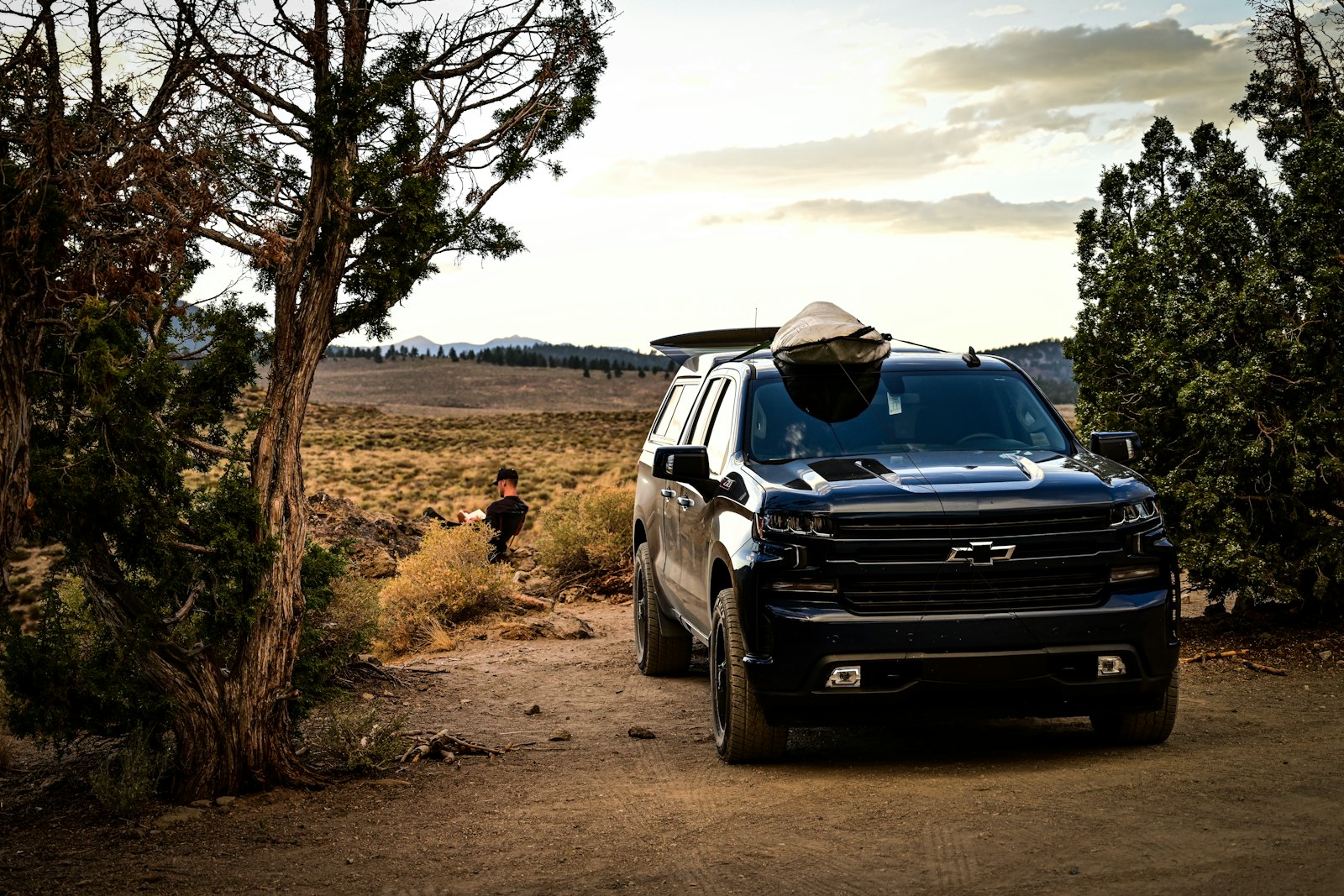
A Chevrolet Silverado 1500. Truck shown for illustration only. (Photo by Samantha Fortney / Unsplash)
For most owners, General Motors’ fix for a V8 that can chew through its own bearings came down to an oil change. It was a very particular oil change: 0W-40 instead of the factory 0W-20, a new oil fill cap to mark the switch, and an insert for the owner’s manual. Federal safety regulators now have 473 reports of engines that got exactly that treatment and failed anyway.
On August 20, the National Highway Traffic Safety Administration’s Office of Defects Investigation opened Engineering Analysis EA26005 into GM’s 6.2-liter L87 V8. The probe covers 997,743 vehicles from the 2021 through 2026 model years, which means the full-size Chevrolet Silverado 1500, GMC Sierra 1500, Tahoe, Suburban, Yukon and Cadillac Escalade. That’s far more trucks than the original recall covered, including 2025 and 2026 models it never touched.
The recall that was supposed to settle this
GM filed Recall 25V-274 in April 2025. It covered 597,630 trucks and SUVs from the 2021–2024 model years whose L87 engines were built between March 1, 2021, and May 31, 2024. The recall filing says GM estimated that about 3% of that population actually had the defect.
According to that filing, the root cause traces to a supplier. GM described two problems: sediment contamination in the connecting rods and the crankshaft’s oil galleries, which led to rod-bearing damage, and crankshafts that were out of spec on dimensions and surface finish. When that combination lets go, GM warned, the engine can fail on the road and the vehicle loses propulsion.
The recall filing’s chronology is not flattering. GM opened and closed internal investigations into the issue in February 2022, June 2023 and July 2024. It opened another in January 2025 after NHTSA contacted the company. By then GM had counted 28,102 field complaints dating back to April 2021, and 14,332 of them alleged a loss of propulsion. The supplier-side manufacturing fixes were in place by June 1, 2024.
Under the remedy, dealers inspected each engine first. The dealer bulletin used a stored P0016 trouble code as the gate. P0016 is a crankshaft/camshaft position correlation fault. Engines with that code set were pulled aside for repair or replacement. Engines without it got fresh 0W-40, a new filter, a new 0W-40 oil fill cap and the manual insert, and went back to their owners.
What the 473 failures tell us
NHTSA first looked at whether the fix worked through a recall query, RQ26001, opened January 16. The Engineering Analysis upgrades that inquiry. Here is the key math from the agency’s opening resume:
- 499 complaints to NHTSA of engine failure after the recall remedy was completed.
- 473 of those engines had received the oil-viscosity remedy.
- 26 were engines that had already been fully replaced under the recall.
- 6,953 post-remedy complaints reported to NHTSA by GM itself.
- 191 failures in engines built after the recall’s production window closed.
NHTSA’s tally so far counts one crash or fire, one injury and no deaths.
These numbers deserve some caution. Complaints are not confirmed defects, and NHTSA hasn’t published how many trucks have received the oil remedy, so nobody outside GM can calculate a failure rate for the fix yet. That is part of what an Engineering Analysis is for.
Still, two things stand out. Nearly 95% of the post-remedy failures NHTSA counted involved the cheap fix rather than the expensive one. And GM’s own complaint count is roughly 14 times what landed in the agency’s inbox.
Why thicker oil was the bet, and why it can’t be a cure
A connecting-rod bearing doesn’t really touch the crankshaft when things are working. It rides on a pressurized wedge of oil a few thousandths of an inch thick. A higher-viscosity oil holds a thicker, sturdier film at operating temperature. In theory, that gives a marginal journal (slightly out of round, slightly too rough, slightly off on clearance) more room before metal meets metal. As a mitigation for a borderline crankshaft, 0W-40 is a defensible engineering call.
But oil can’t remove debris that’s already in the galleries. It can’t un-score a bearing that was damaged before the truck reached the dealer, and it can’t change the shape of a crankshaft. The dealer screen also looked for a trouble code rather than tearing the engine down, so an engine could pass inspection while already hurt. That describes a mitigation, and the Engineering Analysis exists to determine whether a mitigation was enough.
The 26 failed replacement engines complicate things further. So do the 191 failures from engines built after May 31, 2024, when GM says the manufacturing problems had been fixed. Neither group fits neatly into a story where only a bad batch of parts from one window was affected. That’s presumably why NHTSA has expanded its probe to cover model years through 2026.
Ford went through something similar with its 1.0L EcoBoost timing belt: a known internal-engine defect, a remedy owners were told to trust, and federal investigators asking whether it held up. The Ford recall that followed shows how these probes can end.
Who pays
Recall work is free no matter the truck’s age or mileage, and the 25V-274 filing provides for reimbursing owners who paid for qualifying repairs before the recall. Anything outside the recall’s scope is a different story. That includes a post-window engine or a failure GM decides not to tie to the defect. Chevrolet and GMC’s standard powertrain coverage runs 5 years or 60,000 miles, whichever comes first, so the earliest 2021 trucks are already aging out of it.
GM’s customer-relations stance hasn’t helped. When word spread of an L87 owner discount program, GM said in a statement that no such offer exists and that it reviews circumstances “case-by-case.” In practice, the paper trail you keep is your leverage.
There’s a resale angle too. If you’re shopping full-size trucks and a 6.2 is on the list, ask for the recall paperwork and the oil-change history. If you’re selling one, have both ready.
The L87 owner checklist
1. Find your engine’s build date
The recall window is based on when the engine was built, not the truck. GM’s service bulletin places the build-date sticker on the rear of the driver’s-side (left-hand) cylinder head, visible from under the vehicle. The first two digits are the year, and the next three are the day of that year. For example, “24114” means the 114th day of 2024. The recall window runs from roughly 21060 (March 1, 2021) through 24152 (May 31, 2024).
An engine built after that isn’t automatically in the clear, because it falls in the group behind those 191 post-window complaints.
2. Confirm whether the recall was done
Run your VIN through NHTSA’s recall lookup or GM’s owner center at gm.com/service. Then open the hood. If the oil remedy was performed, the fill cap should be the new 0W-40 cap. On a used truck, that cap is the fastest way to tell whether someone actually did the work.
If it was done, the whole remedy depends on the thicker oil, so every oil change from now on needs to follow the remedy spec. Keep receipts showing the grade used.
3. Know the warning signs
GM’s recall FAQ and filing list these symptoms:
- Knocking, banging or other unusual engine noises
- A check-engine light
- Hesitation, unusually high RPMs or abnormal shifting
- Reduced power or a no-start condition
A rod knock gets worse under load, not better. If you hear one, park the truck rather than nursing it home with a trailer attached.
4. If it fails after the fix, report it
Tell the dealer, and also file a complaint with NHTSA. Those complaints built this investigation, and they’re what the agency will weigh when it decides whether 25V-274 needs a bigger remedy or a bigger population.
What happens next
An Engineering Analysis is the stage where NHTSA gathers detailed data from the manufacturer and tests its explanation. It can close without action, or it can end in a recall request, which GM would face on a population now close to a million vehicles.
GM made a bet that a thicker oil film could carry a marginal crankshaft for the life of the truck. NHTSA is now checking whether 473 failures mean that bet has already been lost. Until it decides, check your build date and your oil cap.
Sources: NHTSA Engineering Analysis EA26005; NHTSA Recall 25V-274 Part 573 report, dealer bulletins and owner FAQ. Featured photo by Samantha Fortney / Unsplash; vehicle shown for illustration only.
About the Author