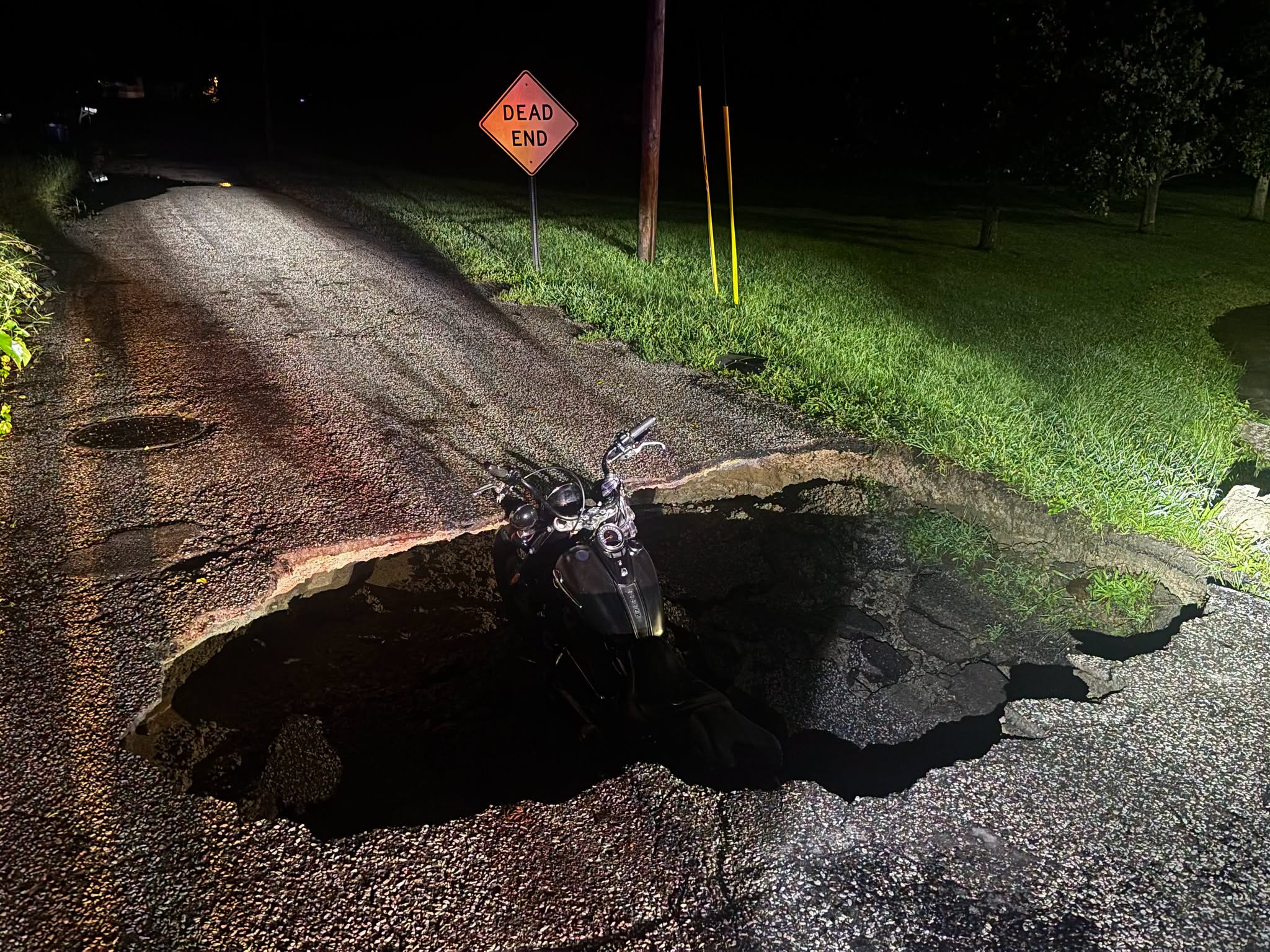
A stretch of dead-end pavement near the Putnam County Sheriff’s Department did something roads aren’t supposed to do this week: it disappeared. A motorcyclist riding through the area after dark on Tuesday, August 25, found that out the hard way when the road surface gave way beneath his front wheel, dropping bike and rider into a sinkhole that hadn’t existed the day before.
The rider escaped without reported serious injury, and the reason is almost entirely mechanical: he wasn’t moving fast when the pavement disappeared. Hit a sudden vertical drop at speed and a motorcycle’s front wheel digs in, the fork compresses past its travel, and the bike catapults the rider over the bars. Hit that same drop at a crawl, and the front wheel simply drops in while the bike stalls against the far wall of the hole and gravity does the rest. There’s no clever riding technique that saves you from a hole appearing in the road at speed. There’s only how fast you were going when the ground ran out.
The Putnam County Sheriff’s Office announced the incident the way small-county departments increasingly do now: on Facebook, in a tone somewhere between public safety bulletin and stand-up set. “Be safe out there! Be ready for random sinkholes, apparently!” the department wrote, adding that a deputy had floated the idea of building a temporary ramp over the hole until the street department could get to it.
Buried in the jokes was a real legal citation, and it’s worth untangling because the department cited it backwards. The post referenced Indiana code 9-16-21-1, covering when a vehicle can be stopped or parked on a public roadway. The actual statute lives at Indiana Code 9-21-16-1, which bars leaving a vehicle standing on the paved or main-traveled part of a highway outside a business or residential district whenever it’s practical to get off the roadway first. It’s a law written for drivers who stop to check a phone, not for pavement that opens up underneath them, which is presumably why the department itself admitted it wasn’t sure how the law applies to a vehicle parked involuntarily inside a hole the road created for it.
Sudden roadway collapses like this one are rarely mysterious once crews start digging. The overwhelming majority trace back to a failed culvert or stormwater pipe running beneath the road surface. Once corrugated metal or aging concrete pipe rusts through or a joint separates, groundwater keeps flowing but starts carrying the surrounding soil and gravel along with it, hollowing out a void under the pavement while the surface above stays intact and looks completely normal, right up until it isn’t. Rural dead-end roads with light traffic and no scheduled maintenance are exactly the kind of asset that falls through the cracks of a county’s inspection budget, sometimes literally.
Fixing it typically means excavating the failed pipe, compacting new backfill, and repaving the surface, a job that on a rural road usually runs into five figures once equipment and traffic control are factored in, with the final bill depending on how far the void extends beneath the surrounding pavement. Whether that bill stays with the county or gets contested by a resident’s insurer if a claim is filed depends heavily on notice: Indiana’s Tort Claims Act generally requires that a governmental unit have actual or constructive notice of a dangerous roadway condition before it can be held liable for it, a meaningfully higher bar than the ordinary negligence standard drivers are used to after a crash with another car.
For the rider involved, whether this becomes anything more than a good story depends on paperwork most owners never read closely. Standard motorcycle liability coverage doesn’t pay to repair your own bike, full stop. Physical damage to the motorcycle only gets covered if the rider carries comprehensive coverage, and even then, insurers can be skeptical of pavement-defect claims that don’t involve another vehicle, which is exactly where photos, an official incident report, and yes, that Facebook post, become genuinely useful documentation instead of internet comedy.
This isn’t the first time a road has opened up on a motorcyclist mid-ride, and it won’t be the last. We’ve covered the unsettling dashcam version of this exact scenario before, and the lesson repeats every time: unlit, low-traffic roads at night are where infrastructure failures and rider vulnerability overlap the most. A helmet doesn’t stop a hole from opening under a front wheel, but it’s still the difference between a bruised ego and a hospital bill when a bike goes down sideways, which is presumably the point buried under the department’s jokes. Sheriff’s offices leaning on social media to warn the public about road hazards is becoming its own trend in traffic enforcement worth watching, since the same platforms that turn a sinkhole into a viral moment are also, increasingly, how departments get ahead of a hazard before someone else finds it the hard way.
About the Author