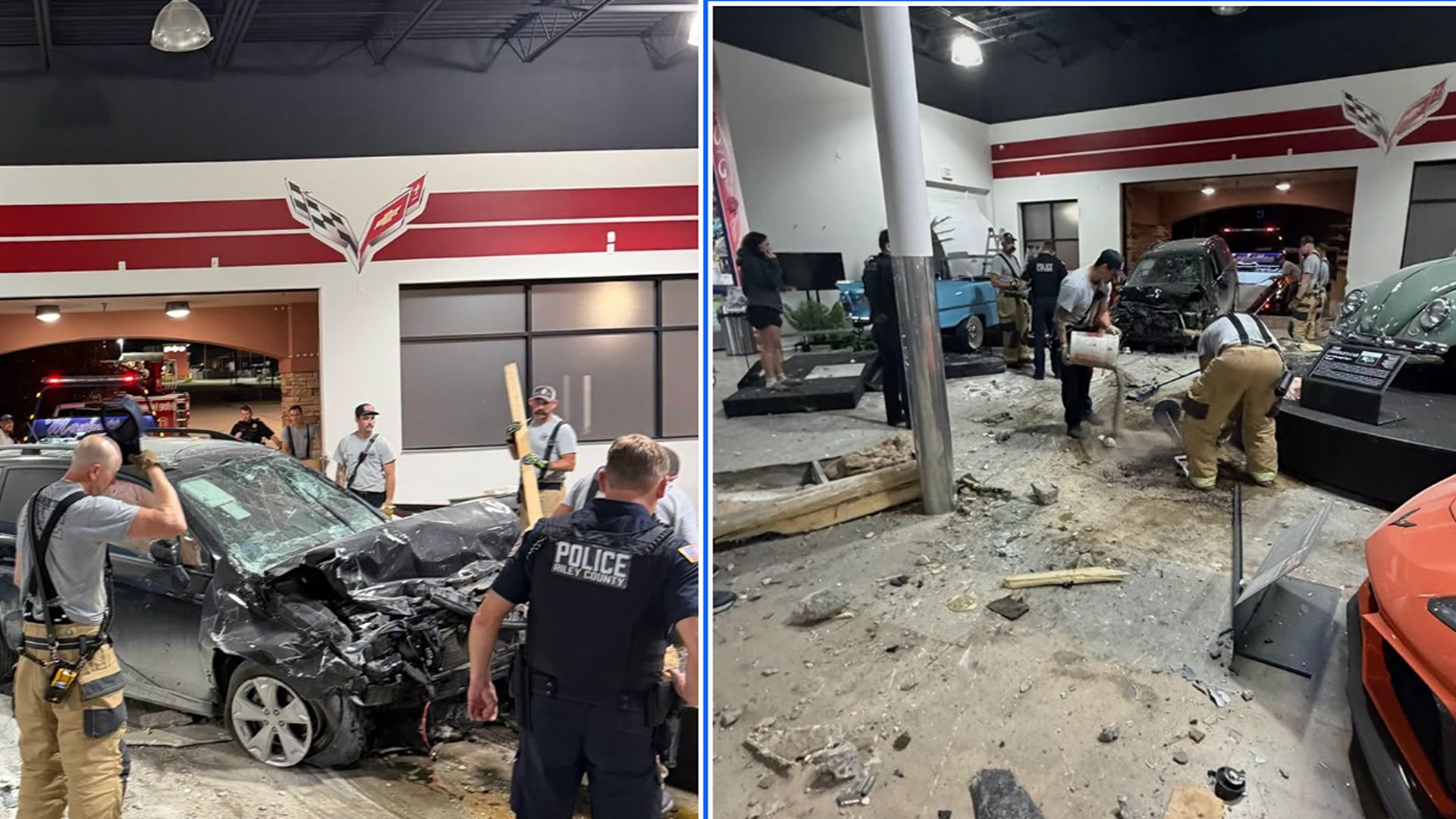
Late Friday night in Manhattan, Kansas, a driver suffered a medical emergency in the parking lot of the Midwest Dream Car Collection and ended up putting a real car through the wall of a building full of cars that were only supposed to be looked at. It’s not even the strangest car story out of Kansas this year, that title still belongs to the stolen car that turned up two baby goats in the trunk, but it’s the one that just closed a nationally recognized car museum for a weekend. The museum bills itself as one of Travel + Leisure’s Top 8 car museums in the country, and it spent the days after the crash doing the least glamorous part of running one: sweeping up drywall, shoring up a hole in the building, and figuring out how to keep the lights on while a contractor rebuilds a wall.
According to the museum’s own account, the crash happened late on a Friday night and, in its words, ended up “resulting in a vehicle striking the museum and causing significant damage inside and outside the building.” The driver’s injuries were described as not life-threatening. Riley County Police Department officers, EMTs, and a crew from Manhattan Fire Department Station 3 stayed on scene well into the night, building a temporary wall to secure the building before BHS Construction’s team showed up early the next morning to keep reinforcing it. The museum closed for the entire weekend to deal with the aftermath.
The timing is what makes this more than just another building-versus-bumper story. The crash landed during the closing weekend of the museum’s “Cars from Radiator Springs” display, a Route 66-themed exhibit built around full-size versions of Lightning McQueen and friends from Pixar’s Cars franchise, a movie that has spent two decades quietly teaching kids more accurate automotive history than most car-guy uncles manage. Instead of ending the exhibit’s run with a scene involving a real ambulance, the museum extended it through September 20th and reopens to the public on September 4th.
Words like “medical episode” do a lot of quiet legal work in stories like this. When a driver loses consciousness or control because of a seizure, cardiac event, or similar sudden medical event, most states treat that differently than ordinary carelessness. Under what’s generally called the sudden emergency doctrine, a driver with no prior warning of a medical condition typically isn’t found negligent in the way courts usually define it, and criminal charges in these situations are rare. That doesn’t mean nobody pays for the wall, though. Property damage claims like this one usually get resolved through the liability portion of the driver’s own auto insurance policy, which typically covers damage the car caused regardless of whether anyone is ever found criminally at fault.
What actually stops a car from ending up on a showroom floor is a lot more mundane than insurance law: bollards. Steel or concrete posts rated to stop a moving vehicle typically run somewhere between a few hundred and around fifteen hundred dollars apiece installed, a rounding error compared to the cost of repairing structural framing, drywall, HVAC ductwork, and whatever inventory happens to be sitting in the blast radius. Plenty of storefronts, showrooms, and museums built with wide parking lots right up against the glass simply don’t have them, which is exactly the kind of gap that turns a driver’s bad night into a five-to-six-week construction project for everybody else.
That’s roughly the timeline Midwest Dream Car Collection is now working with. Construction is expected to continue for five to six weeks after reopening, and several vehicles will be off the show floor in the meantime. Extending the Cars exhibit rather than quietly ending it isn’t just a nice gesture to disappointed families. Small, single-location car museums operate on thin margins even in good months, and a popular touring exhibit generating a few more weeks of admission revenue helps offset a repair bill nobody budgeted for. These places fold more often than enthusiasts like to admit; even a museum built by Dukes of Hazzard star Ben Jones out of his own Cooter’s Garage had to fight to stay open.
Turning a disaster into part of the exhibit isn’t a new idea for car museums. The National Corvette Museum’s 2014 sinkhole swallowed eight Corvettes on live security footage, and rather than fully restoring every car back to showroom condition, the museum put several of them on permanent display exactly as they came out of the ground, cracked paint and all, because a wrecked Corvette with a story turned out to be more interesting than a repainted one without it. Whether any of Midwest Dream Car Collection’s crash damage ends up as a display of its own or just a repair invoice is still an open question, but the instinct to keep visitors curious rather than just clean up and move on is the same.
For now, the practical details are simple enough: the museum reopens September 4th at 3007 Anderson Ave in Manhattan, Kansas, the Radiator Springs cars stick around through September 20th, and several other vehicles will stay off the floor while crews finish rebuilding the wall a stranger’s medical emergency put a hole through.
About the Author