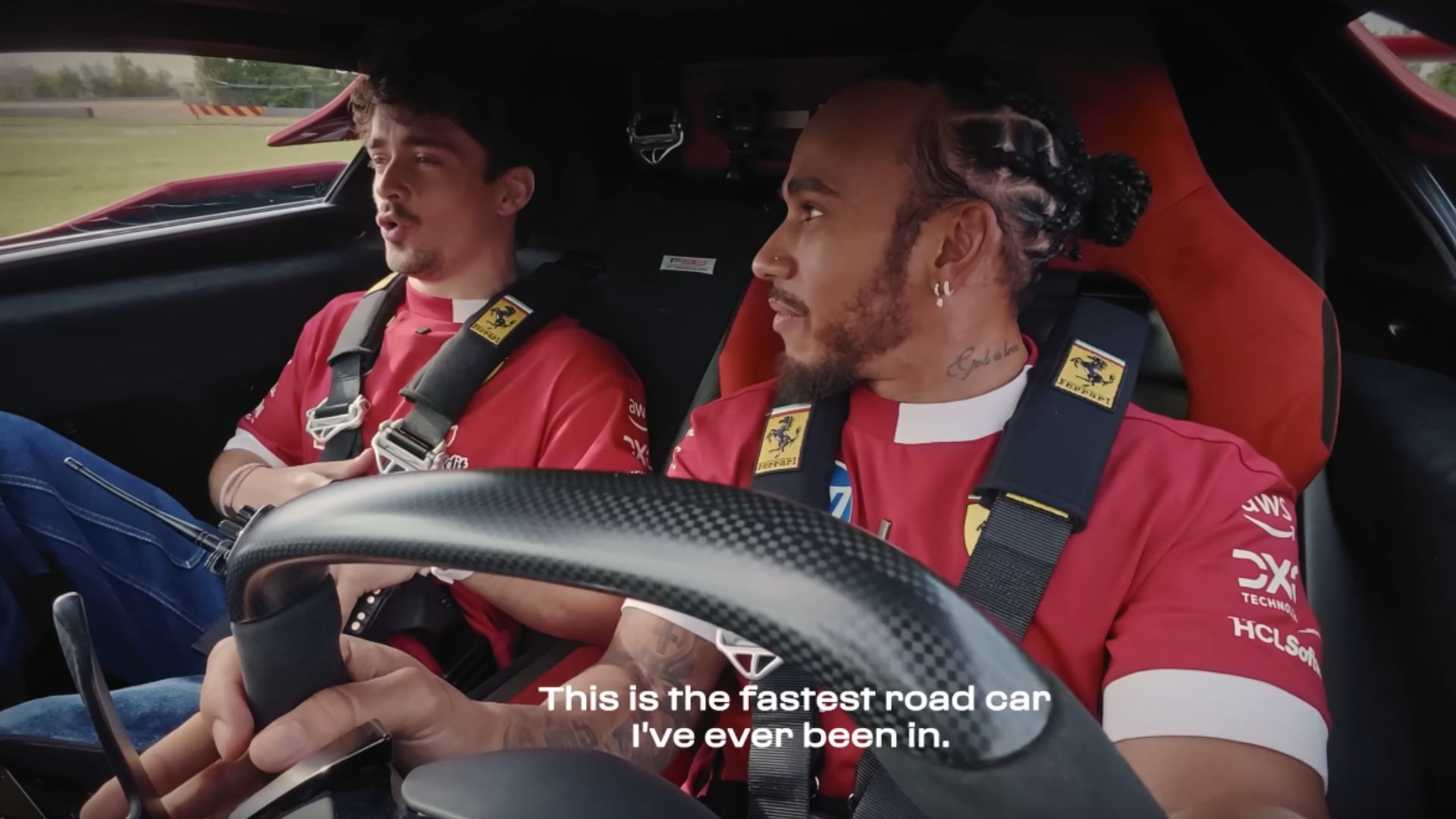
Image via Ferrari/YouTube
Formula 1’s new regulatory era has produced one of the most lopsided first halves in years, but also one of its most compelling. The original 23-race calendar lost its Bahrain and Saudi Arabian rounds to the outbreak of the Iran war, yet the on-track story has been anything but quiet. Below is a full recap of the opening eleven rounds heading into the summer break, followed by five detailed scenarios for how the remaining twelve races could shape the championship fight.
The First Half in Review
2026 brought the biggest rulebook overhaul in a decade. The new power units dropped the MGU-H entirely and roughly tripled the electrical contribution from the MGU-K, paired with active front and rear wings that replace the old DRS system with new “boost” and “overtake” modes. Three fresh power unit manufacturers joined the grid: Audi arrived as a full works outfit built on the old Sauber operation, Ford returned for the first time since 2004 to back Red Bull’s in-house engine program, and Honda relaunched as an independent supplier exclusively for Aston Martin. Cadillac became the sport’s eleventh team, running Ferrari power for now while it develops its own engine for 2029. The team cost cap jumped from $135 million to $215 million, and a wave of new crash-structure and cockpit safety rules were phased in as well.
The new hybrid formula was not without early drama. A scary high-speed crash for Oliver Bearman in Japan, caused by a big speed differential from how drivers were managing battery deployment, pushed the FIA into a series of emergency meetings in April. By the Miami round the sport had already softened the harshest edges of the new energy rules, widening the power-recovery window so cars would not so abruptly lose punch mid-corner.
The season’s geopolitics intruded as well. Both the Bahrain and Saudi Arabian Grands Prix, originally slated for the spring, were scrapped once the Iran war broke out, since safety concerns made it impossible to arrange replacement events on short notice. Bahrain was later revived in relocated form, moved to Sepang in Malaysia for the autumn while keeping its original race branding.
But the headline story of the first half has been the emergence of Kimi Antonelli as a genuine generational talent. The young Mercedes driver won six of the first eleven races, in China, Japan, Miami, Canada, Monaco and Belgium, took the youngest pole position in F1 history in Shanghai, became the sport’s youngest ever championship leader after Suzuka, and then became the youngest winner of the Monaco Grand Prix while completing a rare grand chelem there, leading every lap on his way to pole, victory and fastest lap. He arrives at the summer break with 219 points and a 50-point cushion over Lewis Hamilton, with George Russell a further nine points back in third.
Hamilton’s move to Ferrari finally clicked into gear at round seven in Barcelona, where he inherited the lead from a retiring Fernando Alonso and held on to score his first win for the Scuderia, making him the oldest Grand Prix winner since Jack Brabham in 1970. Charles Leclerc added a win of his own at Silverstone, benefiting from late misfortune for Antonelli, giving Ferrari two different winners and a real sense that the team is Mercedes’ closest challenger even without yet matching Antonelli’s sustained pace.
Russell has arguably been the unluckiest front-runner of the year. He won the season opener in Melbourne and added a second victory in Austria, and he has racked up more poles than anyone bar his teammate, but power unit failures while leading or challenging for the lead in Canada and Barcelona have repeatedly cost him a share of Antonelli’s points haul. Mercedes’ constructors’ lead of 379 points to Ferrari’s 307 and McLaren’s 220 somewhat masks that both of its cars have shown a reliability weakness that has, so far, only ever punished the driver not currently leading the title race.
The reigning champions at McLaren have endured a first half to forget. Oscar Piastri crashed on the way to the grid before the season-opening race and failed to start twice more across the year’s opening rounds because of car issues, while Lando Norris dealt with a DNS of his own in China and a gearbox failure while running for the win in Canada. It took until round eleven in Hungary, where Norris held off a fading Piastri, who retired from the lead with another gearbox failure, for McLaren to finally open its 2026 win column. Norris sits fifth in the standings, 91 points off the pace.
Max Verstappen and Red Bull have been quietly competitive rather than dominant, a jarring change after years at the front. A first-lap qualifying crash buried Verstappen at the back in Melbourne, and a rear-wing failure ended his British Grand Prix while running third. Red Bull’s new in-house, Ford-badged power unit has shown flashes of strong race pace, including podiums in Canada, Austria, Belgium and Hungary, but Verstappen’s 109 points leave him fourth, over a hundred points off Antonelli.
Further down the order, Isack Hadjar has impressed since being promoted from Racing Bulls to partner Verstappen at Red Bull, regularly finishing in the points and taking a podium at Monaco after a penalty appeal reinstated him ahead of Pierre Gasly. Nico Hulkenberg and Audi finally opened their scoring account in Hungary. Aston Martin, saddled with a difficult first season of the new Honda partnership, brought sixteen upgrades to Hungary and reached Q2 for the first time all year with Alonso. Franco Colapinto has had a solid rookie season for Alpine, while Cadillac, in its maiden F1 campaign, is still searching for its first point after a string of retirements and brake-overheating issues for Sergio Perez and Valtteri Bottas.
Heading into the break the top of the drivers’ table reads: Antonelli 219, Hamilton 169, Russell 160, Leclerc 138, Norris 128, Verstappen 109, Piastri 92, Hadjar 68, Lawson 43 and Gasly 42. In constructors it is Mercedes 379, Ferrari 307, McLaren 220, Red Bull 177, Racing Bulls 66, Alpine 61, Haas 21, Audi 12, Williams 11, Aston Martin 1 and Cadillac 0.
Five Scenarios for the Second Half
Twelve rounds remain, starting at Zandvoort in late August and finishing in Abu Dhabi in December, with two more sprint weekends at the Dutch and Singapore Grands Prix. Roughly 316 points are still on the table for a driver who wins everything left, which is more than enough to swing a championship on paper but a tall order against a 50-point deficit and a driver in Antonelli’s current form. What follows are five detailed, plausible ways the rest of 2026 could play out. These are speculative narratives, not predictions or reported news.
Scenario 1: The Coronation
In the most statistically straightforward version of the second half, Antonelli simply keeps doing what he has done since March. Mercedes’ car is the class of the field on both low and high-downforce layouts, and the team’s development trajectory, sharpened by lessons learned from its two power unit failures, closes off the reliability window that has cost Antonelli and Russell points so far. Antonelli wins at Zandvoort and Monza back to back, stretches his lead past 90 points by the Singapore sprint weekend, and turns the run to Mexico City and Sao Paulo into a formality. Mercedes clinches the constructors’ title as early as the United States Grand Prix, and Antonelli wraps up the drivers’ championship at Las Vegas or Qatar with one or two rounds to spare, becoming the youngest World Champion in F1 history and eclipsing the record Max Verstappen once eclipsed himself.
The subplot in this version of events is how the paddock and the media handle a runaway. Attention shifts to Russell’s rearguard action for second in the standings against Hamilton, to whether Ferrari can hold off McLaren for second in constructors, and to Antonelli’s growing celebrity as sponsors, F1 marketing, and even Mercedes’ own road-car division lean hard into his stardom. There is chatter about complacency creeping into Antonelli’s driving once the title is mathematically won, and Mercedes has to actively manage the temptation to rest him or rotate strategy in the final rounds so as not to hand Russell an unearned scalp.
Scenario 2: Hamilton’s Long Game
A second, more dramatic path has Ferrari’s upgrade cycle finally catching Mercedes just as the calendar swings toward power-sensitive tracks that suit the SF-26, including Monza, Baku and Las Vegas. Hamilton, newly comfortable in his second year at Maranello and freed from the adaptation struggles of 2025, strings together a run of podiums and wins through September and October while Antonelli hits the sophomore-style rough patch that has derailed young leaders before: a costly power unit change and grid penalty at Monza, a first-lap misjudgment while lapping traffic in Baku, and a rare qualifying error in Mexico City that leaves him starting outside the top five. Russell, still hampered by Mercedes reliability, fades from the fight and effectively becomes a spoiler who occasionally beats Antonelli on merit but never his own teammate’s points total.
By the Sao Paulo round, Hamilton has cut what was once a 50-point gap down to somewhere in the mid-teens, and the momentum, plus the psychological weight of a chasing former champion, is entirely with Ferrari. The title is not settled until Abu Dhabi, where Hamilton needs a win and a poor Antonelli result to complete one of the great comebacks of his career. Whether he pulls it off is left ambiguous in this scenario, but the sheer fact that it goes to the wire would make it one of the sport’s most talked-about seasons regardless of the outcome, and would validate Ferrari’s decision to build its 2026 project so heavily around Hamilton’s experience.
Scenario 3: Silver Arrows Civil War
The third scenario keeps the title inside Mercedes but turns it into an internal fight. Russell’s power unit luck finally turns, the team fixes the reliability issue that has struck both cars at different times, and he starts closing the 59-point gap simply by finishing every race Antonelli does not win outright. As Zandvoort, Monza and Baku pass with Russell taking points off his teammate in qualifying and occasionally beating him in wheel-to-wheel racing, Mercedes suddenly finds itself managing two title contenders from the same garage, a dynamic the team has not faced since the Hamilton-Rosberg years. Team orders become a recurring flashpoint: a contested moment at Singapore or Monza, where Russell is asked to hold station behind Antonelli despite running a faster pace, draws comparisons to past intra-team controversies and puts Mercedes’ management under intense scrutiny.
This version of the second half is less about who wins and more about how much the rivalry costs Mercedes collectively. A late-race collision or overly aggressive defensive move between the two teammates, perhaps in Mexico City or Sao Paulo, hands a win to Leclerc or Verstappen and opens a crack in what had looked like a canter to both titles. Antonelli still likely leaves as champion given his head start, but the margin shrinks dramatically, and the story of the run-in becomes as much about Mercedes’ ability to manage its own drivers as about the number on the trophy.
Scenario 4: McLaren’s Late Charge
A fourth path centers on McLaren finally getting out of its own way. The gearbox and reliability gremlins that produced two Piastri DNS results and cost Norris a win in Canada get diagnosed and fixed over the summer break, and the Hungary victory turns out to be the moment the papaya cars’ second-half form clicks into place. Norris and Piastri, still driving what may be the second-fastest chassis on the grid on pure pace, start winning at a rate that makes up for lost ground, particularly at Zandvoort, Monza and Interlagos, three circuits where McLaren’s low-drag efficiency has historically shone. Norris climbs from fifth to as high as second in the drivers’ standings by chipping away at Hamilton and Leclerc, even if catching Antonelli’s 91-point head start remains a bridge too far.
The real prize in this scenario is the constructors’ championship’s minor placings. McLaren’s late run turns second place, currently Ferrari’s by 87 points, into a genuine three-way scrap with Ferrari and a resurgent Red Bull, decided only in the final rounds in Qatar and Abu Dhabi. It would not be enough to stop Antonelli and Mercedes from sealing both titles well before the finale, but it would give the second half of the season a meaningful battle beneath the runaway leader and set McLaren up as the team many expect to start 2027 as favorites.
Scenario 5: Reliability Roulette and the Verstappen Wildcard
The final scenario is the least tidy and, given how chaotic the new regulations have already proven, arguably the most likely. Rather than one team or driver seizing control, the second half turns into a rolling series of one-off results driven by the new power units’ continued sensitivity to setup, weather and track temperature. Red Bull’s Ford-backed engine, which has already shown race-winning pace in short bursts, takes a step forward over the summer break, and Verstappen mounts the kind of late-season surge that has defined his career, winning in Baku, Interlagos and Las Vegas as cooler conditions suit his car. Meanwhile a wet or disrupted session at Zandvoort, Singapore or Sao Paulo throws a curveball into the order, with midfield runners like Hadjar, Colapinto or even a rejuvenated Aston Martin snatching a surprise podium.
In this version, Antonelli does not implode the way he might in the Hamilton-centric scenario, but he does not extend his advantage cleanly either. His lead narrows from 50 points to something closer to 25 or 30 by Mexico City as Mercedes’ reliability weakness resurfaces at least once more against him personally, while Hamilton, Russell, Norris and Verstappen all take turns as the week’s fastest car without any of them mounting a sustained title challenge. The championship is technically still Antonelli’s to lose by the time the paddock reaches Qatar, but the second-place battle among Hamilton, Russell, Leclerc, Norris and Verstappen stays unresolved until Abu Dhabi, and the constructors’ fight for second and third between Ferrari, McLaren and Red Bull becomes the tightest three-way battle of the year. It is the messiest outcome, but also the one that would make for the most unpredictable, most watchable run of races on the calendar.
Whichever way it breaks, the second half of 2026 has an unusually rich set of ingredients to work with: a runaway rookie-turned-favorite trying to make history, a seven-time champion chasing one more storybook run at 41, a reigning championship team clawing back from a nightmare start, and a fresh grid of new manufacturers still finding their footing. None of these five outcomes is a forecast, but each is built directly from the trends, personnel and machinery already on display through eleven rounds, and real racing has a way of finding whichever of them is written with the most drama attached.
About the Author