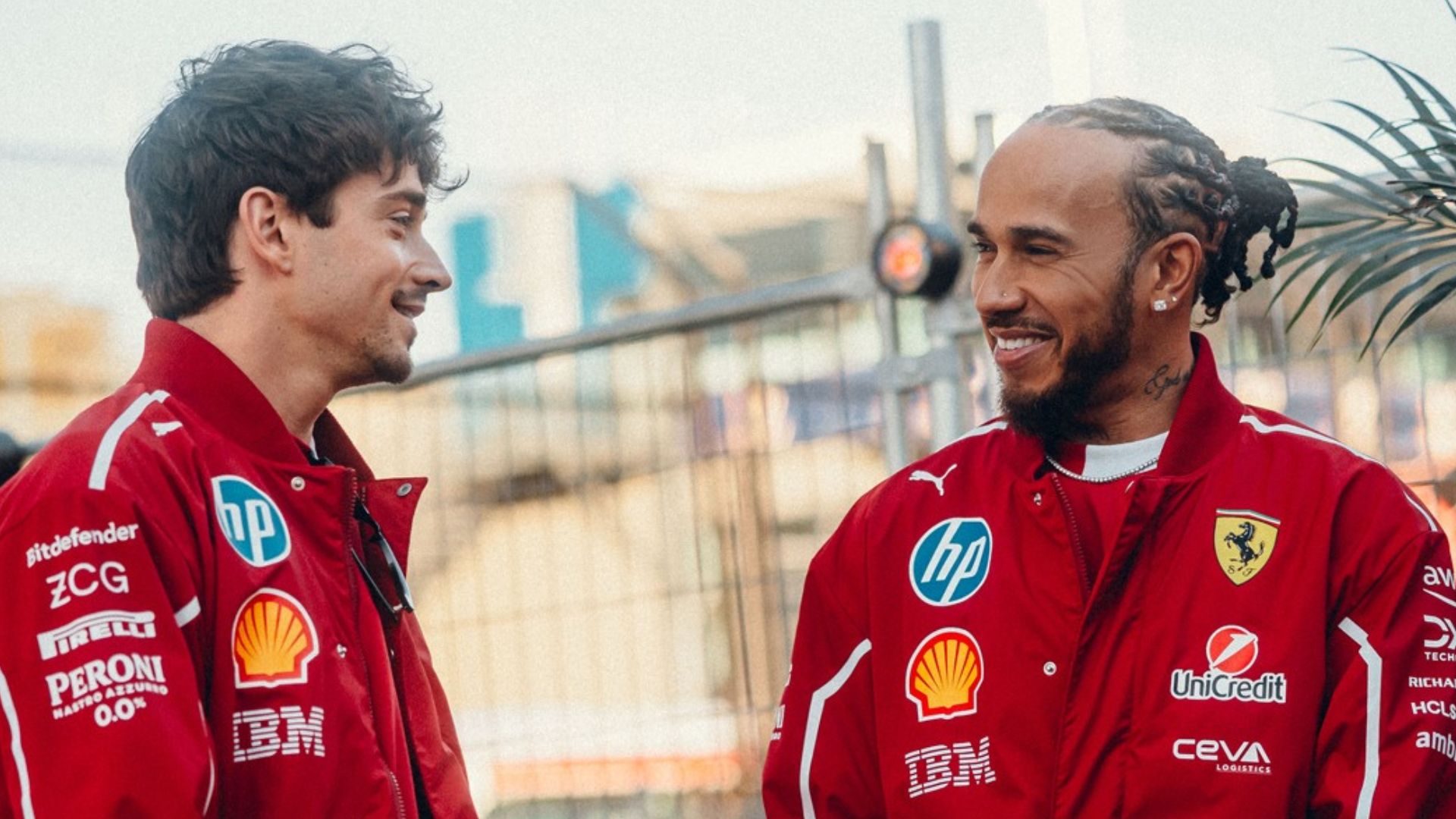
Image via Scuderia Ferrari HP/Facebook
Silverstone didn’t need much help manufacturing drama this year, but the 2026 British Grand Prix weekend still found a way to overdeliver. Round 9 crammed a full sprint format, a scary front-wing moment in qualifying, a LEGO-themed drivers’ parade, and a race that ended under a safety car into three days, and by the time the checkered flag fell, almost nothing about the result matched how the weekend started. Charles Leclerc won it. Kimi Antonelli lost the plot, his car, and a chunk of his championship cushion. And Max Verstappen turned a one-off qualifying crash from two weeks earlier into a worrying pattern.
Here’s the full rundown of what happened at Silverstone, session by session, and why the fallout matters more than the trophy suggests.
Practice: One Session, Then Locked In
Because Silverstone was a sprint weekend, teams only got a single hour of practice on Friday morning before parc ferme regulations froze setup changes for the rest of the event. Lewis Hamilton topped that lone session for Ferrari, a tenth clear of Antonelli’s Mercedes and six tenths up on teammate Leclerc, with all 22 cars on track and running representative long-run programs rather than sprint-focused low-fuel laps.
That single-hour window matters more than it sounds. With no FP2 or FP3 to fix a bad balance, whatever a team gets wrong on Friday morning tends to follow it through Sprint Qualifying, the Sprint itself, and into Saturday afternoon’s Qualifying session. Teams that guess wrong on setup are stuck living with the consequences for the rest of the weekend.
Sprint Qualifying and the Sprint: Antonelli Finally Breaks Through
Hamilton backed up his practice pace by taking Sprint Qualifying pole by a scarcely believable 0.011 seconds over Antonelli, with Verstappen third. But the story flipped once the Sprint itself got going on Saturday morning. Hamilton held the lead into Turn 1 by squeezing Antonelli toward the pit wall, and the Mercedes driver then spent seven laps sitting in his mirrors before finally completing the move at the Hangar Straight on Lap 8 using the manual override “Boost” mode, the push-to-pass-style energy deployment system that’s become one of the more talked-about additions under F1’s 2026 power unit regulations. From there Antonelli drove off to his first career Sprint win.
Lando Norris held off George Russell for third, Leclerc came home fifth, and Verstappen recovered from a scrappy Sprint Qualifying to salvage sixth. Further back, Alex Albon’s Williams started the Sprint from the pit lane after his team altered the car’s suspension under parc ferme conditions without sign-off from the FIA’s Technical Delegate, an increasingly common headache now that sprint weekends leave so little practice time to sort mechanical issues before setups get frozen. Sergio Perez picked up a 10-second penalty for collecting Fernando Alonso, and Nico Hulkenberg was penalized for gaining an advantage off track.
Qualifying: Antonelli’s Fifth Pole, and a Near-Miss for Russell
Saturday afternoon’s Qualifying for the Grand Prix itself belonged to Antonelli again, the championship leader claiming his fifth pole of the season by 0.175 seconds over Leclerc, with Hamilton third. Russell, his own teammate, could only manage fourth after a genuinely hairy moment in Q1: he locked up at Luffield, slid through the gravel trap and clipped the barrier hard enough with his front wing that Mercedes had to perform a hasty nose change to get him back out in time to progress. It cost him track time he badly needed against a red-hot teammate.
Grid penalties reshuffled the back of the order ahead of Sunday. Pierre Gasly dropped three places for impeding Lance Stroll in Q1, while Stroll himself picked up a 10-place penalty for exceeding his season’s power unit component allocation, though since he’d already qualified last on the road, it only cost him one further position. Both penalties are a useful reminder of how F1’s component allocation rules actually work: parts like the turbocharger, MGU-K and battery are rationed across the season, and going even one over the limit triggers an automatic grid drop, regardless of how minor the swap is or how far down the order the driver started.
Sunday’s Drivers’ Parade Came With a LEGO Twist
Ahead of the race, Silverstone hosted its traditional drivers’ parade, this year built around a fleet of LEGO-branded minicars ferrying the grid past the crowd. The gimmick had already generated its own subplot in the build-up, with plenty of speculation over whether Hamilton would actually climb into a brick-built kart in front of his home crowd. Whatever reservations existed didn’t stop the parade from going ahead as scheduled, though it’s safe to say nobody was still thinking about toy cars two hours later once the race itself descended into chaos.
The Race: Two Safety Car Periods, A Broken Mercedes, and Another Verstappen Crash
All 22 cars started the 52-lap race on medium tires, with Pirelli expecting a one-stop strategy to dominate the afternoon. Leclerc made the better of the two Ferrari launches, jumping both Hamilton and Antonelli off the line, while Hamilton also squeezed ahead of the pole-sitter into Turn 1. Antonelli spent the next 11 laps stuck behind Hamilton before finally reclaiming second at Copse, then set off in pursuit of his teammate’s teammate up the road.
Hamilton’s afternoon unraveled from there. He was handed a five-second penalty for jumping the start, served during his first pit stop, and later in the race was flagged for a separate yellow-flag infringement at Turn 9. Both incidents reflect how tightly F1 now polices race starts and yellow-flag compliance using telemetry and start-line sensors rather than relying purely on stewards watching a monitor. Elsewhere, Williams’ Alex Albon was hit with a 10-second penalty of his own after tagging Oliver Bearman’s Haas at Brooklands on the opening lap, sending both cars off track and into the pits for repairs.
Up front, Antonelli’s championship-leading weekend came apart in the space of a few laps. Running second and hunting down Leclerc, the Mercedes driver reported a handling issue on Lap 41 that the team diagnosed as a failed left-front wheel shield, the aerodynamic bodywork panel that manages airflow around the front wheel and brake assembly. A part change and a second stop dropped him from the podium fight to tenth, and a five-second penalty for exceeding track limits while managing the ailing car later demoted him to a final classification of 16th, a brutal swing for a driver who had looked unbeatable all weekend.
Then came the moment that decided the race. On Lap 48, running third and still in podium contention, Verstappen speared off into the gravel at Stowe, triggering a Safety Car that never got the chance to go green again before the finish. The Red Bull driver later attributed the spin to the same rear-wing closure fault that ended his qualifying session at the previous round in Austria: when the wing fails to close fully at speed, the car loses rear downforce abruptly and snaps into a spin. Asked about the recurrence, he didn’t hide his frustration. “It’s just painful, frustrating,” he said. With the race finishing behind the Safety Car, Russell’s decision to stay out on track while both Ferraris pitted allowed him to leapfrog Hamilton for second, leaving Leclerc to cruise home for his ninth career win and his first at Silverstone, with Russell and Hamilton completing the podium.
What It Means: The Championship Math Just Got Messier
Leclerc’s win didn’t actually improve his title position, because he’d fallen so far behind earlier in the season; he’s still fourth in the standings on 108 points, well adrift of the Mercedes pair. What it does change is the psychological picture atop the field. Antonelli still leads on 179 points, but a scoreless weekend that started with pole and a Sprint win trimmed his cushion over Russell to just 25 points, with Hamilton a further seven back on 147. A championship that looked like a procession a month ago now has three drivers from two teams within striking distance of each other, and Mercedes has to manage an intra-team fight at the same time it tries to hold off a resurgent Ferrari and a Red Bull that, reliability issues aside, has genuine race pace.
It’s also worth noting how differently this era of F1 distributes bad luck compared to a decade ago. Antonelli’s wheel shield failure and Verstappen’s wing fault are both symptomatic of a regulation set still in its first season, where teams are pushing new aerodynamic and power-unit concepts closer to their structural and control-system limits than they would in a mature rules cycle. Silverstone’s high-speed corners, Stowe and Copse especially, are brutally unforgiving of exactly these kinds of marginal failures.
The Technical Story: Red Bull’s Rear Wing Problem Is Now A Pattern, Not An Incident
One retirement from a mechanical fault is misfortune. Two identical failures in consecutive qualifying and race sessions, at two different circuits, is a design or manufacturing problem that Red Bull needs to solve before it costs Verstappen more than points. The rear wing on a 2026-spec car isn’t just a fixed aerodynamic surface; it’s an active component that opens and closes as part of the new manual override and drag-reduction systems mandated for this rules era, and a wing that doesn’t fully close at speed sheds downforce asymmetrically and violently rather than gradually. That’s a fundamentally different failure mode than a simple mechanical breakage, and it explains why both incidents ended in an instant, uncontrollable spin rather than a slow puncture-style off.
For Red Bull, the fix isn’t simple. It likely means auditing the actuator, the locking mechanism, or the control software governing wing deployment across the whole system, not just swapping a part on Verstappen’s specific chassis. Until that happens, every lap he spends deploying the wing at high speed carries a rerun risk of Silverstone and Austria, which is a brutal position for a four-time champion who is already 103 points off the championship lead.
Next Up: Spa
The grid gets a rare weekend off before the championship resumes at the Belgian Grand Prix on July 17-19, a fast, high-downforce-sensitive layout at Spa-Francorchamps that tends to punish exactly the kind of aerodynamic instability Red Bull is currently fighting. Ferrari, meanwhile, will want answers on Hamilton’s wildly inconsistent form since his Barcelona win, and Mercedes has three weeks to figure out how to manage a title fight that’s now happening entirely inside its own garage.
About the Author