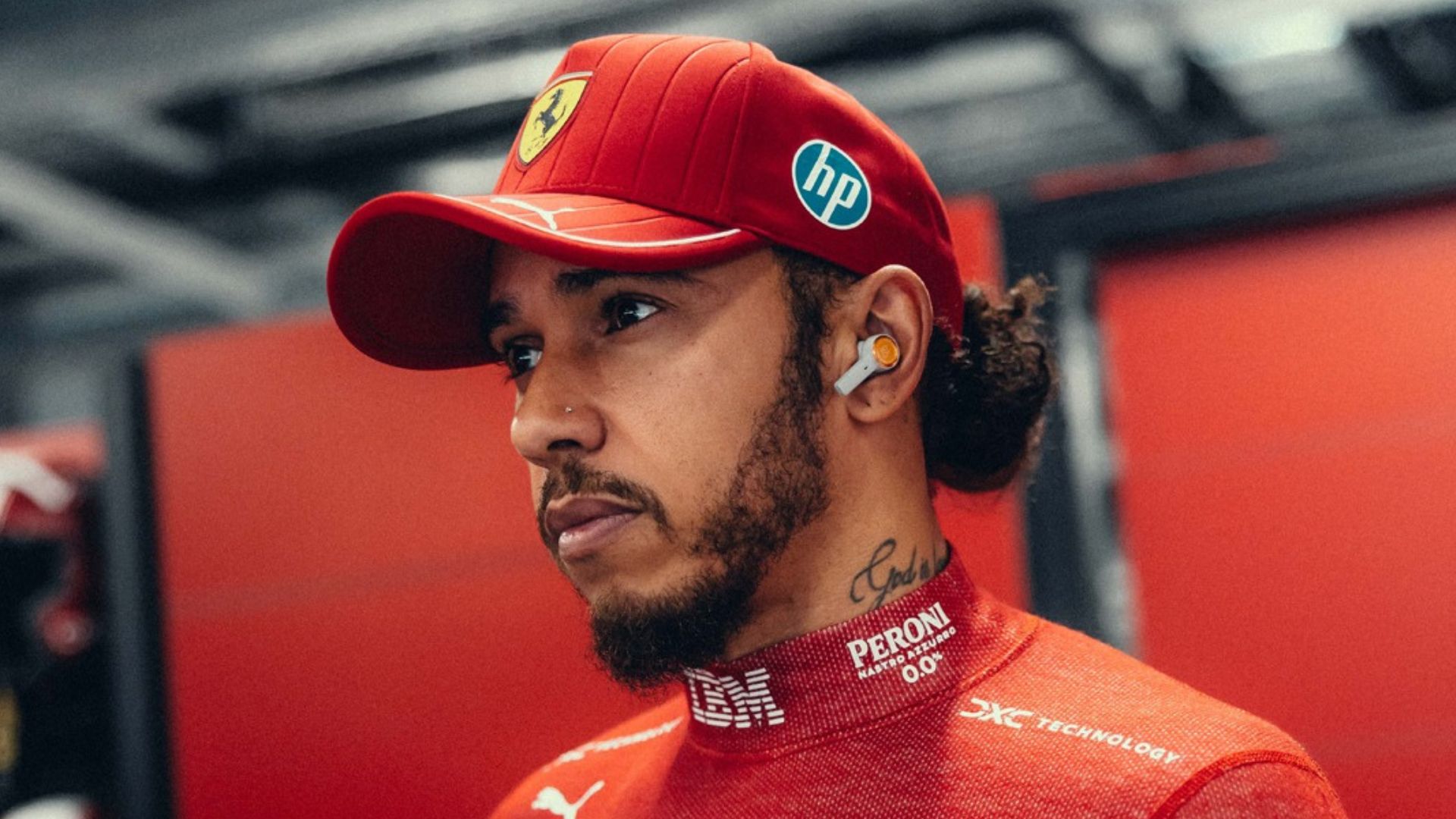
Image via Scuderia Ferrari HP
Formula 1 rolled back into Silverstone this week with a second helping of its Lego publicity stunt, and one of the sport’s biggest stars immediately threw a wrench into the plan. Lewis Hamilton spent Thursday’s press conference making it very clear he isn’t thrilled about climbing into a go-kart made of plastic bricks in front of a reported 175,000 fans, and by his own admission, he still hasn’t decided whether he’s doing it at all.
According to the Press Association, Hamilton and several other drivers have quiet financial gripes about being asked to pilot the sponsor-branded karts around the circuit, but he was the only one willing to say so out loud. F1 announced Thursday morning that all 22 drivers would take the wheel roughly 90 minutes before the race. A few hours later, Hamilton was overheard telling former teammate Valtteri Bottas, off mic, that he simply wasn’t going to do it.
Hamilton didn’t hide behind vague scheduling excuses when reporters pushed him on it. Referencing last year’s version of the stunt at the Miami Grand Prix, where he let Charles Leclerc take the controls of their shared two-seat build, he called it “the most dangerous part of the weekend.” Asked directly whether fear of injury was the real issue, the seven-time champion shut the question down, saying it was something he needed to work out privately rather than in front of a room full of cameras.
It’s worth being a little skeptical about the framing here. The PA’s reporting points to appearance-fee friction as the actual root of the standoff, with safety concerns serving as the more press-friendly explanation. That’s not a knock on Hamilton so much as a reminder of how these manufacturer activations work: drivers are contractually obligated to show up for promotional duties, but the fine print on who gets paid what for a made-for-social-media parade lap is negotiated separately from race weekend duties, and apparently not everyone is happy with their cut this time around.
Ferrari, for its part, doesn’t seem worried. The team posted a photo of Hamilton’s custom-liveried kart on social media, playfully bracing fans for another round of chaos on Sunday, and insiders indicate the team fully expects him to climb in when the moment comes. F1 officials are reportedly planning a separate conversation with Hamilton about his comments, which suggests this is less a throwaway joke and more a genuine bit of paddock friction heading into the weekend.
Here’s what actually gets built for one of these things, because the engineering is more serious than the marketing photos let on. Each of the 22 minicars is a single-seat go-kart built around a steel structural frame, then clad in more than 28,000 Lego bricks arranged to mimic each team’s 2026 livery, according to Lego’s official release. The finished kart weighs roughly 280 kilograms, with about 65 kilograms of that being bricks alone, and it rides on standard go-kart wheels rather than anything plastic. Top speed is capped at 25 km/h, or about 15.5 mph. Lego says 20 designers, engineers and builders spent a combined 6,400 hours putting the fleet together at the company’s Kladno factory in the Czech Republic.
That weight matters more than the toylike branding suggests. A current F1 car with driver tips the scales around 800 kilograms, so these karts aren’t far off a third of that mass while carrying a single occupant at low speed. Fifteen miles an hour sounds tame until you remember that’s still enough kinetic energy to hurt someone if a quarter-ton go-kart clips another one sideways, which is exactly what turned last year’s Miami version into a highlight reel of drivers plowing into each other.
Miami is precisely why this year’s version looks so different. That 2025 debut paired teammates in ten shared two-seat builds, each made from close to 400,000 bricks and limited to roughly 20 km/h. Lego’s own recap of the event describes the results as a lap of unmistakable chaos, and the reaction from both drivers and fans was apparently enthusiastic enough that Lego and F1 redesigned the whole concept into individual karts for every driver this time around, according to the company’s Chief Product and Marketing Officer.
There’s a real liability angle buried under the jokes, too. Most F1 driver contracts already restrict personal activities like skiing or riding motorcycles specifically to protect a team’s investment in its driver during a season, and a scripted, cameras-rolling promotional stunt is a strange item to leave off that list. If a title contender broke a wrist bumper-karting for a sponsor two days before a Grand Prix, that’s a public relations problem for everyone involved, not just the driver, which likely explains why F1 wants a word with Hamilton rather than shrugging the comments off.
The timing adds some weight to Hamilton’s reluctance. He arrives at Silverstone, a track where he’s won a record nine times and stood on the podium fourteen times, sitting 46 points behind championship leader Kimi Antonelli after finally picking up his first win in Ferrari red at Barcelona in June. Nobody wins a title by getting banged up in a novelty kart, however slow it’s geared to go.
The parade is scheduled for 1 p.m. local time Sunday, ahead of the main race, and F1 plans to stream it live on its YouTube channel. Whether Hamilton actually straps into his brick-built kart or watches from the sidelines, the bigger story is how far Formula 1 and Lego are willing to push this partnership as a fan-engagement tool, and how quickly a lighthearted marketing stunt can turn into a genuine behind-the-scenes negotiation once real money and a championship campaign are on the line.
About the Author