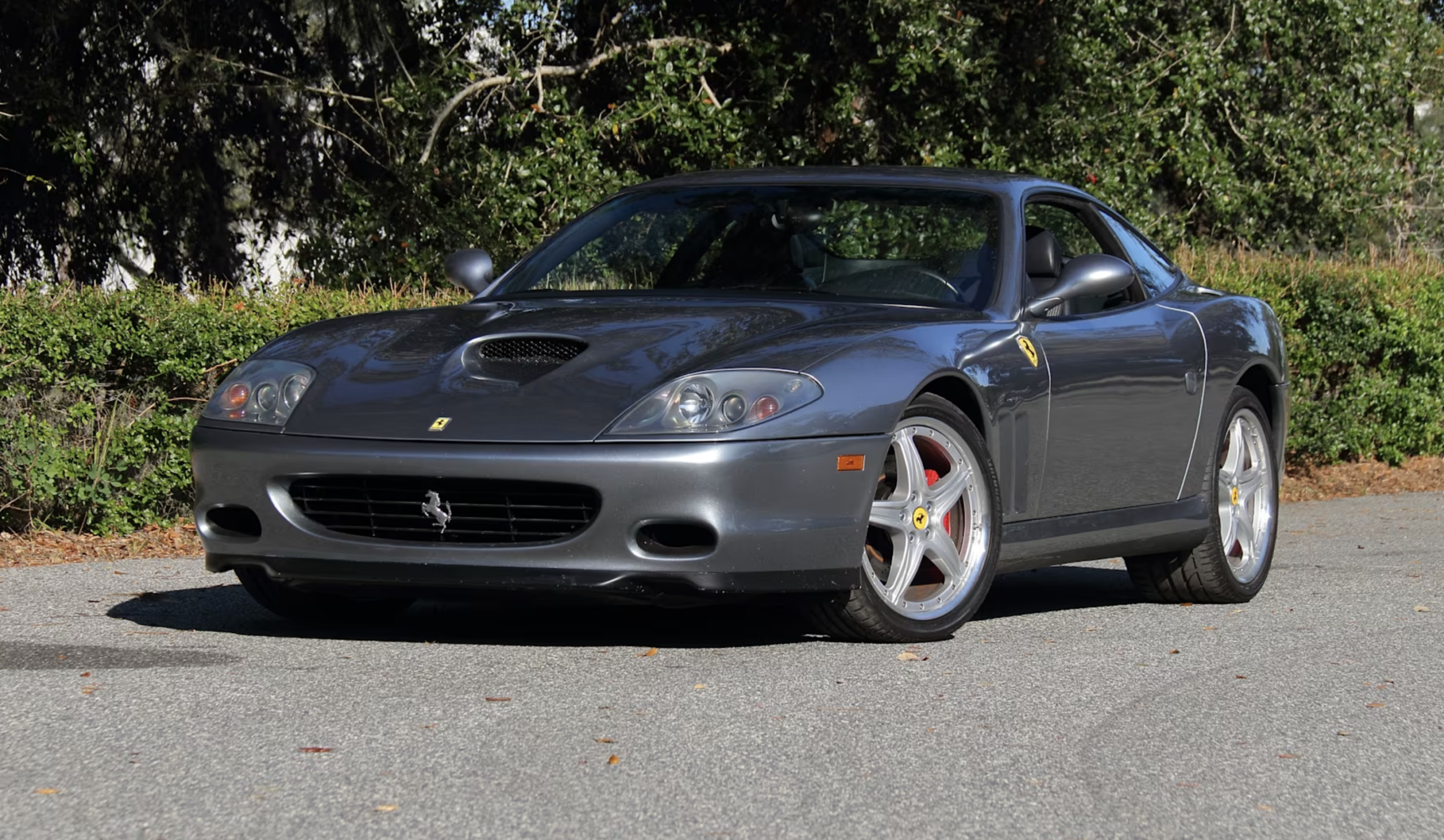
A 2003 Ferrari 575M Maranello returned to Mecum four times after a reported $120,000 sale. Its public auction history offers a lesson in reserves, presentation, and repeated exposure.
One trip across the auction block can establish a car’s value. Five trips in 14 months can complicate it.
That appears to be what happened to a 2003 Ferrari 575M Maranello identified by VIN ZFFBV55A830130820. The front-engine V-12 grand tourer sold at Mecum Glendale in April 2023 for a reported $120,000. It then returned to four Mecum events during the first five months of 2024, failing to sell each time.
The car itself seemingly changed very little. The audience’s response did.
According to auction records compiled by CLASSIC.com, bidding reached a reported $100,000 at Kissimmee, fell to $60,000 at Glendale, and later recovered to $85,000 at Indianapolis. The available Houston record confirms another no-sale but does not disclose a final bid.
That does not necessarily mean the Ferrari lost half its value. It does show what can happen when a recognizable car keeps returning to the same auction circuit without giving bidders an obvious new reason to reconsider it.
One Sale, Followed by Four No-Sales
The Ferrari’s documented auction timeline begins at Mecum Glendale on April 1, 2023, where it sold for a reported $120,000.
Nine months later, the same VIN appeared at Mecum Kissimmee. Bidding reportedly stopped at $100,000, and the car did not sell.
Its next stop was Mecum Glendale in March 2024, almost exactly one year after its successful appearance at the same venue. This time, the reported high bid was $60,000.
Less than a month later, it surfaced as Lot S174 at Mecum Houston. Mecum’s surviving listing shows 29,984 miles and identifies it as part of the auction company’s “Bid Goes On” inventory, indicating that it left the block without a completed sale during the live auction.
The fifth appearance came at Mecum Indianapolis on May 18, 2024. There, the Ferrari reportedly attracted an $85,000 high bid but again failed to sell.
| Date | Auction | Reported result |
|---|---|---|
| April 1, 2023 | Mecum Glendale | Sold — $120,000 |
| January 11, 2024 | Mecum Kissimmee | Not sold — $100,000 high bid |
| March 9, 2024 | Mecum Glendale | Not sold — $60,000 high bid |
| April 6, 2024 | Mecum Houston | Not sold — bid undisclosed |
| May 18, 2024 | Mecum Indianapolis | Not sold — $85,000 high bid |
The public records do not establish the seller’s net proceeds from the 2023 transaction, the reserve used at any later appearance, or whether the same consignor controlled every offering. Those unknowns matter, and they limit how confidently anyone can interpret the results.
What the record does establish is that the car changed hands after its first appearance and did not sell during its next four trips across the block.
The 575M’s Two-Tier Market
Introduced in 2002, the 575M was an updated evolution of the 550 Maranello. Its naturally aspirated 5.7-liter V-12 produced 515 metric horsepower, and buyers could choose between a traditional gated six-speed manual and Ferrari’s six-speed F1 automated-manual transmission.
That distinction matters enormously today.
Manual 575Ms have become genuinely scarce collector cars. F1-equipped examples are substantially more common, and the market prices the two versions accordingly. CLASSIC.com currently places its market benchmark for a manual 575M at approximately $308,000, compared with about $116,000 for an F1-equipped example.
The auction listings describe this particular car as an “automatic,” but that is imprecise. The 575M’s F1 unit is a single-clutch automated manual operated by paddles, not a conventional torque-converter automatic. It delivered exotic technology when new, but it has not acquired the collector cachet of Ferrari’s open-gate manual.
That left this approximately 30,000-mile example in a crowded middle ground. It had a desirable naturally aspirated V-12 and classic Pininfarina proportions, but not the transmission that commands the largest premium. Its mileage was usable rather than extraordinarily low.
The surviving public descriptions also provide little information about recent service, clutch wear, ownership history or supporting documentation. That does not mean such records did not exist. It means bidders reviewing the archived material today cannot see evidence that the car was differentiated through them.
None of those points makes it a bad Ferrari. They make it a car that depends heavily on price, condition and documentation.
Was $120,000 Ever the Repeatable Number?
The easiest conclusion would be that the Ferrari sold for $120,000 and then rapidly lost value. The evidence does not support such a clean verdict.
A single auction result reflects the specific bidders in the room on a particular day. It does not create a guaranteed price for the car’s next appearance. Taxes, auction fees, transportation, preparation and maintenance can also increase the amount an owner needs from a later sale, even if the underlying market has barely moved.
The four later auctions were not identical tests. Kissimmee, Glendale, Houston and Indianapolis attract different bidders and different mixes of inventory. Lot placement, competing consignments and the pace of the room can all affect a result.
The $100,000 Kissimmee bid nevertheless deserves attention. It came closest to the previous reported sale and sat reasonably near the broader benchmark for F1-equipped 575Ms. Because the reserve was not disclosed, however, the public record cannot tell us how far apart buyer and seller actually were.
The $60,000 Glendale bid looks dramatic, but a high bid on an unsold lot is not necessarily a reliable appraisal. Bidding may stall early when participants believe the reserve is out of reach. A thinly attended bidding contest can also produce a number well below what another venue or format might achieve.
Indianapolis brought a partial recovery to $85,000, but still no sale. Houston adds another unsuccessful appearance without a publicly available bid amount.
The numbers are evidence of four unsuccessful auction attempts. They are not proof that the car’s fair value moved from $120,000 to $60,000 and then back to $85,000.
The Cost of Becoming Familiar
Repeated exposure can create its own problem.
When a car returns quickly, bidders begin asking questions that have little to do with horsepower or production figures. Why is it back? Why did it fail to sell last time? Is the reserve reachable? Will it simply appear at another event if they decline to bid today?
Those questions do not establish that anything was wrong with this Ferrari. The available records do not demonstrate a mechanical defect, title problem, accident history or undisclosed condition issue.
They do illustrate how uncertainty can accumulate around a repeatedly offered car.
Scarcity encourages urgency. Familiarity can do the opposite.
The presentation preserved in the Houston listing may also have left prospective buyers with work to do. It supplies the VIN, mileage, basic configuration and 35 photographs, but offers little detail about service history, clutch condition or recent mechanical work.
Those subjects matter on an aging Ferrari equipped with a V-12 and an electrohydraulic transmission system. A 575M supported by detailed invoices, a recent inspection and current clutch-life information is easier to evaluate than one presented primarily through its model, mileage and photographs.
The records may have been available to bidders at the time. The surviving online listing simply does not tell us.
What This Ferrari Actually Teaches
This 575M’s history is not a verdict on the model, the auction house or the unidentified sellers involved. Too much remains unknown for that.
It is instead a lesson about the difference between an auction result and a durable market value.
The reported $120,000 sale in April 2023 proved that the car could bring that amount under one particular set of circumstances. The four later no-sales proved that the result could not be readily repeated at the recorded reserves, whatever those reserves may have been.
A different venue, a more detailed presentation, newly completed service or a lower reserve might have changed the outcome. So might a different day with two determined bidders. Without access to the consignors, reserve agreements and inspection records, those possibilities must remain possibilities rather than conclusions.
That uncertainty is part of the story.
By its fifth appearance, bidders were no longer evaluating an unfamiliar 575M. They were evaluating a Ferrari with a visible trail: one sale, three previous no-sales and another trip across the block.
The car had not stopped being a 515-horsepower, front-engine Ferrari V-12 grand tourer. But its auction history had become part of its specification.
And unlike mileage, color or transmission, that history grew every time the car failed to sell.
Sources: Mecum Houston listing, CLASSIC.com VIN history, Ferrari 575M specifications, and CLASSIC.com 575M market data.
About the Author