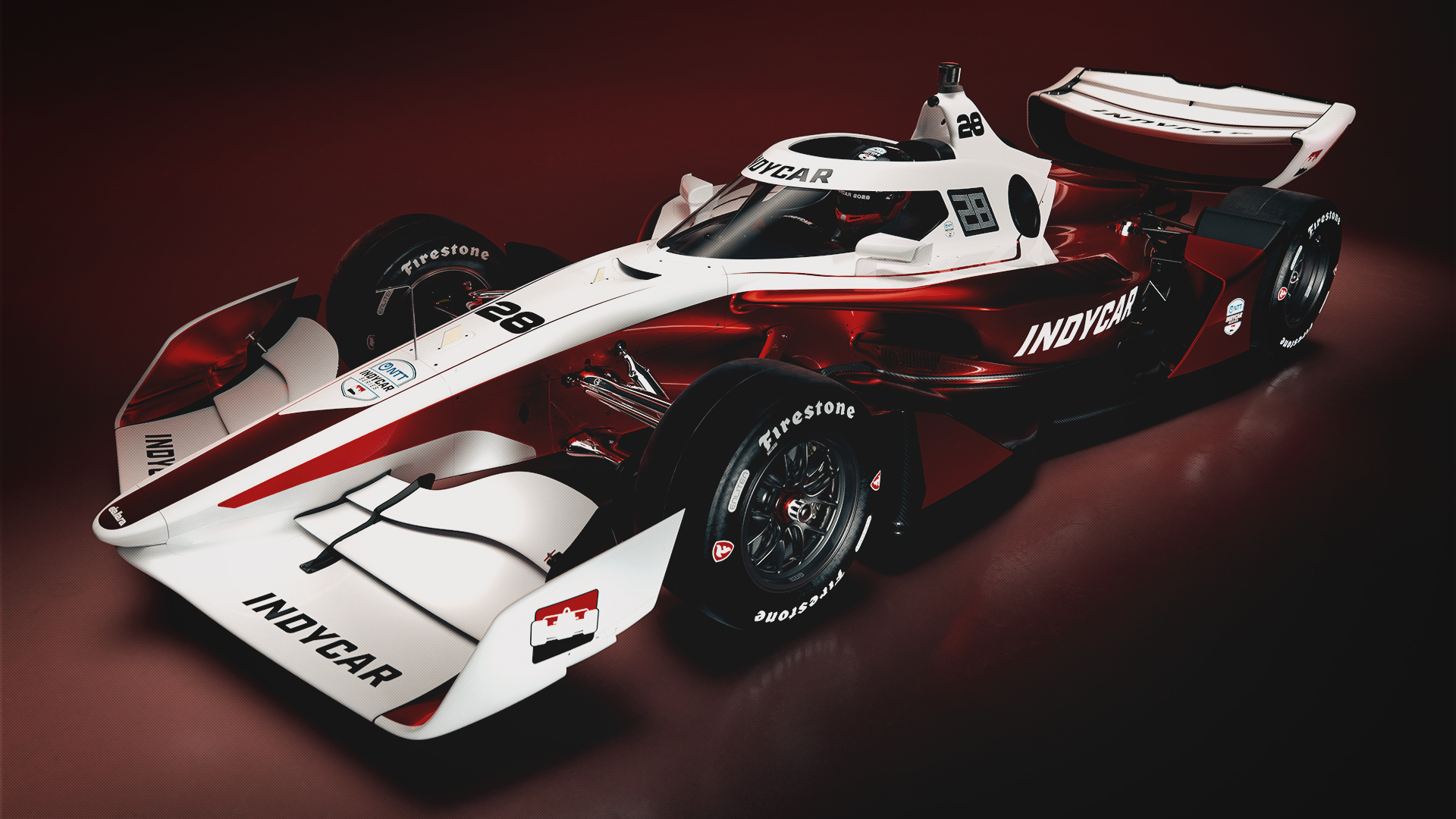
IndyCar pulled the wraps off the car it says will define the series starting in 2028, and it did so with all the trimmings: slick renderings, a reveal video narrated by Matt Damon, and a new three-letter designation to memorize – IR-28. That is a lot of polish for a car that has not turned a lap yet. Actual on-track testing of the new Dallara-built chassis was scheduled to begin the same week as the unveiling, which is worth remembering the next time a glossy reveal video tries to sell lap-time promises that have not touched pavement.
That said, once you get past the studio lighting, there is a genuinely interesting engineering story buried in the spec sheet, and it has less to do with the bodywork than with what is stuffed inside it.
Same Partners, Bigger Swing
IndyCar did not blow up its supplier list to build the IR-28. Dallara remains the chassis builder, continuing a partnership that stretches back more than a decade. Chevrolet and Honda are still supplying engines, Firestone is still on tires, and Shell is still providing fuel. What changed is the scope of what those partners were asked to deliver: a chassis roughly 100 pounds lighter than the current car, a gearbox from Xtrac that sheds 25 pounds, and a hybrid unit about 20 pounds lighter than the system it replaces. None of that is a redesign for the sake of a redesign. Every pound removed from a spec-series car has to be justified against cost caps, crash certification, and sign-off from two separate engine manufacturers, which is a slower and far more political process than an aftermarket shop swapping in a carbon fiber panel.
The Suspension Detail Worth Knowing About
Buried well past the headline renderings is the introduction of what IndyCar calls the Custom AXIS Inertance Control Suspension System, built around a shared damping architecture that adds inerters into the mix, devices that resist relative acceleration between two points, acting more like a flywheel wired into the suspension than a traditional spring or damper. Formula 1 has used third-element inertance devices for well over a decade, but typically restricts how heavily and where teams can lean on them. IndyCar says its version permits both front and rear third-element inertance systems, a first among major open-wheel championships by its own account. In practical terms, that hands engineers another independent way to manage mechanical grip without leaning as hard on aerodynamic downforce, which matters on a car that is also being asked to produce closer racing in traffic.
IndyCar’s First Real Battery
The more consequential change might be under the bodywork rather than on it. The IR-28’s hybrid system swaps the supercapacitor-based energy storage IndyCar has run since hybrid assist arrived, in favor of a battery-based Energy Storage System supplied by BOLD Technology, a company that also builds battery systems for Formula 1 and aerospace programs. IndyCar says the new unit holds roughly 14 times the energy capacity of the outgoing supercapacitor setup. Supercapacitors are excellent at dumping and absorbing energy almost instantly, but they hold very little of it. A proper battery trades some of that instant responsiveness for dramatically more usable capacity, which should give teams far more flexibility in when and how they deploy hybrid boost during a run instead of being limited to short, frequent bursts. UK-based Helix is engineering the broader hybrid package, which stays tucked inside the bellhousing between the engine and gearbox, the same basic packaging approach IndyCar has used since hybrid assist arrived, just with a different chemistry doing the storage work now. For race teams, a battery-based system also brings new handling and safety protocols that never existed with supercapacitors, from thermal monitoring to post-incident procedures, which is a quieter but very real cost of admission that does not show up in a rendering.
Aero Built to Let Cars Actually Follow Each Other
Visually, the IR-28 keeps IndyCar’s proportions recognizable while sharpening nearly every panel around them. The front and rear wings come in two distinct flavors: a road and street course package built for an aggressive stance, and a superspeedway package tuned to shed drag while still generating enough downforce to hold the car flat at high speed. IndyCar says the aerodynamic architecture was purpose-built to manage the wake coming off a leading car, reducing outwash so a trailing car is not fighting as much disturbed air in traffic, a problem that has dogged open-wheel racing long before anyone had a catchy name for it. A more aerodynamically stable front wing specifically tuned for Indianapolis Motor Speedway hints at a very particular number IndyCar may be chasing: the one-lap and four-lap qualifying records at IMS, both of which have belonged to Arie Luyendyk since 1996. Nearly three decades without a broken qualifying record at the Speedway says a lot about how conservatively IndyCar has managed speeds there for safety reasons, so any hint that this car was built with those records in mind is worth watching once real numbers start showing up in testing.
The aeroscreen, the curved canopy that has protected IndyCar drivers’ heads since its introduction in 2020, gets lighter and more aerodynamically integrated rather than reinvented, giving the car a sharper, fighter-jet profile without walking back the protection that arrived after a run of serious cockpit injuries pushed the series toward canopy-style safety in the first place.
Safety and Cockpit Changes You Won’t See in a Photo
Some of the more meaningful updates barely photograph at all. The cockpit is wider to fit a broader range of driver heights and body types, addressing a fit complaint that has followed spec-chassis racing for years. Internal airflow and cooling are improved, side-impact structures are stronger and more efficient at absorbing energy, and engineers say the chassis behaves more predictably in nose-up, sliding, or spinning incidents, the kind of crash dynamics that never make a highlight reel but matter enormously when something does go wrong. Electronically controlled, driver-adjustable anti-roll bars also clean up the cockpit by removing physical knobs and handles, which sounds like a minor ergonomic tweak until you consider that fewer hard protrusions near a driver’s hands and legs is its own quiet safety upgrade in a crash.
What the Drivers Are Actually Saying
Reigning points leader Alex Palou, who has spent this season extending his championship lead while also making headlines off track over his contract fight with McLaren, said seeing the car in person only added to his excitement about where the series is headed. Alexander Rossi and Felix Rosenqvist both singled out the extra cockpit room as an immediate, tangible improvement, with Rosenqvist adding that the car still carries recognizable IndyCar DNA despite the overhaul. INDYCAR president Doug Boles summed up the entire program bluntly: “We are confident the IR-28 is the ideal package to move INDYCAR forward.”
Why the Business Model Behind This Matters
IndyCar leans on a leased, spec-chassis structure rather than the constructor-built cars of Formula 1 or the increasingly valuable charter system reshaping NASCAR team ownership. That distinction matters here: teams are not designing the IR-28, they are buying into it, which keeps costs more predictable but also means every gram and every dollar of this program had to clear Dallara, two engine manufacturers, and IndyCar’s own competition department before it ever reached a rendering. It is a very different economic model than the one turning NASCAR ownership into an appreciating asset, and it is part of why IndyCar can promise a lighter, more advanced car without touching off the kind of manufacturer bidding war that reshapes budgets elsewhere in racing.
Initial testing on the IR-28 begins this week across multiple circuits, including the Indianapolis Motor Speedway road course and oval and Sebring International Raceway, with the car’s competitive debut still set for the 2028 season opener. Everything above reads well on paper. Whether it translates into the closer racing and record-setting speeds IndyCar is promising will depend entirely on what the timing sheets say once the renderings stop mattering and the stopwatch starts, and it will be worth watching against the backdrop of a 2026 season that has already delivered plenty of its own storylines across every major series racing this summer.
About the Author