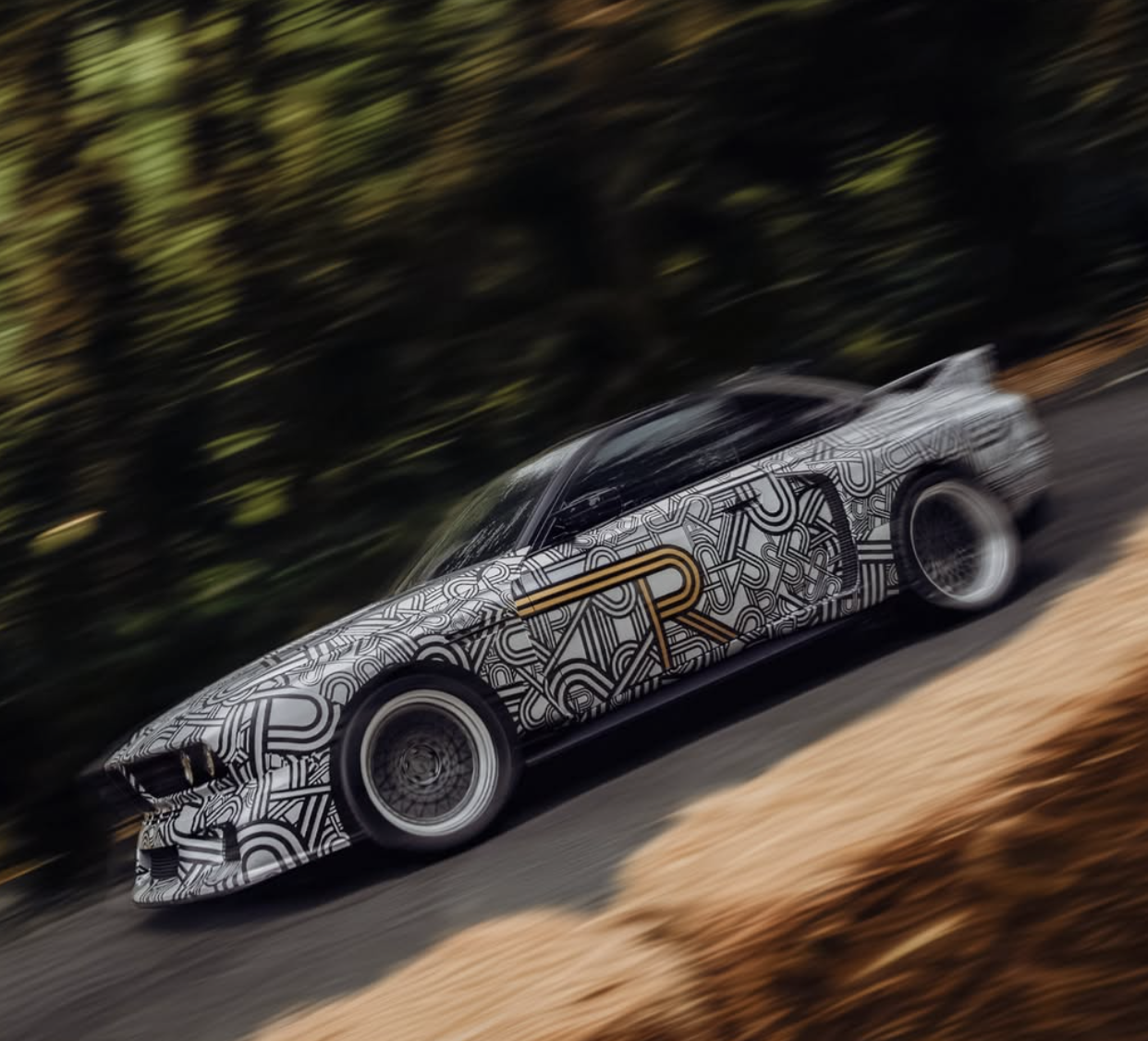
A small Italian outfit called Riverti Automobili is teasing a coachbuilt car based on the current G87 BMW M2, re-skinned to channel the 3.0 CSL of the early 1970s. The teasers show the key ingredients: a shark nose, round quad headlights, bulging arches and a big rear wing.
There’s no name, price, production count or powertrain spec yet. What exists is a running prototype that turned up at this month’s Tutto Bene event on Italy’s Mottarone hill climb, which BMW M says took place on 9 September 2026 above Lake Maggiore. Tutto Bene is a nine-kilometer climb up the Strada Borromea, a sensible place to show a car that you want people to believe is real.
Why the CSL is such a big target
The E9-based 3.0 CSL was a homologation special, built so BMW could go touring-car racing. It won the European Touring Car Championship in its first season, 1973, and then won five more titles in a row from 1975 through 1979.
Related Articles
- One Lane Change, Five Totaled Cars: What a State Street Crash Into a Salt Lake City Audi Lot Will Really Cost
- Red, White, and 9,000 RPM: Hennessey Blackbird Renderings Imagine a Patriotic, Military-Style Hypercar
CSL stood for Coupé, Sport, Leichtbau, and the last word, lightweight, was the whole point. BMW used aluminum doors, hood and trunk lid, thin-gauge steel elsewhere, and swapped the chrome bumpers for plastic. The final road car weighed just 1,270 kilograms, about 2,800 pounds, and its 3,153 cc straight-six made 206 hp.
The famous wing wasn’t road-legal in Germany, so BMW delivered it in the trunk and let owners sort it out. That wing gave the car its “Batmobile” nickname, and regulators have had opinions about this car ever since.
The weight problem nobody can style away
Building a CSL tribute on a modern M2 runs into an obvious problem: the “L” is nearly impossible to honor.
The 2027 M2 with M xDrive has a curb weight of 3,988 pounds. That’s roughly 1,190 pounds more than the original CSL, or about the weight of a Formula Ford hanging off the back bumper. Carbon body panels can trim some of that, but most of the M2’s mass lives in things a coachbuilder doesn’t touch: the steel unibody, the S58 engine, the crash structures, the airbags and the electronics.
The flip side is that the M2 wins the power-to-weight fight by a mile. BMW rates the original CSL at 6.2 kilograms per horsepower. The M2 xDrive works out to 8.4 pounds per hp, about 3.8 kilograms. So the tribute will be heavier than the original and much, much faster.
What’s under the costume
Unless Riverti says otherwise, the donor is a very good car. The current M2’s twin-turbo 2,993 cc straight-six makes 473 hp at 6,250 rpm and 443 lb-ft in US trim. The rear-drive car can still be had with a six-speed manual, which is the obvious pick for anyone chasing 1970s spirit.
BMW now offers the M2 with all-wheel drive for the first time, paired only with the eight-speed automatic. The xDrive car hits 60 mph in 3.6 seconds, 0.3 seconds quicker than the rear-drive version. A CSL homage on an AWD automatic would be quicker and less authentic, so buyers will care which donor Riverti uses.
Donor supply shouldn’t be a problem. BMW says the M2 was its best-selling high-performance model in 2025, and every one comes out of San Luis Potosí, Mexico.
BMW already showed how hard this is
BMW built its own modern 3.0 CSL in 2022 and 2023, on M4 underpinnings rather than M2. It’s a useful benchmark for what “doing it properly” costs.
BMW made exactly 50 numbered cars. Each took up to 10 days to assemble across eight production stations, with a dedicated team of 30 technicians. The paint alone involved 134 separate processes per car. BMW spent around 200 hours on aero development, including 50 in the wind tunnel, and crashed two pre-production cars in frontal and side tests to make the car road-legal.
That’s what a manufacturer with its own crash lab needed to put new bodywork on its own platform. A small coachbuilder is working with far less, and that makes the legal side more important than the wing.
The legal fine print for buyers
In the US: How a re-bodied M2 is regulated depends on when the modification happens. If a certified vehicle is modified before its first retail sale, the modifier becomes an “alterer” and must certify continued compliance with federal safety standards. If the work happens after a customer buys the car, businesses doing the work are barred from “making inoperative” any equipment installed to meet those standards, with civil penalties per violation.
For a CSL-style nose, that means lighting, bumper structures, airbag sensors and driver-assistance hardware all have to keep working as certified. Round quad headlamps are charming, but they also have to be legal lighting equipment.
Related Articles
- A $400,000 GTO Judge Rode Off in a Stolen Trailer in Dayton. Detectives Had It Back Before Lunch.
- Jay Kay’s Former Competition-Spec BMW E30 M3 Heads to Online Auction
In Europe: Body swaps of this scale typically need national inspection and approval before the car can be registered. Ask how Riverti handles that for your market before paying a deposit.
Owning one
- Repairs: A minor parking-lot scrape stops being routine when every exterior panel is bespoke. Expect body repairs to route through the coachbuilder, with long lead times on parts.
- Insurance: Declare the conversion and push for an agreed-value policy. A standard policy will value the car as a used M2, not as a coachbuilt one-off.
- Warranty: The M2’s mechanical warranty may remain intact, but disputes over bodywork, sensors or electrical faults could get messy. Get Riverti’s own warranty terms in writing.
- Resale: Coachbuilt cars can go either way. Small runs from builders that last become collectibles. Orphaned projects become very expensive M2s that nobody can fix.
Why now
BMW has shown there’s demand for nostalgia on this platform. It just launched the US-only M2 Turbo Design Edition, a tribute to the 1970s 2002 turbo with hand-painted stripes and a six-speed manual. Riverti is betting that some buyers want to go much further than stripes.
If the finished car keeps the manual, gets the nose right and has real engineering behind the panels, it could be one of the better BMW-based coachbuilds in years. Until Riverti publishes specs, a price and a homologation plan, though, it’s a promising prototype on a mountain road.
Images Via: Riverti Automobili on Instagram
About the Author