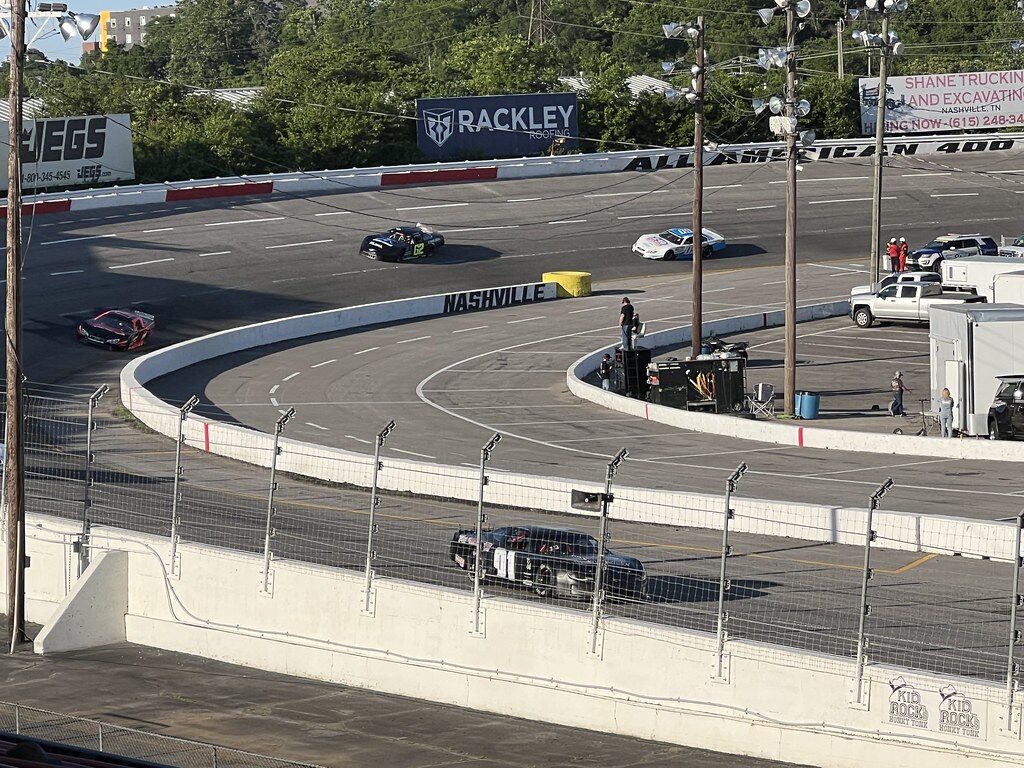
A Pro Late Model races at Nashville Fairgrounds Speedway. Photo via Openverse.
Nashville’s Fairgrounds Speedway has now survived one lawsuit and absorbed a second signature drive aimed at shutting it down for good — and even if the racing question eventually gets decided at the ballot box, Metro Nashville is stuck with a bond bill that doesn’t care how the vote goes.
On September 18, the coalition behind Restore Our Fairgrounds — officially organized as Citizens Against Racetrack Expansion — delivered a petition carrying nearly 75,000 signatures to the Davidson County Election Commission for verification, part of a Metro Charter amendment already filed with the Metro Charter Revision Commission. If certified and eventually approved by voters, the amendment would strip auto racing out of the list of activities the fairgrounds site is legally required to host. It wouldn’t touch the state fair, the flea market, or the expo center. It would, however, clear the way to repurpose the speedway property for green space and housing.
That part of the story is straightforward. What’s easy to miss is that this is the second time in five months this exact fight has landed in front of a judge — and the first time it got thrown out on a technicality that says a lot about how hard Tennessee’s charter process makes it to rewrite the rules by petition.
Round one already failed once
In April 2026, Davidson County Chancellor Patricia Head Moskal reversed the Metropolitan Charter Revision Commission’s certification of an earlier version of this same amendment. Her reasoning had nothing to do with racing or housing. It came down to Metro Charter § 19.03(c)(6), which requires that the subject of a proposed amendment be “clearly expressed in its title.” The rejected petition was titled “Updating the Functions and Duties of the Metropolitan Board of Fair Commissioners” — a title Moskal found gave voters no real notice that the amendment would eliminate racing and introduce housing use on the site. Every other part of the petition survived the challenge: no issues with vague terminology, no conflicts with state law, no problems with how it defined its own terms. The title alone sank it.
That ruling is why September’s filing exists at all. It’s a corrected, retitled version of the same amendment, built to survive the one objection that actually worked. It also means the easiest way to kill this petition a second time is off the table, which makes this round more consequential than the last one.
Nashville already voted on this — in the other direction
The irony is that Nashville voters already used a charter amendment to settle this exact question once, and it went the other way. In August 2011, a citywide referendum passed with more than 70% support, amending the charter to require the fairgrounds to continue hosting its existing activities — racing included. That 2011 amendment is precisely why this fight needs a new charter amendment instead of a simple Metro Council vote: once a use is locked into the charter by referendum, only another referendum can take it back out. Whichever way this one goes, it will be the second time in fifteen years that Nashvillians have reached for the same blunt instrument to try to permanently settle the fairgrounds question, which says plenty about how unsettled it actually still is.

The bond bill doesn’t wait for an election
Here’s the part getting lost in the racing-versus-housing framing: Metro’s financial exposure on this property is already locked in, and it isn’t small. The Fairgrounds Speedway renovation now underway carries a total project cost of roughly $116.3 million — about $96 million in hard construction costs plus $20.3 million in design, financing, and reserve costs. After a $17 million state grant and a $2 million contribution from the Nashville Convention & Visitors Corp, Metro is financing the remaining $97.3 million through 30-year revenue bonds at 5% interest, which the Metro Sports Authority projected would carry annual debt service of roughly $6.3 million. Add a required “make-good” payment to the Fair Board and an escalating replacement reserve fund, and Metro’s total annual carrying cost starts around $7.2 million and climbs toward $7.9 million by year 30.
Bristol Motor Speedway’s parent company, Speedway Motorsports, holds a 30-year lease to operate the renovated track, starting at $850,000 in annual rent and rising 1% a year, plus a share of ticket taxes, sponsorships, and concessions. That revenue stream is what the debt service is counting on. Speedway Motorsports CEO Marcus Smith called the plan a chance to “transform Nashville Fairgrounds Speedway into an amazing multipurpose entertainment destination” when the partnership was first announced. If Nashville votes to strip racing out of the charter after the bonds are sold and the track is rebuilt, those bonds don’t disappear — Metro would still owe roughly $6.3 million a year on a facility that just lost the tenant expected to help cover it. Neither side of the petition fight is running that math out loud yet, but whoever wins this vote inherits it.
What actually gets erased if this passes
Fairgrounds Speedway isn’t just old — it’s arguably the second-oldest operating motor speedway in the country, with automobile racing on the site dating back to 1904, on an oval that started life in 1891 as Cumberland Park’s horse-racing track and became the Tennessee State Fair’s home two years after cars first ran there. NASCAR’s premier series raced there from 1958 to 1984, a 26-year run on a tight .596-mile bullring where Richard Petty won six times and Chevrolet took ten manufacturer victories. That history is a big part of why Speedway Motorsports wanted back in, and it’s the same instinct that led NASCAR to spend years bringing racing back to a similarly historic short track at North Wilkesboro instead of building something new from scratch. Nashville is being asked to walk in the opposite direction at almost the exact moment the sport is rediscovering why tracks like this matter.
It’s also worth remembering who actually races there on a normal weekend. It isn’t Cup Series teams — it’s weekly short-track divisions and touring series like the CRA Street Stock Series, racing for a fraction of the audience and none of the attention that follows fights like the one still playing out over Lake Elsinore’s track on the other coast, or the loyalty that keeps regulars coming back to bullrings like Bowman Gray’s “Madhouse.” Those are the racers with the most to lose here, and the least say in how a countywide referendum turns out.
What happens next
The Davidson County Election Commission now has to verify the signatures — a formality given the size of the margin, but not a rubber stamp given how the last attempt died on paperwork rather than substance. Assuming certification holds this time, the amendment moves toward a public vote on a timeline neither side fully controls. Speedway Motorsports, for its part, still has a full slate of racing to run at its Tennessee flagship in Bristol while Nashville sorts this out, a reminder that whatever happens to the Fairgrounds, the company rebuilding it isn’t exactly hurting for a place to race.
About the Author