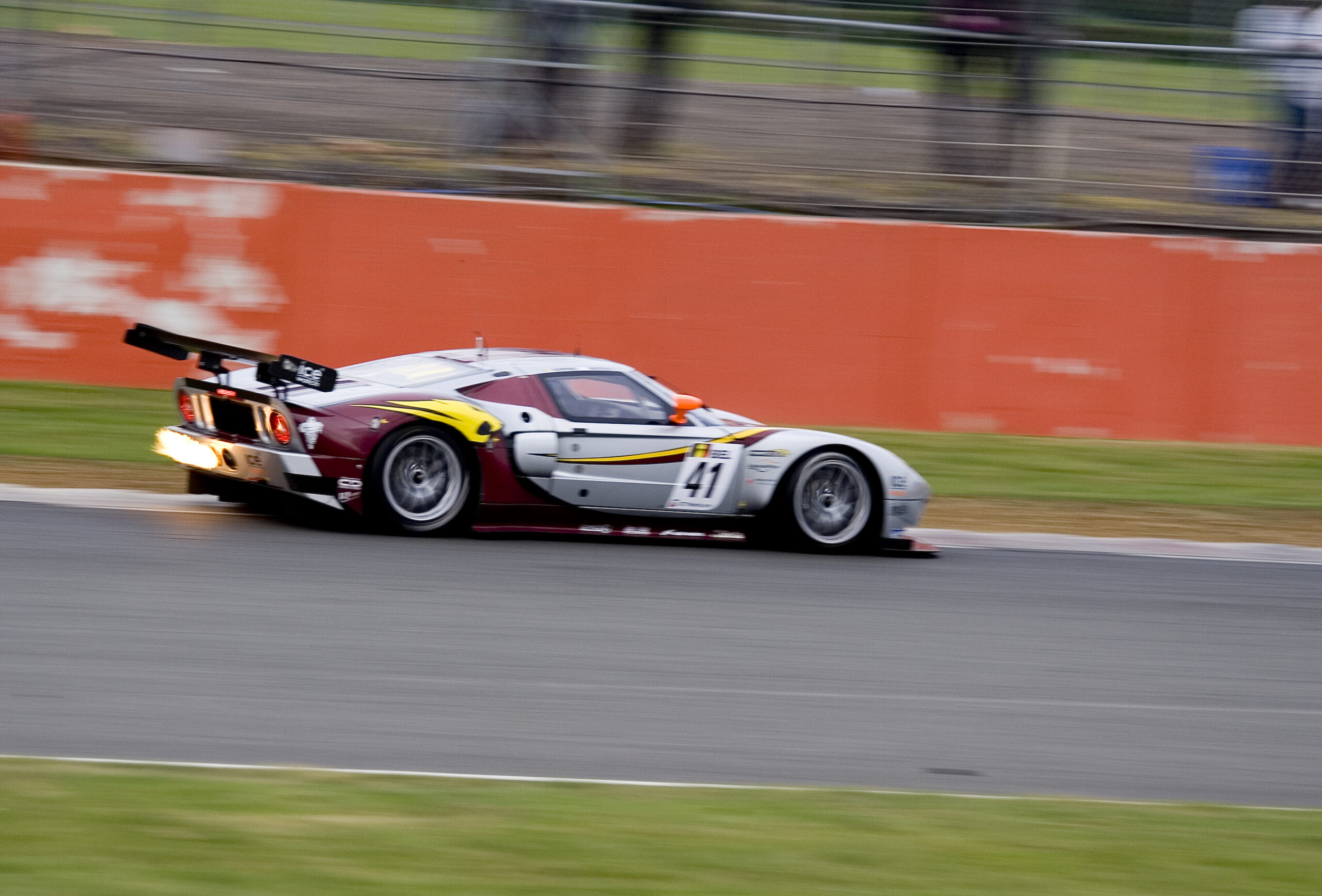
By Adam Pigott from Coningsby, UK - Flaming into Becketts, CC BY 2.0, https://commons.wikimedia.org/w/index.php?curid=10289740
Marc van der Straten died at his home in Switzerland on July 5, at age 78. If your motorsport diet is heavy on GT3 and Blancpain results, you know his name from a BMW Z4 that tore through the Spa 24 Hours a decade ago. If you follow Grand Prix motorcycle racing, you know it from a Moto2 garage that quietly produced three world champions. What most people on either side of that divide don’t realize is that it’s the same man, running the same family operation, for the better part of three decades. That’s the part of this story worth sitting with — not just the loss of a team owner, but the exit of one of the last people in professional racing who genuinely built something on both two wheels and four.
The timing makes it sting a little more. Seven days before he passed, a Boutsen VDS-run Porsche crossed the line eighth overall at the 79th running of the CrowdStrike 24 Hours of Spa, an event SRO Motorsports Group itself markets as the biggest GT race on the planet. Van der Straten was, by every account from people who worked with him, still fully engaged with that program. He didn’t get a slow fade into retirement. He got one more finish on the board first.
A Belgian Brewing Fortune and a Kit Car Nobody Else Wanted to Race
Van der Straten came from the van der Straten-Ponthoz family, tied to the lineage behind Stella Artois, which tells you where the checkbook came from but not why he spent it on race cars. That part came from his father, a onetime racer himself, and it pointed young Marc toward a genuinely strange starting point: the Gillet Vertigo, a low-volume Belgian sports car that most enthusiasts outside the Ardennes have never heard of. Van der Straten ran it in the domestic Belcar series under the Belgian Racing banner before pushing into the international FIA GT Championship by 2005.
Here’s the part that’s easy to gloss over: the Vertigo program was never eligible to score points toward the actual GT championship, because homologation rules require a minimum number of road-going examples to exist before a manufacturer’s race car can compete for a title. Gillet never built enough Vertigos to clear that bar. Van der Straten was paying to go racing at the top level with a car that, on paper, couldn’t win anything. That’s either an expensive hobby or a serious statement about priorities, and by 2008 even he seemed to agree it was time to pivot.
Ford, BMW, and the Livery Everyone Actually Remembers
The team rebranded as Marc VDS for 2009 and became a development partner for the Matech-built Ford GT1, which earned it one of twelve entries in the inaugural FIA GT1 World Championship in 2010 — a season that also included a Ford GT1 at the 24 Hours of Le Mans, a race the team wouldn’t finish. The following year told a different story: a Kronos Racing/Marc VDS-entered Lola-Aston Martin LMP1 finished seventh overall at Le Mans with Vanina Ickx, Bas Leinders, and Maxime Martin sharing the car. If that surname looks familiar, yes, Vanina is Jacky Ickx’s daughter, which is its own small piece of Belgian racing trivia buried inside a bigger one.
It’s the BMW years that built the livery people actually recognize. Running Z4 GT3s from 2011 onward, Marc VDS took the 2013 Blancpain Endurance Series Pro Cup title with Yelmer Buurman, Bas Leinders, and Maxime Martin, then won the 24 Hours of Spa outright in 2015 as BMW Sports Trophy Team Marc VDS, with Augusto Farfus, Maxime Martin, and Dirk Werner sharing driving duties. That Spa win is the one BMW people still bring up, and it’s a legitimate flex — winning GT racing’s longest, most attrition-prone race outright, not just in class, is the kind of result that outlives whatever team ran it.
Then, in October 2015, van der Straten pulled the plug on the sportscar program entirely. The immediate trigger was a new SRO regulation requiring Pro Cup teams to contest the full Blancpain season to remain eligible for the Spa 24 — van der Straten reportedly only wanted to do the one race, and balked at the cost of a season-long commitment plus what he described as management overspending his money. It’s a useful reminder that sanctioning bodies shape team behavior as much as engineering budgets do: tie a marquee event to a season-long entry requirement, and you’ll find out fast which owners were only ever there for the trophy. Backfire has covered how those same kinds of scheduling and regulatory calls can upend a series’ calendar with this year’s WEC Qatar 1812km postponement, and the logic is identical — the rulebook, not the racing, often decides who shows up.
The Career Most GT Fans Never Clocked
What van der Straten did next is the genuinely surprising part. He’d already merged with Michael Bartholemy and Didier de Radiguès to enter the brand-new Moto2 World Championship back in 2010, fielding Scott Redding and Héctor Faubel on Suter machinery. Moto2 is a spec-engine intermediate class where every team runs the same power unit and comparable control tires, which means results come down almost entirely to chassis development and team execution rather than manufacturer muscle — a sharp contrast to the GT and prototype world, where a factory partnership can make or break a season regardless of how good the crew is. Marc VDS turned out to be very good at that particular game: Tito Rabat won the Moto2 title in 2014, Franco Morbidelli in 2017, and Álex Márquez in 2019, three champions produced by one satellite operation in a single decade.
The team also ran a satellite MotoGP effort from 2015 to 2018, and its high point deserves more attention than it gets: Jack Miller won a soaked 2016 Dutch TT at Assen, the first win for a non-factory team in the premier class since the 2006 Portuguese Grand Prix. Satellite teams almost never win in MotoGP because factory squads get first access to new parts, tire allocations, and development resources — Miller’s Assen win happened anyway, in the rain, on a bike that was a season or two behind the works machines. Marc VDS was squeezed out of the MotoGP grid at the end of 2018 as Dorna Sports trimmed the field, a reminder that even a well-run team can get cut for reasons that have nothing to do with results. The operation kept going in Moto2, added a MotoE entry for the 2019 launch season, and expanded into World Superbike in 2024 with Sam Lowes on a Ducati Panigale V4 R, then into the FIM Endurance World Championship in 2025, finishing ninth at the Suzuka 8 Hours. Across every World Championship category the team has entered, its livery has now collected more than 100 podium finishes.
What Happens to Boutsen VDS Now
The GT3 chapter didn’t stay closed forever. In December 2023, Marc VDS partnered with Boutsen Racing — the Wavre-based team run by Olivier Lainé and Olivia Boutsen, sister of former F1 driver Thierry Boutsen — to form Boutsen VDS, returning the Marc VDS name and its Félin logo to GT World Challenge Europe with a Mercedes-AMG GT3 for 2024. The results have been genuinely strong for a comeback: a Silver Cup Endurance and Sprint championship double in 2024, an overall Silver Cup title in 2025, and a switch to the Porsche 911 GT3 R for 2026 that produced that eighth-place finish at Spa less than two weeks ago.
That partnership structure matters more than it might seem. The old Marc VDS sportscar program was effectively a one-man wallet, and it evaporated within weeks once van der Straten decided he was done with it in 2015. Boutsen VDS is a joint venture with its own management in Lainé and Boutsen, which gives it a structural reason to outlast its co-founder in a way the earlier iteration never had. GT3 racing has plenty of teams that exist because one wealthy owner enjoys writing checks — see the ongoing gentleman-driver economics on display whenever a name like Max Verstappen shows up for a GT3 test — and those operations tend to have a shelf life tied directly to the owner’s enthusiasm. Whether Boutsen VDS keeps running the Marc VDS colors past this season will be the real answer to what his ownership actually built versus what he simply funded.
It’s also worth remembering that privateer-funded entries at the very top of sportscar racing are a much older tradition than people assume, going back to the gentleman-racer era that still occasionally resurfaces — see McLaren’s approach with its own extreme, buyer-focused Le Mans hypercar project. Van der Straten’s teams sat at the more grounded end of that spectrum: never a factory-scale budget, but persistent enough to win Spa outright and develop three Moto2 world champions along the way. Racing has lost a handful of prominent figures already this year, including the motorcycle-crash death of Indy 500 veteran Rick Treadway just weeks earlier, and van der Straten’s passing adds a quieter, but no less significant, entry to that list — a team owner whose name most casual fans never learned, attached to a livery plenty of them would recognize instantly.
He reportedly never parted with the chequered-flag cap that made him instantly recognizable in both paddocks, right up through a Spa weekend that turned out to be his last. For an owner who spent fifty years hopping between two very different disciplines, that’s about as fitting a final lap as it gets.
(image By Adam Pigott from Coningsby, UK – Flaming into Becketts, CC BY 2.0, https://commons.wikimedia.org/w/index.php?curid=10289740)
About the Author