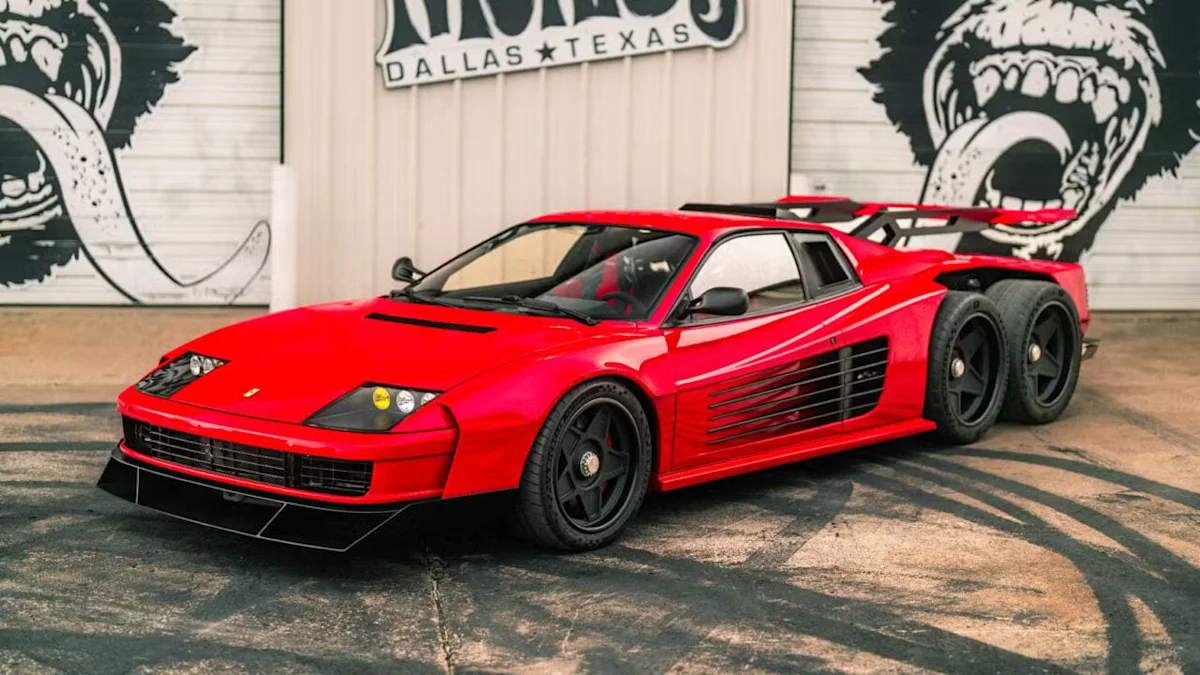
Gas Monkey Garage has at last pulled the wraps off the Ferrari F6, and the headline numbers barely tell the story. Six wheels. A supercharged American V8. More than two years of delays, do-overs, and fabrication nightmares. Richard Rawlings and his crew are calling the finished machine done, but the road to that point was a lot uglier than the polished result lets on. Long before the F6 moved under its own power, it had to survive a botched outside build that left it crooked, oversized, and — by the team’s account — not safe to push hard.
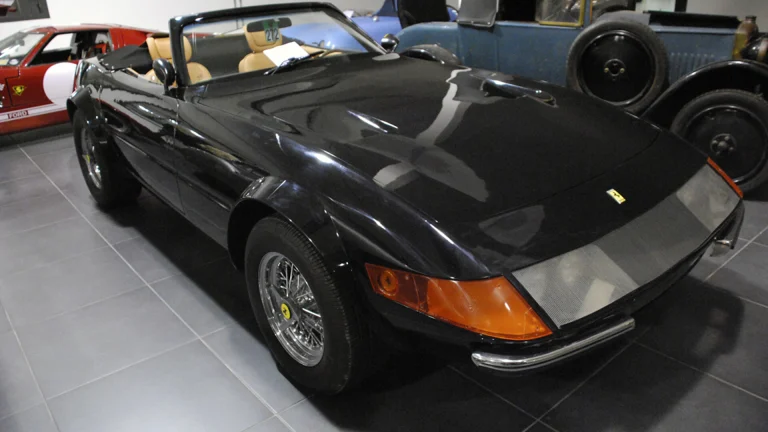
It began as a genuine, VIN-carrying car built around a Ferrari Testarossa. Where it ended up is something the factory in Maranello never imagined: a six-wheeler with four driven wheels at the back and a Detroit V8 sitting where the flat-12 once lived. Rawlings has described it as one of the wildest things his shop has ever attempted, and coming from a crew famous for loud, costly, look-at-me builds, that’s saying something.
What Exactly Is the F6?
Forget the idea of a show prop with extra tires tacked on. Gas Monkey insists the F6 is the real deal — fully operational and shaken down on a track, with genuine grunt reaching the pavement through its oddball six-wheel arrangement. The goal was a car nobody could ignore, but one that could also walk the walk.
Motivation comes from a blown, GM-derived LT4 displacing 427 cubic inches, a gloriously unhinged pick for anything wearing Ferrari bodywork. The engine routes its output to all four rear tires by way of a bespoke driveline. Add in tailored suspension, Wilwood stoppers, custom center-lock rims, and an enormous one-off rear wing, and the recipe gets clearer. The interior, meanwhile, takes cues from the Ferrari F40, leaving at least a thin thread tying the F6 back to Ferrari’s own legends.
How the First Build Went Sideways
Here’s the wrinkle most people miss: the F6 wasn’t fabricated under one roof. The early work was farmed out to a separate fabrication shop, and that partnership collapsed amid blown deadlines and shoddy workmanship.
Once the car landed back at Gas Monkey, the crew kept finding problems wherever they probed. The rear end of the chassis wasn’t square. Components had been bolted in sloppily. The bodywork had ballooned too wide, and certain mechanical bits were, the team says, mismatched or downright dangerous. That’s not finicky cosmetic griping — those are structural and mechanical defects on a vehicle meant to make real power.
The rear differential was among the nastier discoveries. According to the shop, incorrect gearing and corroded internals could have triggered a catastrophic driveline letdown had the car ever been driven in anger. On a six-wheel layout sending torque to four rear tires, that’s precisely the kind of fault that ends in disaster.
The paint told its own story. Rawlings had pictured the deep, glossy Rosso Corsa from the original renderings; what showed up instead wore matte paint, bedliner, and glitter — a pretty good summary of how far the outside job had drifted from the plan.
Essentially a Ground-Up Redo
With the car back home, the assignment quit being a finish job and became a salvage operation. The team trued up the chassis, pulled the body back in, rebuilt the rear structure, reengineered key parts, and effectively redid nearly every major system on the thing. That’s not a quick polish — that’s rebuilding on top of a compromised base.
The wing turned into a signature element of the revival. Gas Monkey 3D-scanned the tail, built the wing in CAD, cut prototype pieces, and kept tweaking the form until it nailed the menacing stance Rawlings had wanted from day one. Beyond the attitude, the wing earns its keep by balancing proportions that six wheels could have made awkward, dragging the whole car into full supercar fantasy rather than stranding it in between.
And It Genuinely Runs
For all the chaos, the part that counts most is that the finished car reportedly delivers. Gas Monkey says the F6 drives, corners, and pulls hard, comes with A/C and a stereo, and can spin up four-wheel rear burnouts. The crew also claims it caught them off guard on track — fast in a straight line and more composed in the bends than a six-wheel custom driveline has any business being.
So What Happens to It Now?
Rawlings and partner John Clay Wolfe haven’t settled the F6’s fate. They’ve floated taking it on a public tour, parking it in major cities, and maybe rolling it across an auction stage eventually. There’s history backing the money angle: the shop’s earlier six-wheel Hummer reportedly fetched a fortune at Barrett-Jackson, and that windfall helped bankroll the Ferrari in the first place.
Auction star or rolling billboard, the goal is already met. The car is loud, over-the-top, and impossible to ignore. The blunter truth underneath the showmanship is that this build almost died in someone else’s hands, and it survives only because the people who ordered it were willing to rip it down and redo it correctly.
Source
Image Credit: Gas Monkey Garage.
About the Author