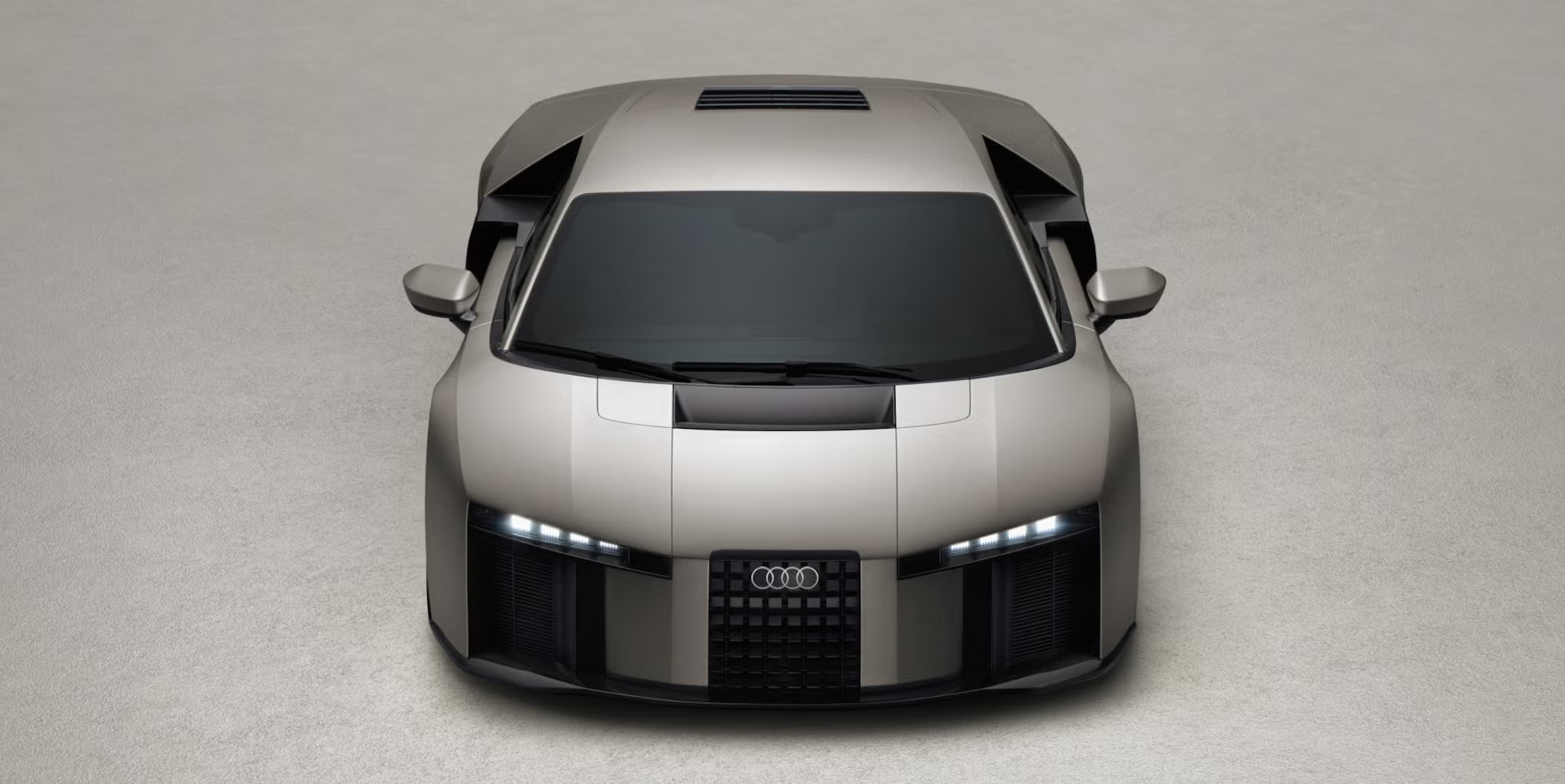
Audi just dropped a 987-horsepower hybrid supercar on the world, and almost nobody saw it coming. The Nuvolari was developed in secret by a small team in just 440 days, will be limited to 499 cars, and carries a base price of $686,613 at current exchange rates. For anyone still mourning the R8, which died in 2023, this is the news they have been waiting for. Sort of. Because the Nuvolari is not an R8 replacement, and that distinction matters for understanding what Audi is actually doing here.
The R8 always knew its place. Through two generations it shared hardware with Lamborghini, first the Gallardo and then the Huracán, and it was deliberately positioned as the cheaper, slightly tamer relative. The Nuvolari throws that hierarchy in the trash. It shares DNA with the Lamborghini Temerario, but this time the Audi is more powerful and more exclusive than its Italian cousin. That is a power move inside the corporate family, and it tells you Audi is operating off the leash.
The Name Alone Breaks the Rules
Audi badges its cars with letters and numbers. Not this one. The Nuvolari is named for Tazio Nuvolari, the legendary Italian racing driver who won three Grand Prix races driving the Auto Union Type D. Reaching back to the Auto Union era for a name signals that Audi considers this car a statement piece, not another rung on the model ladder.
The hardware backs up the ambition. The Nuvolari borrows the Temerario’s twin-turbo 4.0-liter V8, which makes 789 horsepower on its own and revs to a screaming 10,000 rpm. Three axial-flux electric motors join the party to push total output to 987 horsepower. Audi claims zero to 62 mph in 2.6 seconds, zero to 124 mph in 6.8 seconds, and a top speed beyond 217 mph. There is reason to believe those numbers are conservative.
Built in Secret, Sold to the Few
Here’s the part that matters about how this car came to exist. The project only began last March. A small team developed it in complete secrecy over those 440 days, and the result is less a series production car than a street-legal limited-edition concept. Only 499 will be built, with production starting early next year.
Normally a car like this is sold out before the public ever hears its name, with insiders getting the quiet phone call months in advance. That has not happened yet with the Nuvolari, but the window is closing fast. The car is set to lap the Monaco Formula 1 circuit in front of thousands of people for whom $700,000 is coffee money. Do not expect open availability to last the weekend.
Buying one will not be as simple as walking into any Audi store either. Only select dealers will handle Nuvolari sales and support. Buyers in markets like Los Angeles, Miami, and New York should be covered. Everyone else may have a harder road.
Firsts for Audi, and Real Engineering
The Nuvolari’s bodywork is entirely carbon fiber, a first for the brand. The forged aluminum wheels use a center-lock design, another Audi first. A front S-duct and an active rear wing help generate up to 882 pounds of downforce, and that active aero ties into the traction control, stability control, suspension, and engine management through a system Audi calls quattro predictive ride.
There is a fully electric drive mode, though the 7.3-kW gross battery suggests range will be minimal. Beyond that, drivers get balanced, dynamic, and dynamic plus modes, plus a dedicated track mode with wet, dry, race, and traction-off settings. This car is meant to be used hard. It rides on Bridgestone Potenza Race tires, 255/35R-20 in front and 325/30R-21 out back, and Audi says its Ceramic Pro brakes can decelerate at a level comparable to a current Formula 1 car.
Concept-Car Details, Concept-Car Compromises
The design details are where the Nuvolari gets genuinely obsessive. The doors hide three air intakes for cooling and engine breathing, along with the door handles themselves. The Audi rings on the rear wing are not a decal or paint but actual metal set into milled carbon fiber. Everything that looks like metal on this car is metal, with the possible exception of the Titanium paint laid over the carbon body. Buyers who want the raw look can order exposed carbon fiber instead.
The cabin carries the same uncompromising attitude, for better and worse. The center console armrest looks like it should hide storage or a phone charger and does neither. There are no cupholders. The steering wheel uses real buttons and knobs instead of haptic touch surfaces, which enthusiasts will cheer. The rearview mirror is a video screen because there is no rear window, and the camera feeding it hides in the metal grillwork beneath the center-exit exhaust.
The takeaway is hard to miss. Audi spent decades building a supercar that politely stayed in Lamborghini’s shadow. With the Nuvolari, it stopped asking permission. This is what Ingolstadt builds when the brand hierarchy gets ignored, and the only real catch is that just 499 people will ever own the proof.
Audi’s official reveal
Images Via: Audi
About the Author