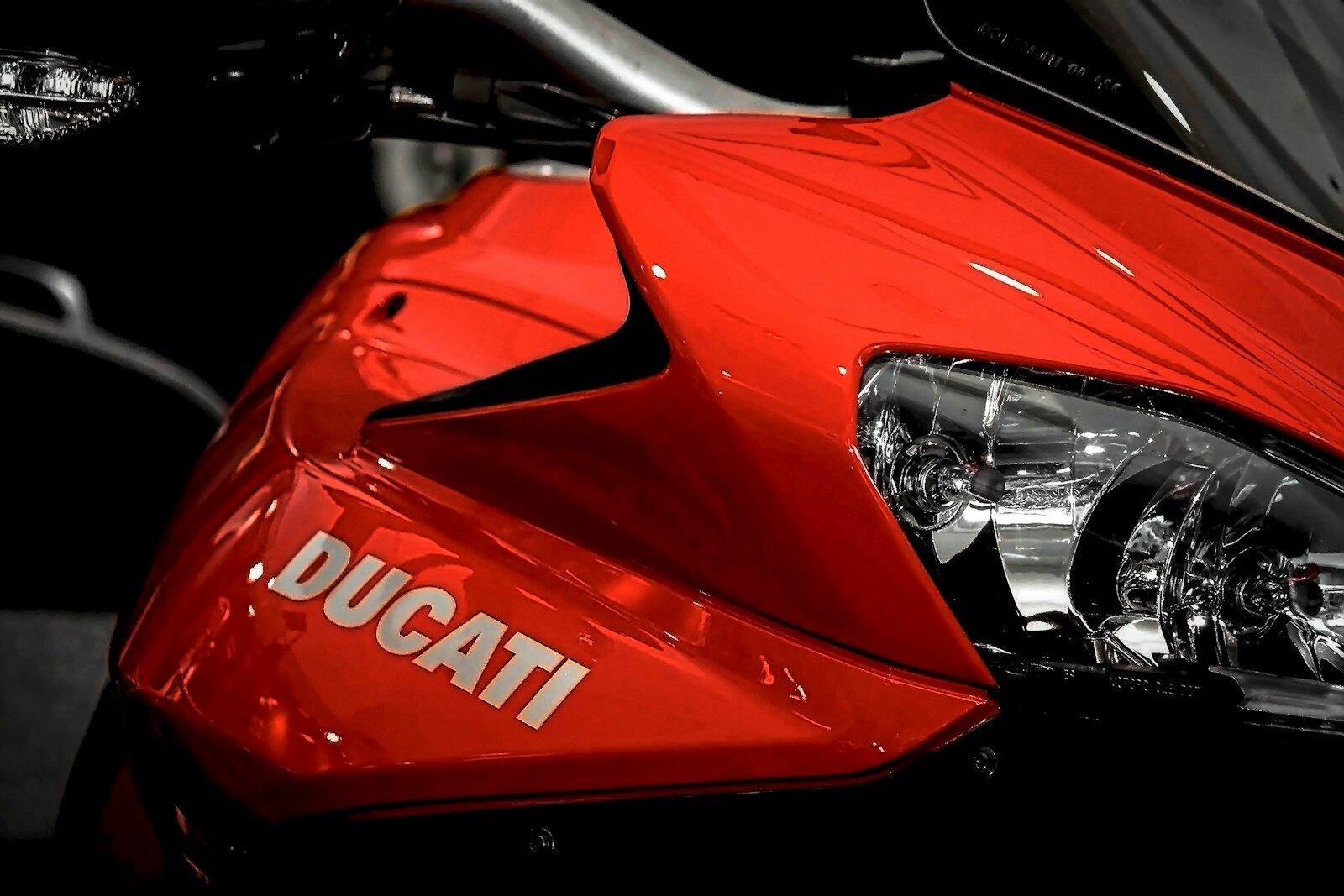
Photo: motomoto sc / Unsplash
Ducati has a very deliberate way of introducing new motorcycles. It’s called the World Première, a rolling calendar of teaser clips and studio photography that runs every year from late summer through EICMA in November. It’s polished, and none of it has mentioned a 2027 Diavel V4 S. California’s emissions regulator beat them to it.
The California Air Resources Board requires every distinct powertrain and evaporative-emissions configuration a manufacturer wants to sell in the state to carry its own Executive Order, a government sign-off that the engine meets emissions standards for its full useful life. Ducati filed its 2027 Diavel V4 certification back in March, covering three variants: the standard Diavel V4, the Diavel for Bentley, and the 50-unit Diavel for Bentley Mulliner. On August 26, CARB issued a revised executive order against that same filing, and the updated paperwork adds a fourth variant: Diavel V4 S. It’s the same agency whose proposed classic-car smog exemption has been generating headlines of its own this year.
That revision is the entire announcement. There’s no press release attached to it, and as of this week, Ducati’s own news archive doesn’t mention a Diavel V4 S at all.
This isn’t the first time Ducati’s paperwork has run ahead of its marketing department. Ducati’s design filing for the new Monster in India followed the same script earlier this year: a shape gets registered with a patent office months before a company is ready to talk about it, because protecting a design and confirming emissions compliance are legal obligations, not marketing beats. Neither a design office nor a state regulator holds a filing until a PR team feels ready, and both processes leave records that outlive anyone’s intent to keep a secret.
It’s also a preview of how selective Ducati’s “S” badge tends to be across its own catalog. On the Multistrada V4 and Streetfighter V4, “S” specifically denotes Ducati Skyhook Suspension, a semi-active system that reads road input through a stroke sensor and adjusts compression and rebound damping electronically rather than leaving a rider to twist preload collars in a parking lot. The standard Diavel V4 already runs a fully adjustable 50mm inverted fork and a single-sided-swingarm monoshock, which is genuinely good hardware, it’s just manual. Semi-active suspension matters more on a machine this size, because a nearly 500-pound power cruiser behaves very differently loaded two-up on broken pavement than solo through a canyon, and Skyhook is built to adjust for that difference without any input from the rider. Ducati has historically charged a real premium for that hardware on other models, and there’s no reason to expect the Diavel V4 S to be the exception.
What almost certainly isn’t changing is the engine. The current Diavel V4 runs Ducati’s 1,158cc V4 Granturismo, a 90-degree V4 with a counter-rotating crankshaft and Twin Pulse firing order, rated at 168 horsepower at 10,750 rpm and 126 Nm of torque at 7,500 rpm. Nothing in the certification paperwork suggests a different engine family for the S variant, and there’s little reason for Ducati to touch a motor it spent years tuning specifically to behave in a cruiser chassis without shaking a rider’s hands numb at highway speed. Ducati’s road engines and its racing department pull on each other constantly, and Backfire Racing laid out where the factory side is headed in MotoGP’s 2027 engine reset. The regulatory side has its own momentum: The Auto Wire covered what SB 1392 really changes for owners in California.
Zoom out, and the bigger story is what the Diavel V4 has become as a platform rather than a single model. It shares its chassis and engine across a standard naked cruiser, a Bentley Batur-inspired special edition limited to 500 units, and a 50-unit Bentley Mulliner edition finished by the coachbuilder’s own workshop. Slotting an “S” trim between the base bike and whatever flagship comes next isn’t a surprising move. It’s the same logic that’s kept Boss Hoss building a cruiser around a big-block Chevy V8 for 35 years, just applied with Ducati’s considerably more expensive toolkit: stretch one architecture across as many price points and buyer types as the market will bear.
For anyone shopping a Diavel V4 today, none of this makes the current bike a bad buy. Ducati hasn’t said when the S variant reaches production, whether it lands before the 2027 model year turnover, or what it costs. If electronically adjustable suspension is the deciding factor for you, this is a reasonable excuse to wait for an actual announcement rather than a filing. If it isn’t, the manually adjustable Diavel V4 in dealerships right now isn’t the compromise version of anything, it’s just not the version a government agency just confirmed is coming.
Lead image: motomoto sc on Unsplash
About the Author