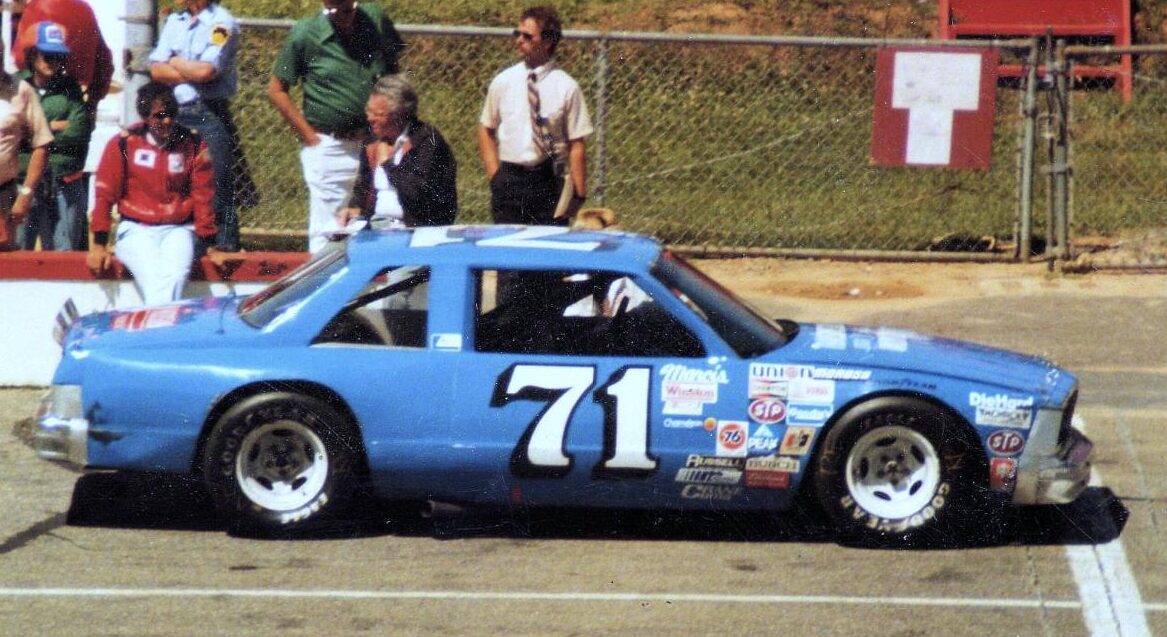
Dave Marcis' #71 Chevrolet at Pocono Raceway in 1983. Photo: Mike Traverse/Wikimedia Commons (CC BY-SA 2.0)
Someone is finally facing charges over the break-in at Dave Marcis’ Arden, North Carolina home, and the way investigators got there says more about how stolen memorabilia moves through the world than anything a detective could have dug up alone.
The Buncombe County Sheriff’s Office confirmed an arrest on September 4, roughly a week after Marcis returned from a trip out of town and found his house tossed. Because the property sits on the line between Buncombe and Henderson counties, both sheriff’s offices have had a hand in the case, and a Henderson County spokesperson was the one who told reporters an arrest had happened before Buncombe deputies released further detail. Neither agency has named the suspect publicly, and the specific charges beyond felony breaking and entering at a residence have not been made public either. What is confirmed is the classification itself: this was never treated as routine theft.
The break in the case did not come from a fingerprint or a pawn shop database flag. It came from Facebook Messenger. Marcis’ daughter, Shawn Beam, said a stranger reached out to her directly after recognizing items that had turned up at Smiley’s Flea Market in Fletcher. The tipster had apparently bought something at the market and later put together that it matched what was being described as stolen. That message gave investigators an actual location and a paper trail to chase, something a house full of missing Rolexes and rifles hadn’t provided on its own.
That detail matters beyond this one case. Flea markets and swap meets have always been an awkward blind spot in how stolen goods get moved. Unlike a pawn shop, which is legally required in most states to log serial numbers and photo ID on every transaction and report that data to local police, a folding table at a weekend market usually involves cash, no receipt, and no questions. It is a nearly perfect laundering point for small, easily pocketed items like jewelry and knives, which is exactly the category of goods that vanished from Marcis’ house. The irony is that whoever sold this merchandise picked a venue built for anonymity and still got caught, because the buyer on the other end of that transaction happened to know exactly whose name belonged on what they had just purchased.
There’s also a legal wrinkle worth understanding here. Whoever broke into the house is exposed to felony breaking and entering, but North Carolina prosecutors typically stack that with felony larceny once stolen property tied to the break-in is recovered, since anything taken during a residential break-in above a fairly low dollar threshold gets charged as a felony regardless of the item’s sentimental value. Whether the person selling items at the flea market table is the same person who broke into the house, or a second party who simply saw an opportunity to unload merchandise, matters a great deal to a prosecutor. Knowingly reselling property you understand to be stolen is its own separate crime, receiving or possessing stolen goods, charged independently of the underlying burglary. Investigators haven’t said publicly whether they’re chasing more than one person, only that the case remains open.
An arrest doesn’t mean Marcis gets his belongings back. Beam said only some of the stolen property has been recovered so far, and the family is still trying to retrace where the rest of it went. That list still includes a handful of Rolex watches gifted to Marcis by Roger Penske when he stepped away from Cup racing, a rifle given to him by Dale Earnhardt, one-of-a-kind rings, and a firesuit, items we detailed when the burglary itself first made news. Some of it may never surface. Once stolen goods scatter across multiple buyers at a market like Smiley’s, tracing every piece back becomes a matter of hoping more strangers recognize what they unknowingly bought, the same slow, unglamorous process that eventually cracked open a stolen classic Mercedes case that nearly got shipped overseas before police caught up with it.
For anyone who needs the reminder, Marcis isn’t a bit player in NASCAR history. He made 883 Cup Series starts between 1968 and 2002, a number that still ranks among the highest in the sport, and he built that longevity as an independent, often running his own team on a shoestring budget while bigger operations came and went around him. That’s the context that makes this burglary sting the way it does. The items taken weren’t just valuable, they were physical proof of a career most of today’s Cup garage wasn’t around to see. Recovering a Toyota Highlander is one thing, since paperwork and VIN records eventually catch up with a mass-produced vehicle no matter how many state lines it crosses. A one-of-a-kind ring or an engraved rifle doesn’t have that kind of safety net, which is exactly why this case leaned on a stranger’s memory instead of a database.
Both sheriff’s offices are still asking anyone with information about the break-in or the stolen property to come forward. Given how this arrest actually happened, that request isn’t just procedural boilerplate. The next tip that cracks this case further is just as likely to come from someone scrolling through a flea market Facebook group as it is from a detective’s desk.
Lead image: Mike Traverse/Wikimedia Commons (CC BY-SA 2.0)
About the Author