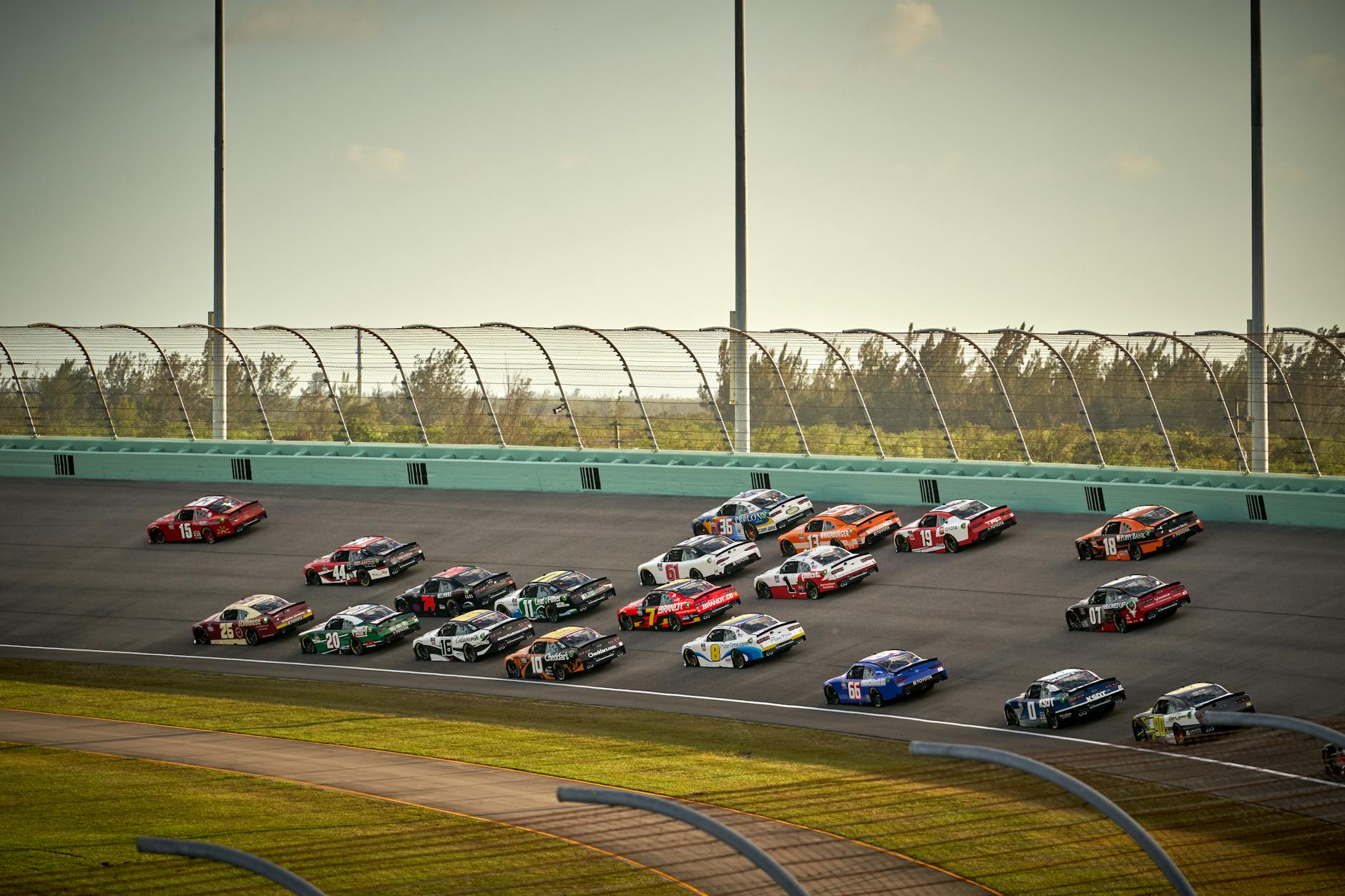
Photo by Alfred GF on <a href="https://www.pexels.com/photo/nascar-cars-racing-on-a-track-11521138/" rel="nofollow">Pexels.com</a>
Somewhere inside the fenced-off guts of Las Vegas Motor Speedway sits a private, L-shaped service road that almost nobody outside the track’s hauler drivers and event staff has ever had a reason to notice. It’s signed “Eren Drive,” connects Las Vegas Boulevard North to Checkered Flag Lane, and despite decades of use, Clark County’s own records show it was never actually given an official name. It just existed, the way a lot of infrastructure inside a sprawling motorsports complex tends to.
That obscurity is about to end, and not quietly. Nevada Speedway, LLC, the entity that operates LVMS, has asked Clark County’s Planning Commission to formally split that road into two named segments: “Busch Brothers Drive,” honoring Las Vegas natives Kyle and Kurt Busch, and “Rowdy Road,” a nod to Kyle’s longtime nickname. Commissioners are scheduled to take up both agenda items at next week’s meeting.
Here’s the part that makes this more interesting than a standard hometown-hero tribute. County planning staff is recommending approval of Busch Brothers Drive, but flagged a real snag with Rowdy Road: Clark County already has a street named Rowdy, and staff’s write-up notes that duplicating it could create a conflict for the Combined Fire Communications Center. That’s not bureaucratic nitpicking, it’s how 911 dispatch actually works. Emergency routing systems lean on unique street names within a jurisdiction to send the right fire, police, or ambulance crew to the right address, and two “Rowdy” streets in the same county, even on opposite ends of the valley, is exactly the kind of ambiguity that can slow a response when seconds matter. Naming a road after a legend still has to clear the same red tape as naming a road after anything else.
Assuming the county works through that wrinkle, Nevada Speedway LLC would have 60 days after approval to install new signage, meaning this wouldn’t just be a symbolic vote. It would show up on GPS routing, county maps, and eventually emergency-response databases as a genuine, physical address, not a plaque.
The tribute exists because Kyle Busch, a Las Vegas native, died on May 21 in Charlotte, North Carolina, after being hospitalized with a sudden, severe illness. The Busch family, Richard Childress Racing, and NASCAR jointly announced his death, and the family later said the cause was severe pneumonia that progressed into sepsis. He was 41. We covered the 911 call that first revealed how serious his condition had become days earlier at a GM facility.
By any measure, Busch was one of the greatest drivers NASCAR has produced: a two-time Cup Series champion, in 2015 and 2019, with Joe Gibbs Racing, a 2009 Xfinity Series champion, and the winningest driver across NASCAR’s three national touring divisions combined, with well over 230 total victories. He’d moved to Richard Childress Racing for the 2023 season and was racing the No. 8 Chevrolet, under a contract already in place to continue through 2027, when he died. His final win came just six days earlier, in a Truck Series race at Dover.
RCR handled its own piece of the Busch legacy differently than the county did. Rather than going through any formal process, the team simply announced it would suspend use of the No. 8 indefinitely, switching to the No. 33 at Charlotte and beyond, with the stated goal of preserving the No. 8 for Busch’s 11-year-old son, Brexton, if he eventually reaches that level of competition. It’s worth understanding why that’s even possible: unlike a retired jersey number in stick-and-ball sports, NASCAR car numbers aren’t owned by the sanctioning body or permanently retired by rule. They’re tied to a team’s charter and can be requested, released, or reassigned depending on business needs. RCR’s gesture is voluntary and, technically, reversible, which is what makes it a choice worth noting rather than a formality.
Las Vegas Motor Speedway is also honoring Busch on the actual racing surface, separate from the county’s paperwork. The track’s Friday-night short-track program at the Bullring, its 3/8-mile paved oval, has been renamed the inaugural Kyle Busch Classic, presented by Star Nursery, running October 2 with a lineup that includes the CARS Tour Series West, Modifieds, Bandoleros, Legends cars, and the ARCA Menards Series. It’s a fitting pairing for a driver whose reputation was built as much on short-track and lower-series dominance as it was on Cup Series wins.
For fans, the practical upshot of all this is simpler than the county process behind it. If the renaming clears the Planning Commission, the road you’ll use to navigate hauler parking and event access around Las Vegas Motor Speedway will carry Kyle and Kurt Busch’s names permanently, the same quiet way the sport has built its history into the concrete and signage of its tracks for decades. It’s a smaller gesture than a statue or a grandstand renaming, but arguably a more durable one. Statues get moved and grandstands get torn down and rebuilt, but a county-recorded street name tends to outlast everyone who remembers why it was chosen. With Richard Childress Racing and the rest of the NASCAR schedule already sorting out what a season without him looks like, that kind of permanence is worth something.
Lead image: Alfred GF on Pexels
About the Author