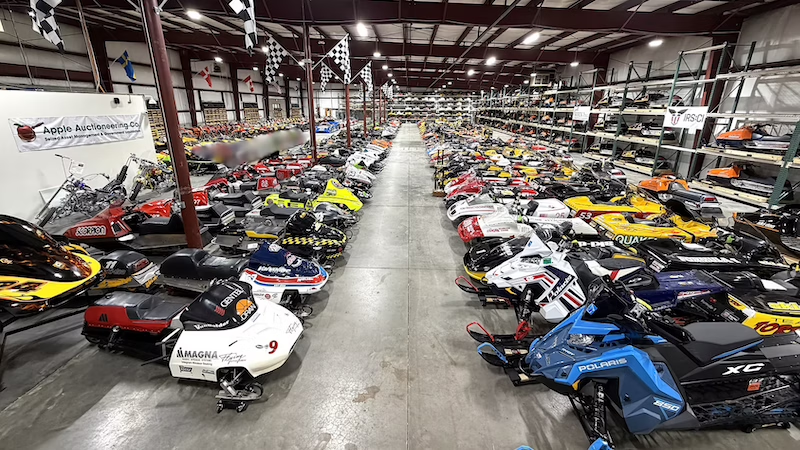
Stanley Pophal spent six years telling investors he could turn their savings into serious money: 20 percent guaranteed returns, sometimes more, backed by a portfolio he claimed spanned cryptocurrency, real estate flips, artificial intelligence ventures, and physical gold, silver, and emeralds. What he actually built was a rented warehouse in Wausau, Wisconsin, packed wall to wall with snowmobiles, plus a healthy stash of motorcycles and other vehicles, all bought with other people’s money.
Garage-worthy EDC gear, on sale this week.
Check This Out: Best Dash Cams of 2026: How to Choose the Right One for Your Vehicle
Pophal, 64, pleaded guilty in June to wire fraud and money laundering after admitting he defrauded roughly 190 investors out of $14.25 million between 2019 and 2025. He ran the operation through a company called Bright with Silver, Inc., previously doing business as Fromm Bros., Inc. Investors signed promissory notes guaranteeing their principal no matter what happened to the underlying investments, because Pophal claimed he had enough personal wealth to make everyone whole if his bets went sideways. He didn’t have that wealth. Instead, he kept the operation running by using new victims’ money to pay off earlier ones, all while quietly funneling cash into a personal fleet, a private plane charter, travel, and his mortgage.
That fleet is now property of the U.S. government, and clearing it out is turning into one of the more unusual liquidation jobs Wisconsin has seen.
A forfeiture, not a repo
Pophal’s plea agreement includes forfeiture of more than 600 items federal investigators traced back to investor funds, including the snowmobiles agents found packed into that rented warehouse. Ownership of the property now sits with the U.S. Treasury’s Executive Office for Asset Forfeiture, the division that manages and liquidates assets seized in federal financial-crime cases nationwide. TEOAF doesn’t run its own auctions — it farms the work out to contracted auction houses, and here that’s Apple Auctioneering Co., a Wausau-based firm already running a rotating schedule of Treasury, Marshals, and Customs and Border Protection liquidation sales through the HiBid bidding platform.
U.S. Attorney Chadwick Elgersma framed the guilty plea as proof that “those who prey on hardworking people through deceit and greed will face decisive consequences.” The mechanics of forfeiture back that up in a literal way: whatever these snowmobiles and motorcycles bring at auction goes toward repaying the investors Pophal took money from, not into any account he controls.
Three auctions, one very large garage
What separates this from a typical seized-vehicle headline is the sheer volume of inventory. Apple Auctioneering’s public sale calendar lists three separate “WI Motorsports” auction events tied to this forfeiture, all run online-only with reserve out of a facility on Stewart Avenue in Wausau. The first opens for bidding July 21 and closes August 4, a second runs August 4 through August 11, and a third continues August 11 through August 18 — nearly a month of overlapping sales just to move through one man’s collection. Most forfeiture sales of this type clear in a single event; needing three back-to-back auctions says more about the scale of Pophal’s hoarding than any single headline number could.
It’s also a reminder of how differently a fraud-case fleet reads compared to a well-provenanced collector sale, the kind where a car’s backstory drives the bidding as much as its condition does. There’s no story behind any individual sled here worth telling; these machines are worth exactly what someone is willing to pay for them today, nothing more.
What buying a fraudster’s snowmobile actually involves
Bidding on this inventory isn’t like scrolling Facebook Marketplace. Apple Auctioneering requires every first-time bidder to register through HiBid and submit a government-issued ID before they’re cleared to place a bid, a verification step that can take 24 to 48 hours to process. Show up on closing day with no account history and you’ll likely watch lots close before approval comes through. Every lot also ends on a three-minute soft close, meaning any bid placed in the closing minutes resets the clock — the classic last-second snipe that works on eBay just extends the auction here instead.
Read Next: The 10 Best Outdoor Knives of 2026: Top-Rated Picks for Hunting, Camping, and Survival
Win a lot and the clock starts immediately. Payment is due within 48 hours by wire transfer, bank deposit, or overnight cashier’s check, and the auction house won’t release title paperwork until funds clear. Buyers should also plan around a detail that trips up plenty of first-time government-auction bidders: these vehicles stay titled in Pophal’s name until the new owner processes the transfer through their own state’s DMV. Skip that step and you’re technically riding around on paperwork that still legally belongs to a convicted felon — not illegal, but not a loose end anyone should leave hanging.
The mechanical catch nobody’s advertising
There’s also the matter of what years inside a rented warehouse do to a snowmobile. Sleds are unforgiving things to store long-term even under ideal conditions: fuel left sitting in a carbureted engine turns to varnish, rubber tracks and drive belts flatten and crack, batteries die completely, and rodents treat exposed wiring like a buffet line. Nothing about this case suggests Pophal’s collection was winterized or maintained with resale in mind; he was accumulating machines as props for a lifestyle, not curating a fleet for future buyers. Anyone bidding sight-unseen on one of these lots should budget for a carburetor rebuild, a new belt, and a fresh battery before assuming anything is trail-ready.
Sentencing still to come
Pophal is scheduled to be sentenced September 2 by U.S. District Judge William M. Conley, with restitution to his victims expected to factor heavily into that hearing. IRS Criminal Investigation and the FBI ran the underlying investigation, and Assistant U.S. Attorney Meredith P. Duchemin is prosecuting the case.
This is far from the only recent case where crime and horsepower collide. We’ve covered a seized Mustang that may end up working patrol duty instead of getting parted out, and a pair of utility workers accused of siphoning power right next to a NASCAR track. Fraud, theft, and forfeiture keep intersecting with the enthusiast world in ways that turn someone’s bad decisions into somebody else’s bargain-bin opportunity, provided the buyer understands exactly what they’re bidding on.
Image Via Apple Auctions/U.S. Dept. of the Treasury
About the Author