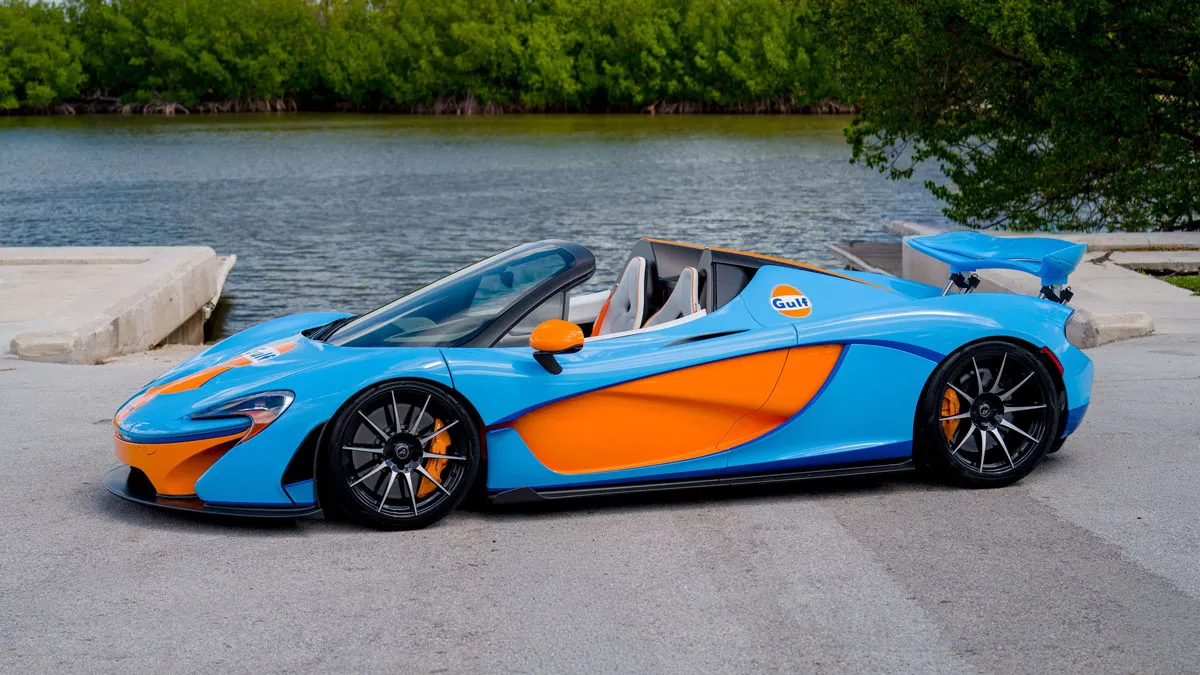
McLaren never planned to build an open-top P1. That was the deal from day one: if you wanted one of the most advanced hypercars of its time, you got a fixed roof, period. No exceptions, no special editions, no last-minute surprises. But now, more than a decade later, one exists anyway, and it’s about to cross the auction block with a price tag that could push well past expectations.
This particular car, known as the Professor, is not just another P1 with a story attached — it’s one of only five open-top conversions ever created by Lanzante, the same outfit responsible for some of the most ambitious McLaren restoration and conversion projects around. They’ve done this kind of thing before, but nothing quite like this.
Originally, this car was just another entry in the 375-unit P1 production run. It rolled out as chassis number 209, finished in a one-off metallic cobalt blue called Professor 2 Blue — a name tied directly to the first owner, a former venture capitalist who later became a professor at Harvard Business School. The car reflected that personality right down to the details: carbon-fiber bucket seats wrapped in red leather with ribbed padding inspired by classic Ferrari design, plus a custom vanity mirror on the passenger side, added at the owner’s wife’s request and etched with a message that made the whole thing feel less like a machine and more like something built for real people.
That level of customization didn’t come cheap. On top of the already steep price of the P1, nearly $140,000 in additional options were added through McLaren Special Operations, and the car was signed off by key figures at McLaren, giving it an extra layer of significance before it even left the showroom. And then it actually got driven — not locked away, not treated like a museum piece. The first owner used it for a couple of years before sending it to auction in 2017, where it sold for a record price at the time, with proceeds going toward funding an academic position — not something you hear about every day in the supercar world.
After that, the car changed hands again, saw minimal use, and resurfaced at another auction in 2023. That’s when things took a turn: the current owner saw something different in it, and after seeing a prototype P1 Spider debut at Goodwood, went back to Lanzante with an idea that was simple on paper but complicated in reality — take one of the most structurally complex hypercars ever built and remove the roof without compromising everything that makes it work.
The P1’s MonoCage carbon structure is a major part of what makes the car so capable, and cutting into that isn’t something you just try out in a garage. Lanzante brought in Paul Howse, the original designer of the P1’s exterior, to help rework the car in a way that still felt authentic. They didn’t just chop the roof off — they redesigned the upper structure, added carbon-fiber buttresses, and integrated new air intakes to keep the twin-turbo V8 breathing properly. It wasn’t just about looks; the goal was to maintain the car’s integrity while completely changing how it felt to drive: open-air, exposed, louder, more intense, a completely different experience than the original coupe.
Once the engineering was sorted, the car got another transformation. The original blue paint was replaced with classic Gulf racing colors — bright, recognizable, and tied to decades of motorsport history — while inside, the red leather was swapped for white weather-resistant material with orange accents. It’s a bold change, and not everyone will love it, but it fits the car’s new identity. This isn’t a factory car anymore; it’s something else entirely.
Now it’s heading to the Miami Auction, scheduled during the Formula 1 Grand Prix weekend — timing that’s no accident, since the audience will be there and attention will be high. There are only five of these P1 Spiders in existence. Not five hundred, not fifty — five. That alone puts it in a category most collectors never even get close to, and combined with the car’s unique backstory, its original configuration, its auction history, and the fact that it’s barely been driven since the conversion, it’s easy to see why expectations are high.
Estimates are sitting between $4 million and $5 million — a huge number, even in this market. But it’s not just about the price; it’s about what the car represents. This is what happens when someone refuses to accept the original limits of a machine. McLaren said no open-top P1 would ever exist. Now there are five, and one of them is about to test just how far collectors are willing to go for something that technically shouldn’t be here at all — and honestly, that’s what makes it worth watching.
About the Author