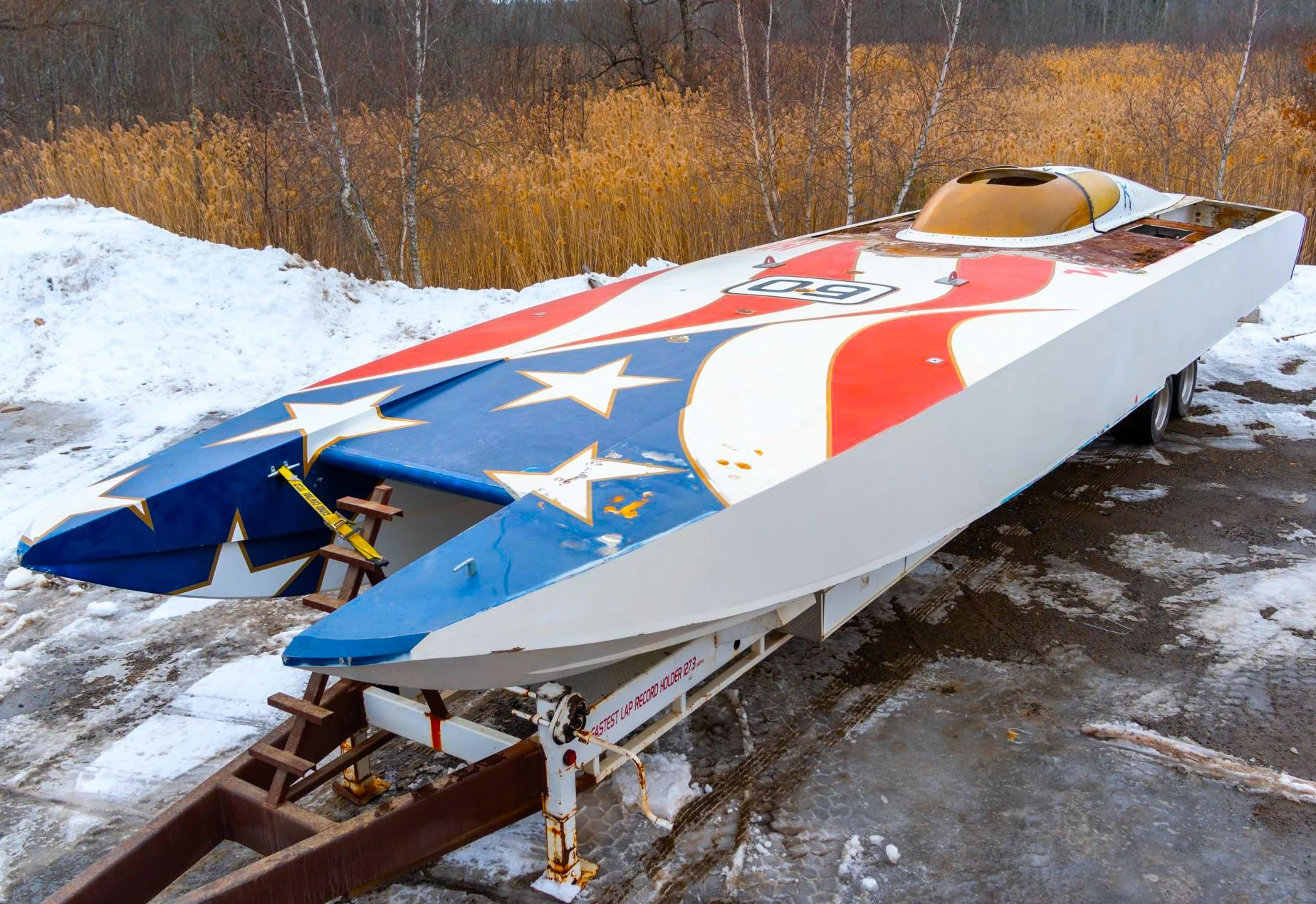
A 50-foot offshore race boat tied to one of the biggest TV stars of the 1980s is back in the spotlight, but not in the way most people would expect. This isn’t some pristine collector piece sitting in a climate-controlled showroom — it’s rough, it’s incomplete, and it’s being sold off with no reserve, which tells you everything about where things stand.
This boat once carried Don Johnson, the face of Miami Vice, across open water at extreme speeds — not as a hobby or a side gig, but as a serious competitor chasing championships. Now it sits stripped down, missing its engines, its interior, and a big chunk of what made it dangerous in the first place. Back in the late 1980s, Johnson wasn’t just playing a cool character on TV; he’d already built a reputation in offshore racing, including a major endurance victory running over a thousand miles up the Mississippi River. That wasn’t a celebrity stunt — that was endurance, risk, and skill.
In 1988, Johnson secured the American Power Boat Association World Championship in the Superboat class, in a different boat, and that win set the stage for something bigger: he wanted his own machine. For the 1989 season, Johnson partnered with builder Jonathan Sadowsky to create a 50-foot racing catamaran called Team USA — not an off-the-shelf build, but a boat purpose-built to compete at the highest level of offshore racing, big, wide, and aggressive.
It worked, at least for a moment. In 1990, Team USA laid down a one-lap speed record of 127.3 mph during an offshore challenge on the Hudson River. For a boat that size, at that time, the number wasn’t just fast — it was borderline insane, and it showed exactly what the setup was capable of when everything lined up. But everything didn’t stay lined up. The boat ran four big-block Chevrolet V8 engines, each pushing around 1,000 horsepower — an enormous amount of power in a marine setup, especially paired with early high-performance surface drives. The system was cutting-edge for its time, but it wasn’t bulletproof, and the boat ended up dealing with multiple engine failures. That’s where the momentum started slipping, and once that starts, it’s hard to recover.
Fast forward to today, and the same boat that once chased speed records is now sitting as a shell of its former self. The engines are gone, the outdrives are gone, the interior has been stripped clean, and even the engine hatches are missing. What’s left is the fiberglass hull, still wearing faded pieces of its original Team USA livery. You can still see the identity if you look close: the white finish is there, the stars-and-stripes details at the bow haven’t completely disappeared, and old sponsor lettering sits worn and barely holding on across the deck. It’s enough to recognize what it used to be, but not enough to ignore how far it’s fallen.
Because this isn’t just a restoration project — it’s a massive undertaking. The deck has areas that need work, especially around the cockpit, and while the structure itself might be intact, everything that made it run at 127 mph is gone. Anyone stepping into this isn’t finishing a project; they’re basically starting from scratch. The boat does come with a trailer, and even that tells part of the story: it’s a tandem-axle setup with storage compartments and basic equipment, but the real standout is the bold lettering on the side calling out that 127.3 mph record, almost like it’s trying to convince you it still matters.
Legally, it’s not exactly straightforward either. The boat itself doesn’t carry a title or registration and is being sold on a bill of sale alone. The trailer has registration, but no VIN is present, adding another layer of complexity for anyone thinking this is a quick flip or an easy rebuild. And yet, despite all of that, it’s going to sell, because history still carries weight, especially when it’s tied to a moment, a name, and a machine that actually delivered results.
There’s also something else here. Offshore racing in that era was raw — it wasn’t polished or sanitized. It was loud, risky, and pushed hard by people who weren’t afraid to break things in pursuit of speed. This boat is a leftover from that time, not cleaned up, not restored, just left as it is. So now it lands in the hands of whoever is willing to take it on. Not everyone should — this isn’t a weekend project, it’s a commitment, financially and mechanically. But for the right buyer, it’s a chance to bring back something real: not a replica, not a tribute, but the actual machine that once tore across the water with a celebrity behind the wheel and a serious racing team backing it up. And if nothing else, it proves one thing — even the fastest machines don’t stay on top forever.
About the Author