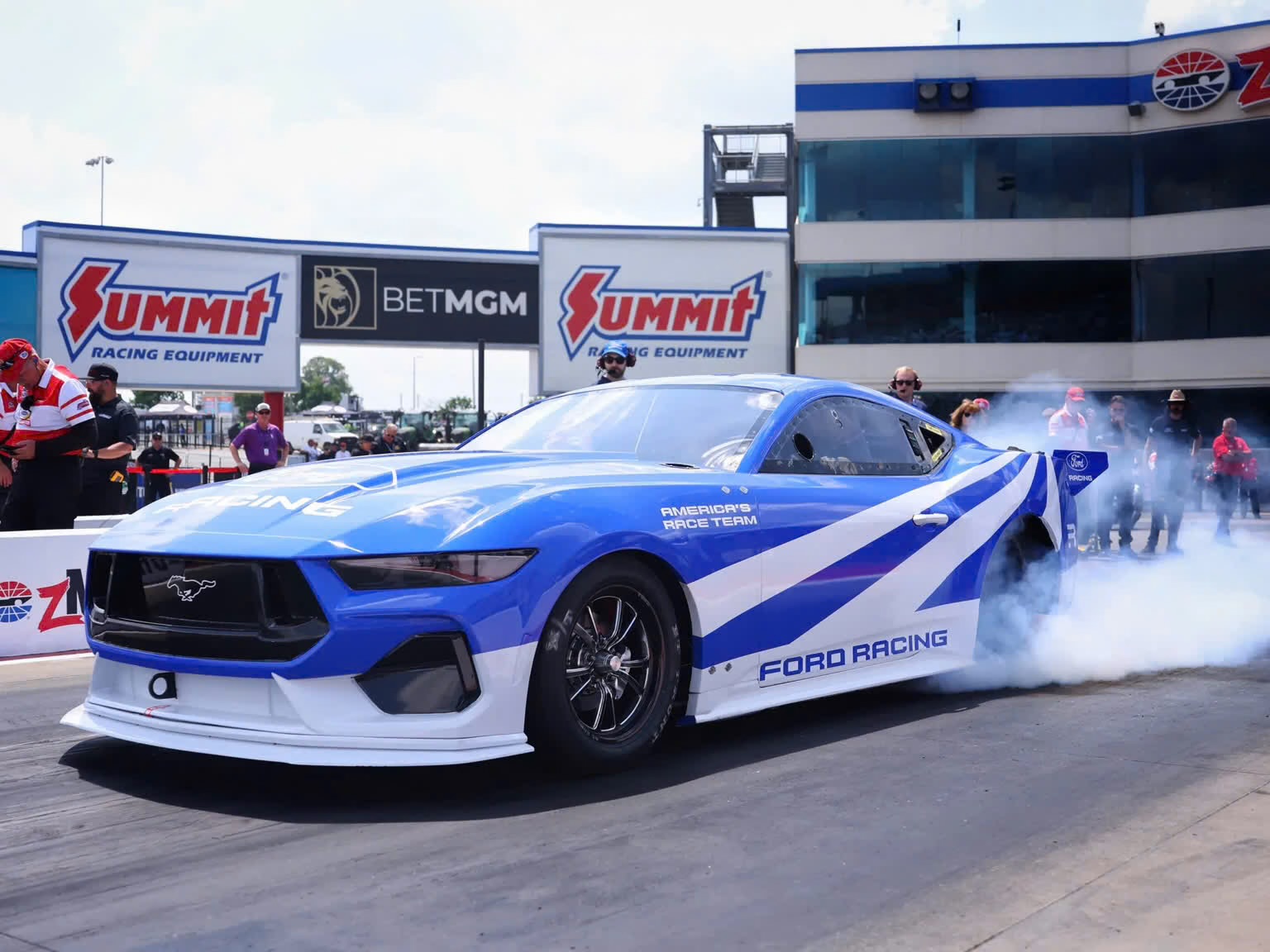
Ford didn’t just break a record this weekend — it blew right past it like the old number never belonged there in the first place.
At the NHRA 4-Wide Nationals in Charlotte, the new Mustang Cobra Jet 2200 ripped down the quarter mile in 6.87 seconds at 221 mph. That number alone is enough to turn heads, but here’s the part that really lands: the previous record, also held by Ford, sat at 7.623 seconds. This car chopped three-quarters of a second off the clock in a sport where people fight over thousandths.
The name gives away the headline number: 2,200 horsepower, coming from two electric motors instead of the four used in the previous car. Each motor pairs with its own inverter, both running at over 98 percent efficiency, and despite losing two motors, the new setup makes more power while weighing significantly less. That’s the part people might miss — these motors are about half the weight of the previous ones yet deliver an extra 600 horsepower overall. Less complexity, less mass, more output. It sounds obvious said that way, but getting there is the hard part, and Ford did it by simplifying the whole drivetrain rather than piling on more hardware.
Electric cars are known for instant torque, which sounds great until you try to launch 2,200 horsepower without blowing the tires off. Ford’s answer feels almost old-school: a centrifugal clutch, in an electric Mustang drag car. It sounds backwards at first, but it makes sense — the clutch allows controlled slip at launch, just enough to manage traction before locking everything in place, and once it’s hooked, the car runs in direct drive where efficiency is highest.
Then there’s the transmission. Most EVs skip multi-speed gearboxes entirely, but this one doesn’t. Electric motors make peak power at higher RPM, so without gearing, a car loses performance during the run — Ford says that transmission alone is worth more than a full second compared to a single-speed setup. The battery layout isn’t fixed either; it can be configured depending on what the team needs, with a large pack under the floor, additional packs in the rear, and adjustable placement up front. That allows fine-tuning of weight transfer, which is everything in drag racing, since more grip at launch can make or break a run.
Put all of that together and you start to understand how this car got so quick, so fast. But it didn’t happen overnight. Back in 2021, the original Cobra Jet 1400 ran an 8.128-second quarter mile — impressive at the time. Then came the Cobra Jet 1800, dropping into the sixes… a 1.26-second improvement in under five years. In drag racing terms, that’s not evolution. That’s acceleration, and Ford reportedly got there with minimal track testing, suggesting a heavy reliance on simulation before the car ever hit the strip that clearly paid off.
Ford didn’t ignore safety, either. The car includes a pyrotechnic circuit breaker that can instantly cut high-voltage power in an emergency using a small explosive charge, built specifically to meet NHRA safety standards — with this level of voltage, that kind of system isn’t optional.
This isn’t just about one fast pass or one record. Ford’s drag racing engineers aren’t just stuffing batteries and motors into a chassis and hoping for the best; they’re applying decades of drag racing knowledge to something completely different, and it’s working. At the same time, there’s a bigger question hanging over all of this: does any of this actually make its way into production cars? Right now, Ford’s EV division is focused on affordability, pushing toward models under $40,000 — a completely different world from a 2,200-horsepower drag machine. But the underlying tech, things like high-efficiency inverters and 900-volt systems, could eventually trickle down. Or it might not; that bridge hasn’t been built yet.
Still, it’s hard to ignore what just happened. A 6.87-second electric Mustang running over 220 mph isn’t just quick — it’s the quickest electric car to ever run a quarter mile. And whether you’re into EVs or not, that kind of performance forces the conversation forward.
About the Author