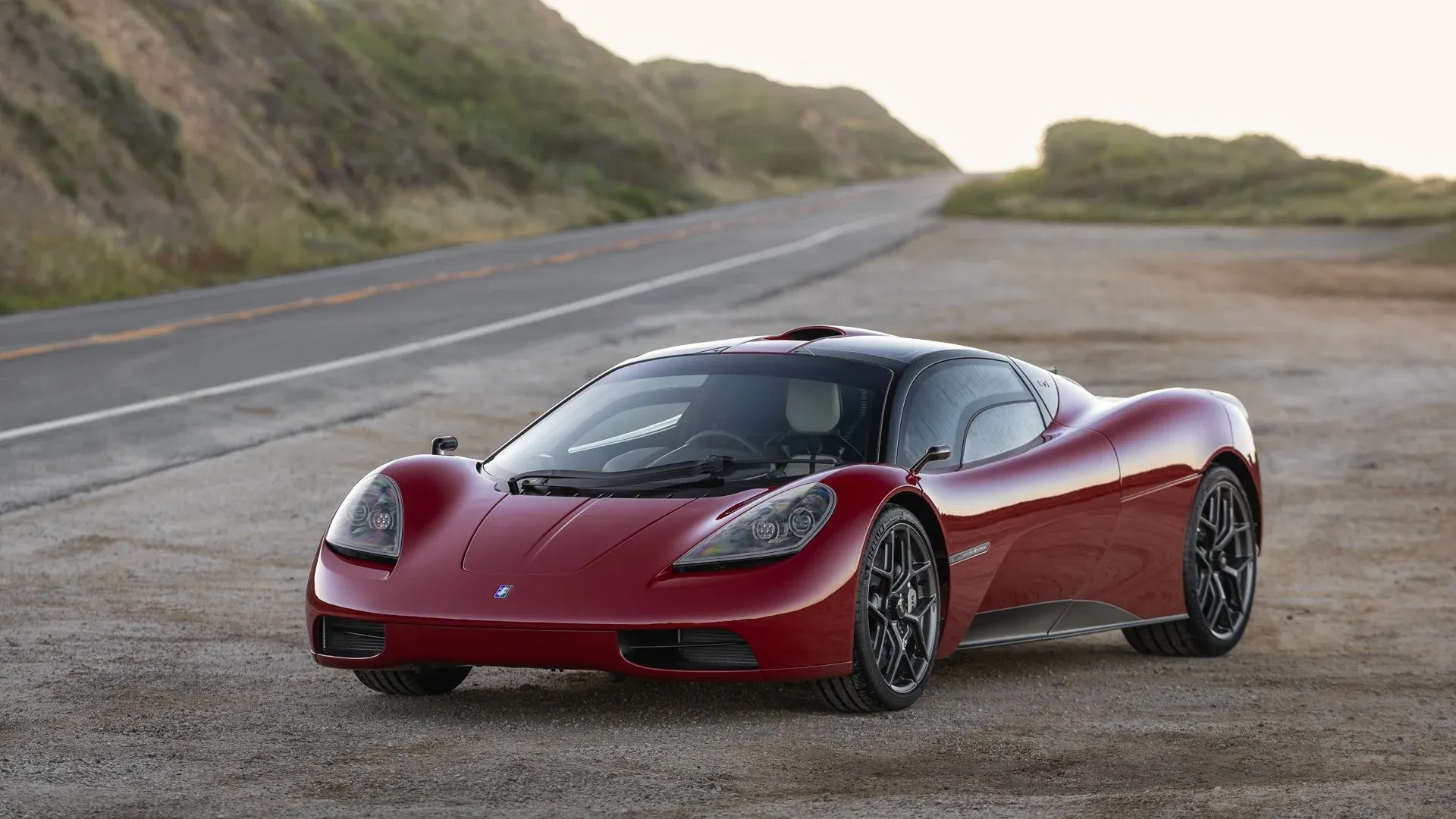
A Gordon Murray T.50 just changed hands for more than $8 million, and the truly wild part is that it has barely turned a wheel. Less than 30 miles on the odometer, and someone still paid roughly $5 million over the car’s original sticker price to own it. That gap alone says a lot about where the hypercar market sits right now, and this wasn’t a one-off outlier either.
The car is a red Gordon Murray Automotive T.50, one of just 100 ever built, and it crossed the block during the California Mille driving event, which already tells you what kind of crowd it was aimed at. Look at the trajectory behind this sale and the pattern is unmistakable: back in December 2025, another T.50 sold for $5.63 million. Same car, same basic proposition, a dramatically different result just months later. A jump like that doesn’t happen by accident. When the T.50 launched, it carried a U.S. sticker price a little over $3 million, already serious money, especially given that it doesn’t fully comply with American emissions and safety regulations. Owners can only legally drive it under the Show or Display exemption, which sharply limits real-world use. You’d expect that restriction to cool demand. Instead, it’s done the opposite, with collectors chasing these cars hard and anyone who missed the original allocation now paying whatever it takes to get one.
That’s essentially what this sale represents: the buyer wasn’t just paying for a car, they were paying for access to something almost nobody else can have. This particular example is chassis number 009 of 100, and with fewer than 30 miles logged, it’s essentially unused. The 3.9-liter Cosworth V12 mounted behind the driver has barely been exercised, and that engine is arguably half the reason the T.50 exists in the first place: naturally aspirated, screaming to redline, built at a moment when nearly everything else in the hypercar space has gone hybrid or fully digital. That mechanical purity is exactly what collectors are chasing, and it’s getting harder to find every year, which is precisely why buyers keep paying up for it.
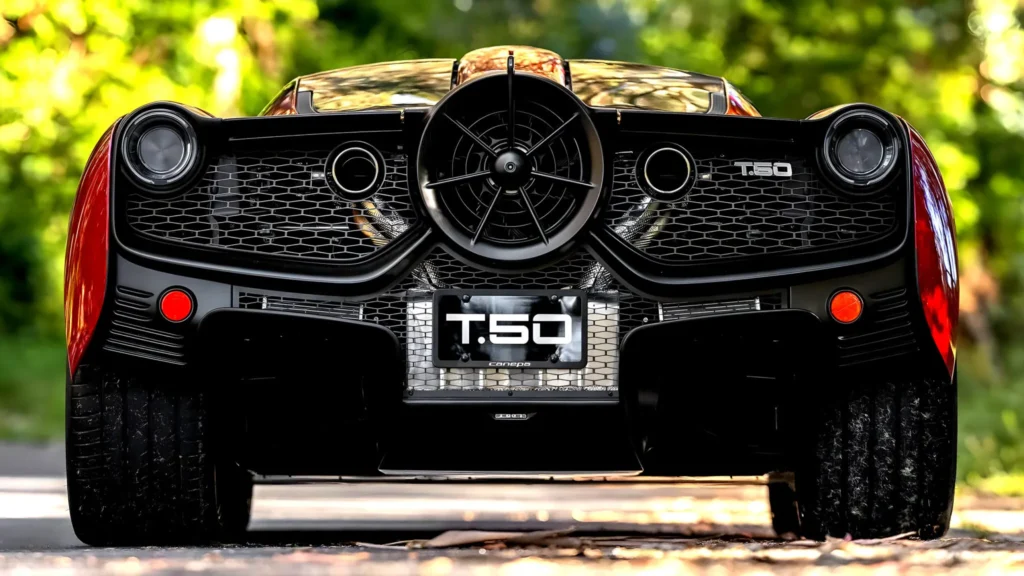
There’s another factor that likely nudged the price higher: a portion of the proceeds benefits the California Highway Patrol 11-99 Foundation and McPherson College’s Automotive Restoration Program. A charitable tie-in at this price level can genuinely move the needle, giving buyers an extra incentive to stretch their bid and sometimes a tax benefit on the back end too. But charity alone doesn’t explain a leap of this size. The bigger story here is raw demand. The T.50 is starting to walk the same path the McLaren F1 walked decades earlier, the car that inspired it in the first place: values climbed steadily, availability dried up, and it eventually became one of the most coveted cars on Earth. The T.50 isn’t there yet, but the trajectory is already visible in sales like this one.
And that’s where it gets complicated. At some point, prices like these stop being about driving and start being about collecting, storing, and waiting, which is arguably already happening here, with one of the most thrilling engines ever built sitting essentially idle under 30 miles. The hope is that the new owner actually drives it, because a car like this isn’t built to sit in a climate-controlled garage. The entire point of the T.50 is the experience: the sound, the feel, the connection between driver and machine. Lock it away purely as an investment and it becomes something else entirely, a very expensive piece of stationary art.
The market, though, doesn’t always prioritize that kind of use-it-as-intended philosophy. Right now the hypercar world is running hot, collectors are active, money is moving quickly, and rare cars are getting snapped up almost as soon as they’re listed. The T.50 checks every box that tends to guarantee rising values: limited production, a legendary designer, and genuinely analog driving in an increasingly digital segment. The only real question is how much further it climbs, and if this sale is any indication, there’s no ceiling in sight yet. Prices are still rising and buyers are getting more aggressive, not less. The Gordon Murray T.50 has officially crossed from a car people buy to drive into a car people buy to own.
About the Author