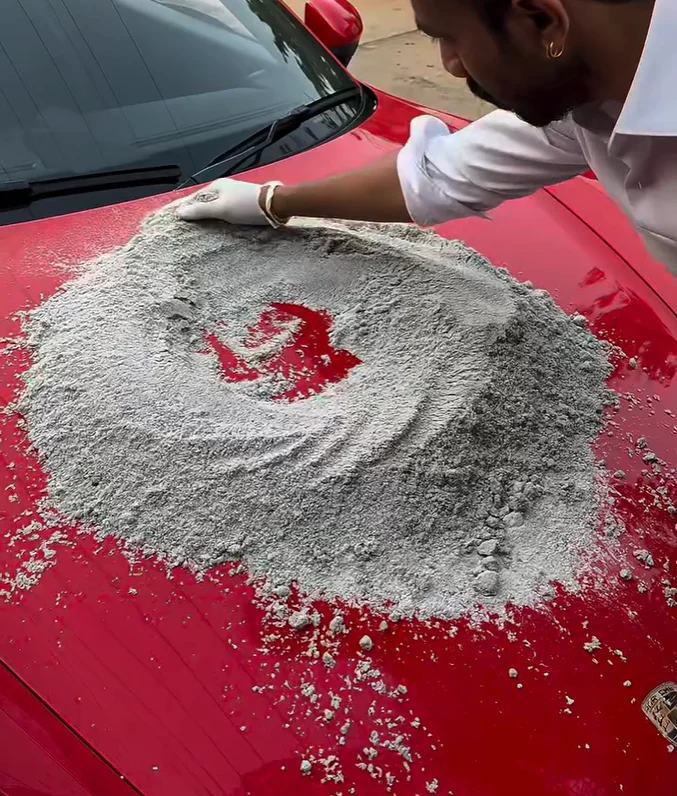
A Porsche Boxster doubling as construction equipment isn’t something you expect to see, but in Bengaluru, that’s exactly what played out on camera. A sports car built around clean lines and careful ownership suddenly became the mixing surface for a batch of raw concrete, and the clip understandably raised questions the moment it started circulating.
At first glance, it looks like pure misuse: a high-end roadster parked on the street with bags of construction material sitting in the frunk, the owner pulling everything out and, instead of setting up on the pavement, dumping it straight onto the hood to mix, right there on the paint. The Boxster isn’t built for that kind of abuse. It’s low, precise, and the type of car owners tend to guard obsessively, so watching someone smear wet cement across the hood plays out like a bad decision in real time.
Except the setup wasn’t as reckless as it looked. After mixing, the owner scoops the concrete up and uses it to patch a pothole in the road, which turns out to be the actual point of the exercise, not destruction, just a rough repair job on a stretch of busted pavement, leaning into a “don’t wait for someone else to fix it” mentality. Reasonable enough in theory. It’s the execution that turns it into a spectacle: doing the mixing in public, on camera, transforms a simple pothole repair into a statement, and once the video started spreading, the pothole itself became an afterthought. All anyone was looking at was the car.
Here’s the twist that explains why the car came out fine: the Boxster never actually took any damage. Once the concrete work wrapped up, the owner peeled away a layer of paint protection film from the hood, and the film had absorbed the abuse rather than the paint underneath, leaving the surface looking untouched. It turns out the owner runs a car detailing business, which explains the confidence. This wasn’t someone recklessly gambling with a sports car, it was someone who understood exactly how far the film could be pushed before it would fail.
That context doesn’t make the stunt normal, though. There’s a thin line between demonstrating a product’s limits and pushing a stunt purely for views, and mixing concrete on a Porsche hood sits right on top of that line. On one hand, it’s a genuinely effective real-world demo of what quality paint protection film can withstand. On the other, it’s an open invitation for copycats who don’t have the same film, the same products, or the same expertise. Remove any one of those variables and the same stunt ends in scratches, chemical staining from uncured concrete, or worse, none of which the clean ending in this video shows.
In the end, a pothole got patched, a sports car stayed spotless, and a video grabbed attention for all the right and wrong reasons simultaneously. But the underlying truth is simple: a Porsche surviving a stint as a makeshift concrete mixer doesn’t make the idea a good one. It just means this particular owner knew exactly how close he could push it to ruining the car, and stopped right before crossing that line.
About the Author