Subaru of America issued a press release on September 22 that is barely a press release. Strip out the boilerplate and you’re left with three sentences: limited-production versions of the 2027 WRX and 2027 BRZ will be shown on September 27 at the York Fairgrounds in York, Pennsylvania, and tickets are on sale. There are no names, production numbers or prices.
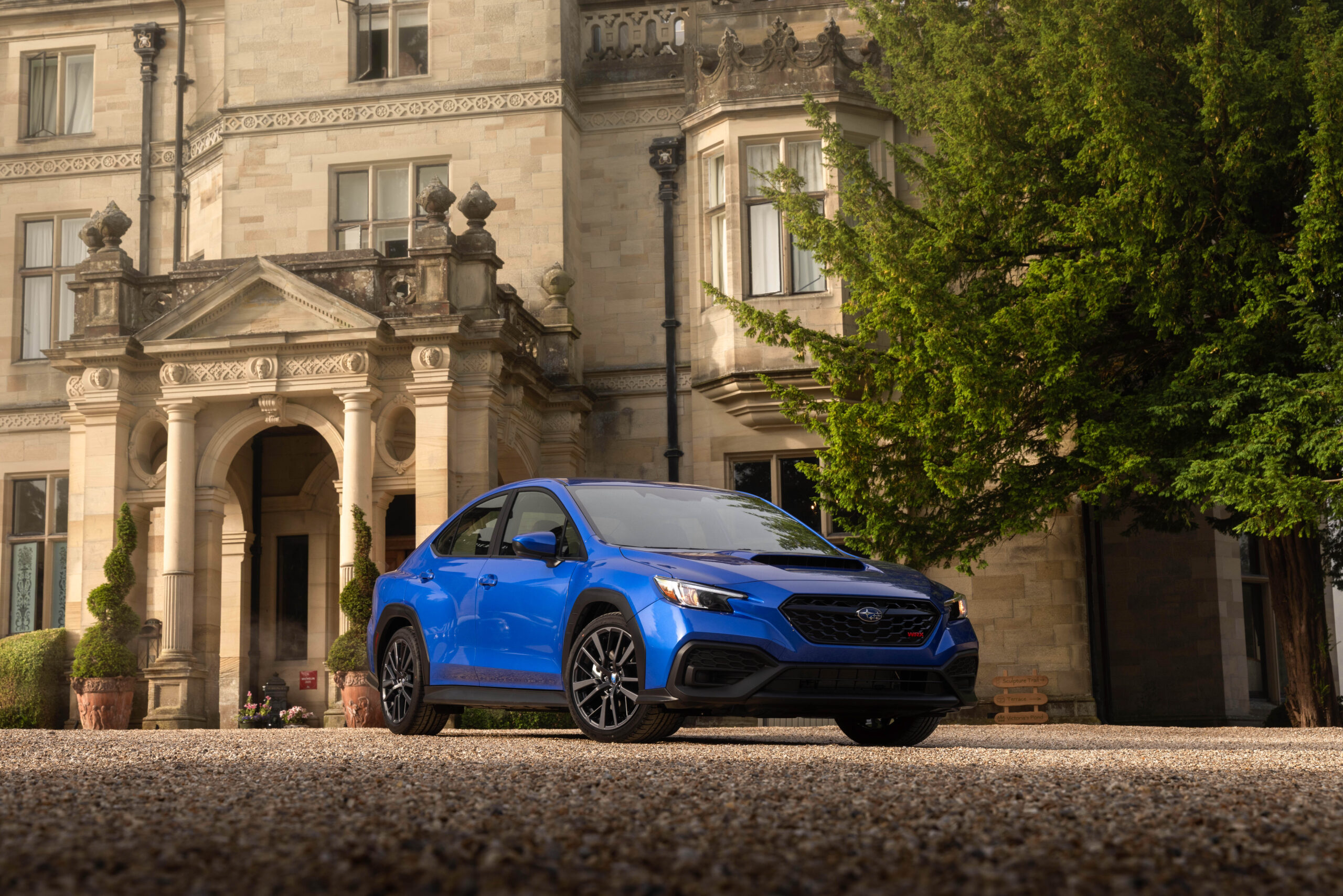
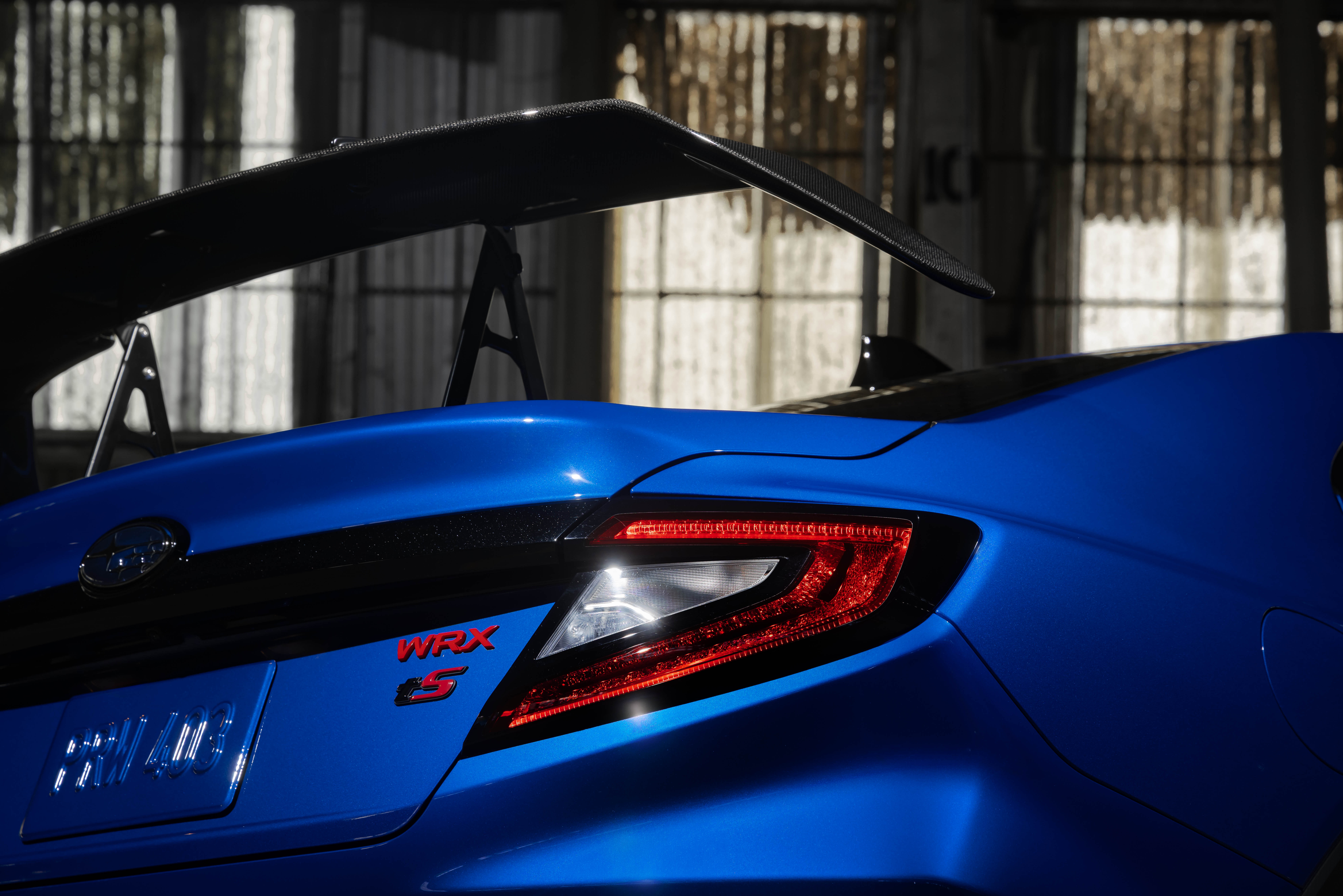
The release came with a single photograph, which Subaru’s media library files under the name 2027 Subaru WRX. It shows a lot more than the text does.
What the photo shows
The teaser is a tight rear three-quarter crop of a car in a deep, saturated blue, lit hard enough to throw a highlight down the quarter panel. You can see the WRX sedan’s C-shaped LED taillight signature, the black trim that wraps the lamp, and a red-and-black tS badge sitting low on the rear quarter. Above the deck, cutting across the top of the frame, is a rear wing on raised pedestals with a visible endplate.
The WRX tS you can buy today doesn’t have a wing. It has STI-tuned electronically controlled dampers, gold Brembo calipers with six pistons up front and two in back, 19-inch wheels wrapped in 245/35 Bridgestone Potenza S007 rubber, Recaro front seats, and a conspicuously flat trunk lid. Subaru has spent the entire VB-generation WRX run avoiding a big wing on U.S. cars, so leading a teaser with one means something.
A fixed wing costs more than it looks like it costs
A decklid spoiler is a styling part. A pedestal-mounted wing is a structural one, because downforce is a load and that load has to go somewhere. A trunk lid is a thin stamped outer panel bonded to an inner frame, engineered to hold itself up and latch, not to resist a few hundred pounds of aerodynamic pull at highway speed. Adding a real wing usually means reinforcement plates, revised inner panel geometry, sometimes a unique stamping, plus fatigue validation so the mounting points don’t start cracking paint at 40,000 miles.
Then there is the balance problem. Bolt rear downforce onto a car that was aerodynamically neutral and you shift the aero center of pressure rearward, which shows up as understeer that gets worse the faster you go. The fix is either front aero to match or a suspension recalibration. The WRX tS happens to be the one WRX with electronically controlled dampers, which means Subaru can rebalance the car in software rather than tooling new springs and bars. For a run of a few hundred cars, that could be what makes the project pencil out.
That’s why this teaser is unusual. Most limited editions are paint, wheels, badges and stitching, because those are the cheapest ways to make a car feel special. Structural aero is the expensive end of the spectrum, and Subaru chose to lead with it.
Boxerfest is now Subaru’s launch pad
This is the second year in a row Subaru has saved a limited sports car reveal for the same fairground in central Pennsylvania. In September 2025 the company used Boxerfest to introduce the WRX Series.Yellow and BRZ Series.Yellow, both built on their respective tS trims, both capped at 350 units, both manual-only, both finished in Sunrise Yellow over matte black wheels with yellow contrast stitching inside. Before that, the WRX TR broke cover at an owners’ event in Florida rather than a convention center.
It makes sense. A press day at a major auto show costs real money and buys you coverage aimed at people shopping crossovers. A Sunday at an owners’ meet costs a booth and a flatbed, and every single person who walks past the car is a plausible buyer for a manual-only, 350-unit sedan. Automakers have been shrinking their auto show budgets for a decade. Subaru appears to have simply moved the budget to where its customers already gather.
Sunrise Yellow itself was a nod backward, a color Subaru had previously used on the first-generation XV Crosstrek here and on the Japan-only BRZ STI Sport and WRX STI S207. That habit of raiding the Japanese-market parts bin for American special editions is a long-running Subaru move, and it is the same reason a certain class of enthusiast keeps a countdown running on the cars America was never allowed to buy. If the 2027 car turns out to wear a name pulled from that same archive, nobody should be shocked.
The BRZ half is much easier to predict
Subaru already priced the 2027 BRZ back in June, which removes most of the mystery. The lineup is two trims deep: Limited at $36,140 with the six-speed manual, $36,990 with the six-speed automatic, and tS at $38,770, manual only, plus $1,245 destination. Power is the same naturally aspirated 2.4-liter flat-four making 228 horsepower to the rear wheels through a Torsen limited-slip differential.
The tS is the interesting donor. It gets STI-tuned Hitachi dampers, Brembo brakes with four-piston front and two-piston rear calipers, and 18-inch wheels on Michelin Pilot Sport 4 tires. For 2027 it also picked up rear parking sensors, and the whole BRZ line moved to a newer EyeSight setup built around a wide-angle mono camera instead of the old stereo pair. In a two-trim lineup where last year’s limited edition was tS-based, there is exactly one sensible starting point for this year’s.
Toyota and Subaru are managing the twins differently. Toyota’s approach to the same chassis has been to fix the things owners actually complain about rather than chase headline horsepower. Subaru keeps the mechanical package stable and sells scarcity, which is the approach that produces cars people flip.
The number Subaru has not published yet
There is still no 2027 WRX price list. For reference, the 2026 lineup runs from $32,495 for the base manual sedan up through $44,995 for the tS, with the Series.Yellow sitting at $45,995, all before the WRX’s $1,195 destination charge. That put last year’s limited edition at a $1,000 premium over the tS for what amounted to paint, wheel finish, badging and stitching.
If the 2027 car really does add load-bearing aero, the premium has more room to move, because there is actual engineering and unique hardware behind it rather than a paint code. Keep in mind where these cars come from, too: both the WRX and the BRZ are assembled in Gunma, Japan, so every dollar of import duty and every swing in the yen lands directly on the window sticker. That pressure is already visible in the financials of automakers selling imported performance cars in the U.S., and small-volume models are the least able to absorb it.
What to do before September 27 if you want one
Start with the math. Subaru of America sells through roughly 640 retailers. If the 2027 cars repeat last year’s 350-unit ceiling, that’s barely one car for every two stores in the country. You won’t order one so much as get allocated one, and allocation is decided by sales volume and by who asked first. Limited runs in the 350-unit range are common across the industry, right down to motorcycle special editions built in the same quantities, and they usually sell out long before the trucks arrive.
Get any allocation commitment in writing with a stock or order number on it, keep your deposit refundable, and do not sign an addendum before a VIN exists. On the insurance side, call your carrier before delivery rather than after. Factory aero is OEM equipment and gets replaced as such, which is a meaningfully different claim than an aftermarket wing that many policies treat as a custom part subject to a dollar sublimit. If you intend to keep the car long term, ask about agreed-value or stated-value coverage, because standard actual-cash-value settlements do not understand why a 350-of-350 build number is worth anything.
Think about repairs, too. A model-specific trunk lid, wing, or endplate is a part number that exists in small quantities, which means a parking-lot tap can become a three-month backorder. Photograph the car and save the build documentation on day one. Resist the urge to swap the aero for something from a catalog; on a car whose whole appeal is factory originality, leave it alone and buy a set of track wheels instead.
If the allocation game goes badly, there’s always the long way around. Subaru’s most extreme factory sedans have historically stayed in Japan, and the 25-year rule keeps turning yesterday’s forbidden imports into legal American driveway ornaments on a rolling basis.
The tS badge means the good dampers and brakes are already in the recipe, and the wing means somebody in Gunma signed off on structural changes. The York Fairgrounds reveal on September 27 will show whether that adds up to a proper send-off for the manual WRX.
About the Author