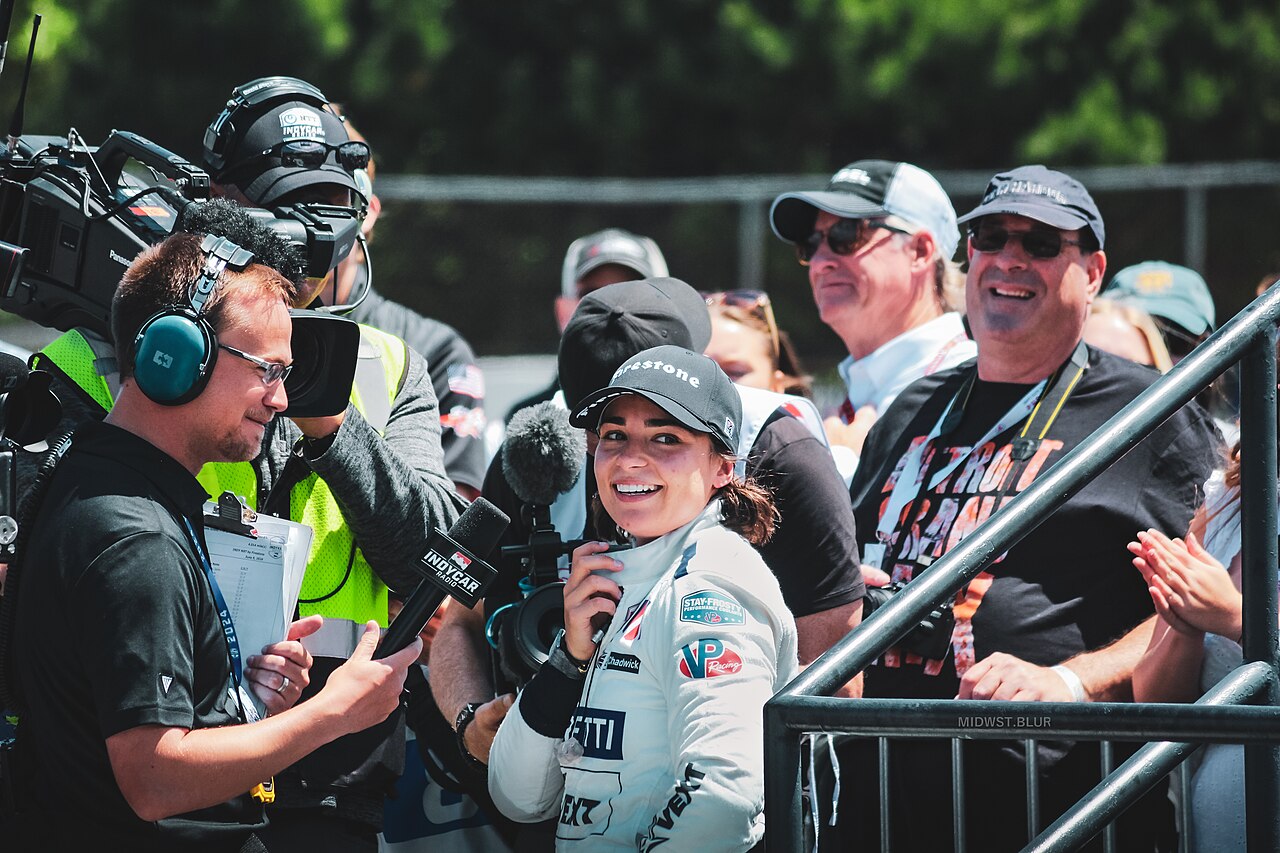
Jamie Chadwick, pictured during her Indy NXT stint at Road America in 2024. Photo: <a href="https://commons.wikimedia.org/wiki/File:Jamie_Chadwick_(53784756947).jpg">MIDWST.BLUR</a> / <a href="https://creativecommons.org/licenses/by/2.0/">CC BY 2.0</a>
Thirty-two laps doesn’t sound like a lot. At the Autódromo Internacional do Algarve, though, that’s roughly 150 kilometers of blind crests, downhill braking zones and corners that load a car up and then drop it out from under you. On Monday, September 21, Jamie Chadwick ran every one of those kilometers in the Williams FW47.
The team confirmed the run on September 24. It makes the 28-year-old Briton only the second woman to test a Williams Formula 1 car, and the first since Susie Wolff in 2015. Williams says video from the day will be released across its own channels and Sky F1 during this weekend’s Azerbaijan Grand Prix.
Williams also had a practical reason to send someone to Portugal in a car it no longer races.
Williams Wasn’t Just Taking Photos
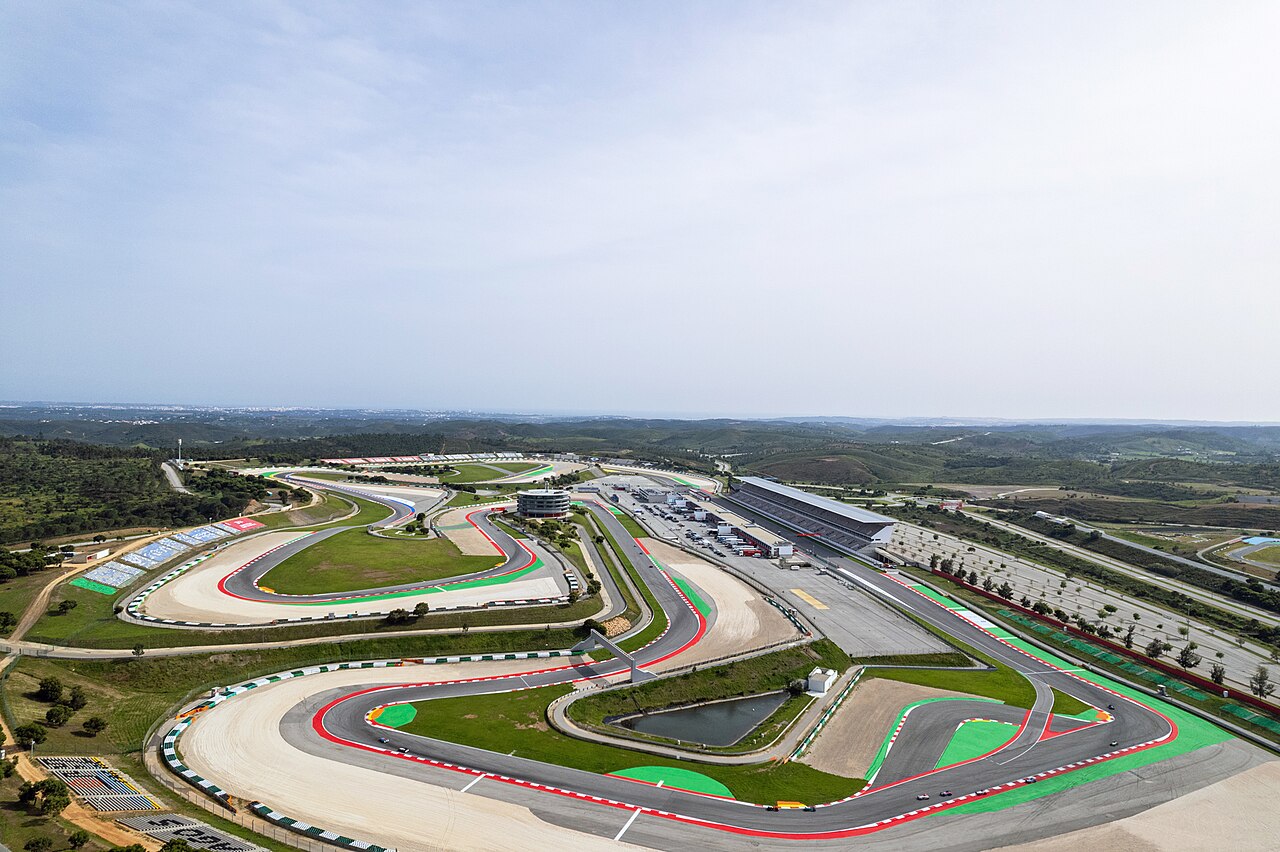
Formula 1 is going back to Portimão. A two-year deal announced in December 2025 puts the Portuguese Grand Prix on the calendar for 2027 and 2028. The track hosted F1 only twice before, in 2020 and 2021, when the pandemic sent the sport looking for any FIA Grade 1 circuit that could put on a race. Portimão has stayed busy since, including as a stage for GT3 machinery, but a modern F1 team’s picture of the place is five years old and was built with a completely different generation of car.
Team principal James Vowles didn’t dress this up as a joyride. He said Chadwick “gathered important data for the team as F1 prepares to return to Portimão next year,” and called her feedback and performance “impressive.”
A 2025 car won’t give Williams a setup sheet for a 2027 race. Ride heights, spring rates and aero maps won’t carry over, but the circuit will. Every team runs a detailed digital model of each track in its simulator, and that model is only as good as the real-world numbers used to check it. Portimão’s elevation changes are the whole problem: big compressions and crests hit a car in the vertical direction, and that shows up in the suspension loads, the kerb strikes, the bump profile through the fast stuff and how the tires take the punishment. Laps with a fully instrumented F1 car let engineers compare what the sim predicts against what a real car actually felt. That’s worth something to a team that will arrive in 2027 with limited practice running like everybody else.
What “TPC” Means
Williams labels the outing a TPC test. That stands for Testing of Previous Cars, and it’s the narrow gap the FIA leaves open in a sport that otherwise bans private testing. Teams can’t simply roll a current car out whenever they like. Older machinery is a different matter, but even that comes with a fence around it.
Under the 2025 Sporting Regulations, for example, TPC running was capped at 20 days a year per team, limited to FIA Grade 1 or 1T circuits, and banned at a venue within 60 days of a championship event there. Race drivers were held to 1,000 km a year across no more than four days. The cars also had to stay in period spec, using only parts and software that had already appeared at a race or official test. The FIA has since rewritten the rulebook for the 2026 regulation era, but the intent hasn’t changed: old cars are fine for mileage and driver running, not as a secret development program.
That’s also why the FW47 makes sense for this. It’s the last car Williams built under the ground-effect rules that ran from 2022 through 2025, with the V6 hybrid that still used an MGU-H. The 2026 cars dropped the MGU-H, lean far harder on electrical power and use active aerodynamics. Very little of what Chadwick learned about how the FW47 behaves goes straight into the current car. What she learned about Portimão is a different story.
It’s not a random old chassis either. Williams credits the FW47 with three podiums in 2025 and the team’s best constructors’ finish since 2017. When the team talks about Chadwick getting a proper F1 experience, it handed her the best car it’s built in close to a decade.
The Résumé Behind the Seat Fitting
Chadwick isn’t new to Williams. Williams’ own records show she was in the team’s driver academy as a development driver back in 2019, working in the simulator at Grove. Before this test she went back to Grove for gym work, sim running and a seat fitting. That last one is not a formality. An F1 seat is custom-molded to the driver’s body, since there’s no room for padding and the driver’s back, hips and shoulders need to transmit what the chassis is doing without anything in the way.
Her record got her that seat. Chadwick won three W Series titles, in 2019, 2021 and 2022. In 2015 she became the first woman to win a British GT title, and she was the first woman to win a British F3 race, at Brands Hatch in 2018. In the U.S., Williams notes, she was the first woman in 13 years to race full-time in Indy NXT, the first in 14 years to reach the podium and the first in 15 years to win. These days she races an IDEC Sport LMP2 car in the European Le Mans Series, is a reserve driver for Genesis Magma Racing in the World Endurance Championship, and works as Williams’ F1 Academy adviser.
An 11-Year Gap
Chadwick’s own reaction was pure driver: “Few things can prepare you for driving a Formula 1 car at speed around a track like Portimão, but it was everything I imagined and 10 times more.” She also went further than most drivers ever do in a press release, calling it possibly “the best day of my life so far.”
She credits Susie Wolff with lighting the fuse. Chadwick remembers watching Wolff climb into a Williams when she was young, and says she’d like to do the same for the next generation. Wolff drove in Friday practice and testing for Williams across 2014 and 2015. Nobody followed her into a Williams cockpit for 11 years.
Williams places Chadwick in the same company as Maria Teresa de Filippis, the first woman to enter a world championship Grand Prix, back in 1958, and Lella Lombardi, still the only woman to score in an F1 race, with a half-point at the shortened 1975 Spanish Grand Prix. It also notes she’s the first British woman to drive a modern F1 car since 2023, when Jessica Hawkins ran an Aston Martin in Hungary. In this sport, “the first in years” still counts as progress.
A Test, Not a Race Seat
A TPC day isn’t an FP1 session, and it isn’t a step on a published path to a race seat. Williams hasn’t announced any race-weekend running for Chadwick, and any Friday outing would require the driver to meet FIA super licence requirements. Timing the footage release for a race weekend, with a TV partner, also tells you this was a media moment as much as an engineering one.
It can be both. Williams got real laps from a driver with a 14-year career in single-seaters and sports cars, at a venue it needs to understand, and the sport got a reminder that the cockpit isn’t the problem. Vowles framed it as proof that “there is a path for women to compete at the top level,” and said he wants Chadwick to feed what she learned back to the team’s young drivers.
You can catch the footage this weekend on Apple TV’s F1 coverage or wait until the circus rolls into Austin later this season. Either way, Chadwick clearly belongs in the car. The harder question is whether anything follows once the cameras are packed up.
Photo credits: Jamie Chadwick by MIDWST.BLUR (CC BY 2.0); Autódromo Internacional do Algarve by Vitor Oliveira (CC BY-SA 2.0), via Wikimedia Commons.
About the Author