Photo: Mecum
Mecum’s first Nashville sale leans on cars from the Roush Automotive Collection. The headliners are a Boss 429 with a very unusual heart, a Paul Newman endurance winner, and a Trans-Am car that forgot how to lose.
Mecum is christening its new Nashville sale at Nashville Superspeedway, Sept. 23 through 26, and it picked a headliner with plenty of Ford blue in its blood. In its event announcement, the auction house says selections from the Roush Automotive Collection will cross the block, drawn from a Detroit-area collection of more than 150 vehicles assembled over 38 years. Mecum describes it as the first time collectors can buy a car out of that private reserve.
Note the word “selections.” This isn’t a dispersal. It’s Roush pulling a handful of cars off the shelf in the middle of a birthday party.
Why now: Roush turns 50
The timing lines up with a corporate milestone. Roush’s own anniversary timeline starts in 1976, when Jack Roush formed Jack Roush Performance Engineering, and it’s a fun read for anyone who thinks of Roush only as a Mustang badge or a NASCAR team. In 1981, Roush formed Engine & Control Systems with former Ford engineering managers, and that company received EPA approval to do emissions testing work. Roush Racing followed in 1983, and its 1984 Trans-Am teams won eight races while helping Ford take the championship. The engineering business became Roush Industries in 1991 and now spans aerospace, theme-park ride vehicles, and propane school-bus fuel systems.
There’s a certain poetry in a company that earned EPA approval for emissions work in 1981 now auctioning a Mustang stuffed with a Pro Stock drag engine. Engineers contain multitudes.
Related Articles
- Lia Block Just Beat Every Car at Ojibwe, Not Just the Field in Her Class
- Toyota’s Hydrogen Truck Math: 1,500 Rigs, 30 Stations, One Break-Even Number
The racing résumé needs no inflation. When NASCAR gave Roush its Bill France Award of Excellence in January, the award announcement credited his teams with 331 combined victories across NASCAR’s three national series and noted he’s the first person to receive that award twice. He was inducted into the NASCAR Hall of Fame in 2019.
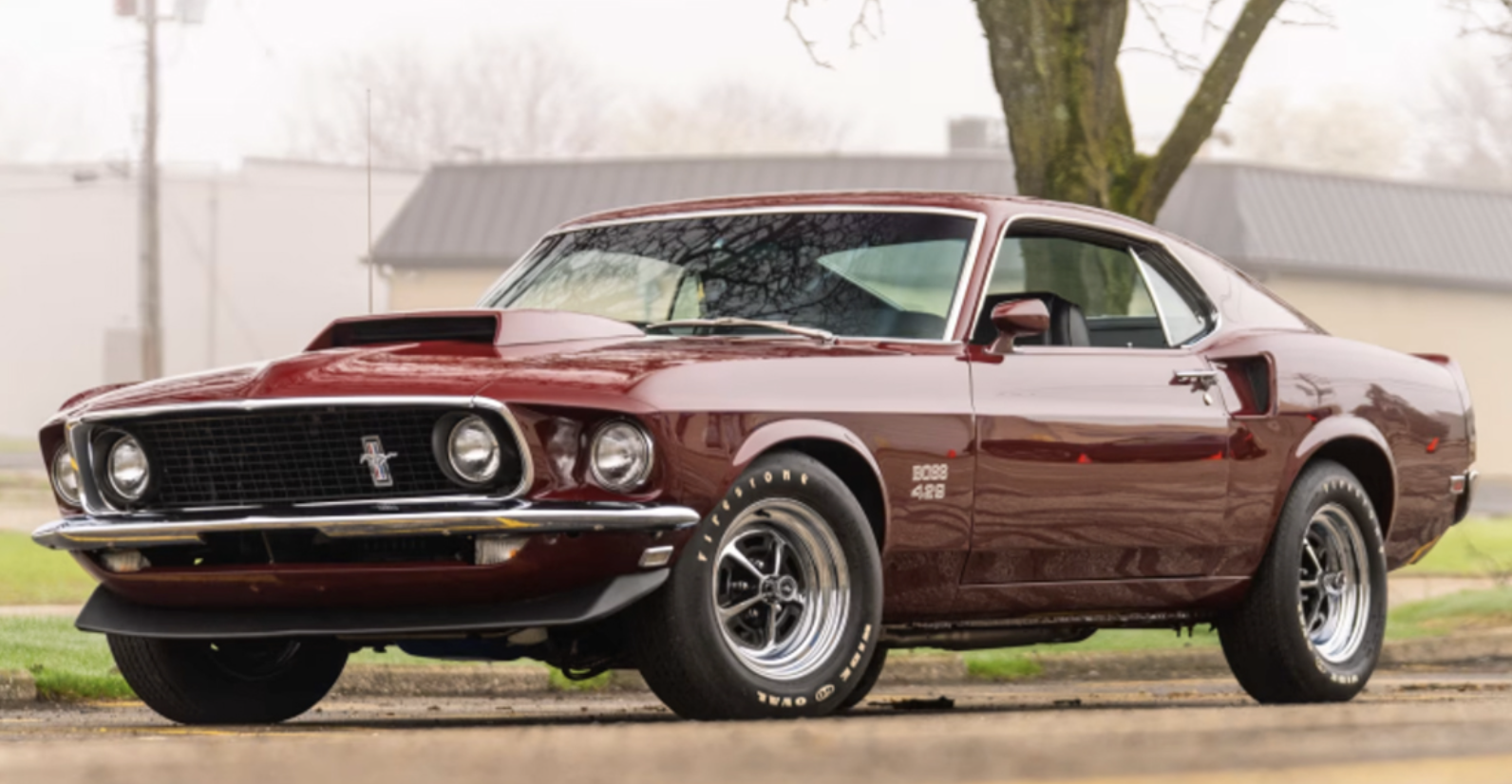
Lot V448: a Boss 429 that doesn’t run a 429
The 1969 Mustang Boss 429 Fastback is the car with the most interesting contradiction. Mecum identifies it as KK No. 1429, says it’s one of Jack Roush’s favorite cars in the collection, and says it now carries a 460 cubic-inch short-block V-8 Pro Stock engine built by Roush himself.
A quick primer on why that matters. The Boss 429 existed because of racing paperwork. A Norwegian Ford dealer’s sales listing for another example lays out the basics: NASCAR rules required the 429 to be installed in at least 500 road cars before it could race, the engine was too big for a stock Mustang, and Kar-Kraft made it fit by moving the shock towers and reworking the inner fenders. That same listing says the first Boss 429 carried the number KKXX1201 and that its own car, KK 1432, is an early S-code example with magnesium engine parts that distinguish the first series from later ones.
If the numbers ran sequentially from 1201, KK 1429 was about the 229th Boss 429 built, and it sits just three numbers ahead of that documented S-code car. That’s an inference, not a certainty, and it’s the first question I’d put to Mecum’s specialists.
The second question is the big one: where’s the original engine? In the Boss 429 world, the semi-hemi 429 is the whole point of the car. A 460 short-block means a Ford big-block bottom end, with its block, crank, rods, and pistons, and “short-block” says nothing on its own about which cylinder heads and induction sit on top. So this car is really two collectibles in one body: a low-numbered homologation Mustang and a drag engine with Jack Roush’s hands all over it. Which half carries more value depends on the buyer. A Boss purist will want to know whether the numbers-matching 429 comes with the car. A Roush collector may not care at all. Everyone should ask for the build records and dyno sheets before raising a paddle.
Lot V462: Paul Newman’s 70th birthday present
The 1995 Mustang Cobra “Nobody’s Fool” IMSA car may be the most charming story in the group. Mecum lists it as Roush Racing chassis No. 23, winner of the GTS-1 class and third overall at the 1995 Rolex 24 at Daytona with a driver lineup that included Paul Newman, Tommy Kendall, and Mark Martin. Paramount Pictures sponsored it with leftover marketing money from Newman’s film Nobody’s Fool, and the car wore No. 70 for Newman’s 70th birthday.
Roush’s own timeline also calls out that 1995 Daytona class win, which is a good sign that this car is central to the company’s story rather than a filler lot. Mecum describes it as remarkably preserved. Buyers should find out exactly what that means. A car wearing its original race-worn finish and hardware is a different asset than one that’s been freshened for display, and the premium for untouched history in endurance-racing provenance can be significant.
Lot V463: the Trans-Am car that just kept winning
The third headliner is the 1997 Mustang Cobra SCCA Trans-Am car. Mecum says Tommy Kendall drove it to a record-setting 11 wins and the SCCA championship for Roush Racing that year. It’s a fitting bookend to a Roush road-racing program that, by the company’s account, started in Trans-Am in 1984.
For a certain kind of collector, this is the smart buy of the trio: a championship-winning car from a single, well-documented season, driven by one driver, with a team owner whose archive presumably holds the paperwork. That’s the kind of chain of custody that makes race cars easier to value and easier to resell.
What bidders should sort out first
Race cars are not just old cars without license plates. Before bidding on the IMSA or Trans-Am Mustang, find out what ownership documents come with each lot. Purpose-built competition cars can change hands on a bill of sale rather than a state title, and that affects registration, transport, and financing.
Then look at the safety hardware as if you were going to strap in tomorrow. Check the date labels on the belts, the fuel cell, and every other piece of safety equipment, and assume a car that’s spent years on display will need current parts before any vintage-racing organizer lets it on track. Ask for engine and gearbox rebuild history, hours or miles since the last refresh, and any spares that come with the car. Race engines are consumables with serial numbers.
Related Articles
- A Car Ended Up Balanced on an Atlanta Overpass Beam, and the Driver Walked Away From It
- Rivian R1T Protest Truck in Denver: What the Warranty and Lemon Law Actually Say
Insurance deserves a phone call before the auction, not after. Many collector-car policies are written around road use and display, and competition use is often handled differently. If you plan to put either race car on track, get that coverage confirmed in writing. For the Boss 429, make sure your agreed-value policy reflects both its Boss 429 identity and the Roush engine provenance, since a claims adjuster won’t sort that nuance out for you.
Finally, budget for the auction house’s buyer fees and transport on top of the hammer, and ask Mecum what Roush documentation, certificates, or letters travel with each car. With a collection this closely tied to one man and one company, the paperwork is part of what you’re buying.
Mecum’s Nashville debut gets a headline act worth the price of admission. The real question for bidders isn’t whether these cars matter. It’s which part of the Roush story each one is actually selling.
Images Via: Mecum
About the Author