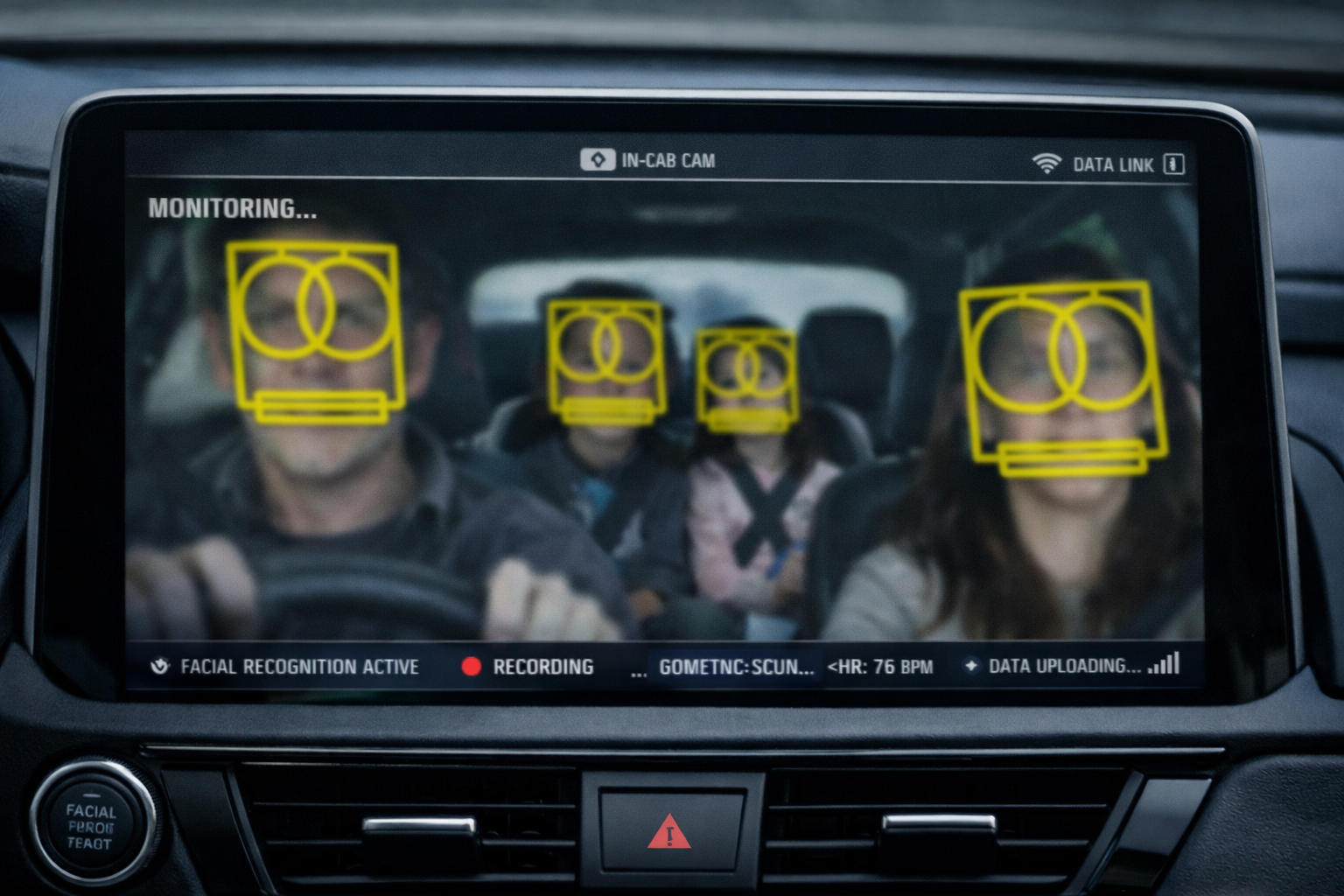
By 2027, every new vehicle sold in the United States could come with something many drivers never asked for: a built-in system constantly watching them behind the wheel. Not checking tire pressure, not monitoring engine temperature, but watching the driver.
The Push Toward Mandatory Driver Monitoring
Under a federal safety initiative aimed at reducing impaired driving, automakers are moving toward technology that actively tracks driver behavior in real time using cameras and sensors, designed to monitor eye movement, head position, attention levels, and signs of possible impairment or fatigue. The requirement is tied to a broader federal effort targeting impaired driving, and on paper the goal is straightforward: lawmakers want technology capable of reducing crashes caused by drunk, distracted, or fatigued drivers. To make that happen, automakers will need systems capable of continuously evaluating the person behind the wheel while the vehicle operates.
That’s a meaningful difference from existing safety equipment. Airbags sit quietly until needed. Traction control only engages during a loss of grip. Driver-monitoring technology operates constantly, meaning the vehicle is no longer just responding to road conditions, it’s actively studying the driver. For many enthusiasts and everyday commuters, that changes the relationship between driver and machine in a real way. Supporters see it as the next major leap in crash prevention; a growing number of drivers see something else entirely, describing it as the beginning of cars becoming rolling surveillance platforms capable of deciding whether the owner is even allowed to drive.
When the Car Starts Deciding
This is where the debate gets uncomfortable. If a system believes the driver may be impaired or dangerously inattentive, it may not stop at a warning light or alert chime — depending on how manufacturers implement the technology, the vehicle could limit operation or prevent the car from starting entirely. That means a software system becomes the deciding authority over whether someone can drive their own vehicle. For drivers already frustrated by increasing layers of automation, that feels like a meaningful shift in control. Cars have steadily added more electronic intervention over the years, but most of those systems still left the driver as the final decision-maker; this changes that balance.
The False Positive Problem
No monitoring system is perfect, and that’s the part making a lot of people nervous. Fatigue detection sounds simple in theory until real-world driving enters the picture — drivers glance away from the road constantly to check mirrors, navigation, gauges, blind spots, and surrounding traffic, and some people naturally appear tired late at night even while fully alert. That creates obvious concerns about false positives: a system interpreting normal behavior as impairment could interfere with someone simply trying to get home safely. Once the vehicle has authority to intervene, even small software mistakes become a much bigger problem. Drivers are used to dealing with mechanical failures; they aren’t used to arguing with their own car about whether they’re capable of driving it.
The Bigger Issue Sitting in the Background
The monitoring itself is only part of the concern — data collection may end up being the bigger fight. These systems rely on continuous observation, generating information about driver behavior over time, including attention patterns, distraction events, and how the system interprets the person behind the wheel. Drivers immediately started asking the obvious question: where does all of that information go? Right now, there’s no single clear answer covering every manufacturer or system, and concerns are already growing around whether that data could eventually be shared with insurance companies, automakers, or law enforcement. For privacy-conscious drivers, this starts looking less like a safety feature and more like a permanent behavioral tracking system built into every new vehicle, a shift that changes the conversation considerably.
Safety Technology or Driver Oversight?
Supporters of the technology argue the purpose is straightforward: if monitoring systems reduce impaired-driving crashes, they could save lives, and that’s difficult to argue against since nobody wants dangerous drivers on public roads. But critics are focusing on the method rather than the goal. This isn’t simply emergency braking or collision avoidance, it’s active surveillance every time someone gets behind the wheel. Drivers don’t opt in, and they can’t permanently disable the requirement — the system operates because the car requires it to. People aren’t just debating safety anymore; they’re debating ownership, authority, and control, because once software can determine whether a driver is “approved” to operate a vehicle, the car itself starts becoming something very different.
An Industry Shift Already in Motion
This technology didn’t appear overnight. Modern vehicles already contain growing layers of automation and driver-intervention systems — lane-keeping assistance, adaptive cruise control, automatic emergency braking, and attention monitoring have slowly reshaped the driving experience over the last several years. This rule would take that evolution a step further by turning the focus directly onto the driver rather than the road alone, which is why this becomes bigger than one federal rule. There’s also a financial side buyers can’t ignore: advanced camera systems, sensors, and monitoring hardware add cost to vehicle production, and those expenses get passed directly to consumers through higher prices, meaning buyers may end up paying more for technology they never specifically wanted while also gaining a system capable of limiting how their vehicle operates based on software interpretation.
The relationship between drivers and vehicles is changing in real time. Cars are evolving from tools controlled entirely by humans into machines increasingly capable of supervising the people operating them. Some drivers may welcome that shift; others see it as the beginning of a future where technology steadily removes human authority from the driving experience, piece by piece. By 2027, this debate will no longer be theoretical — these systems could be sitting inside every new car sold in America, constantly watching, evaluating, and deciding, and once that technology becomes standard equipment, drivers may find there’s no easy way to go backward.
About the Author