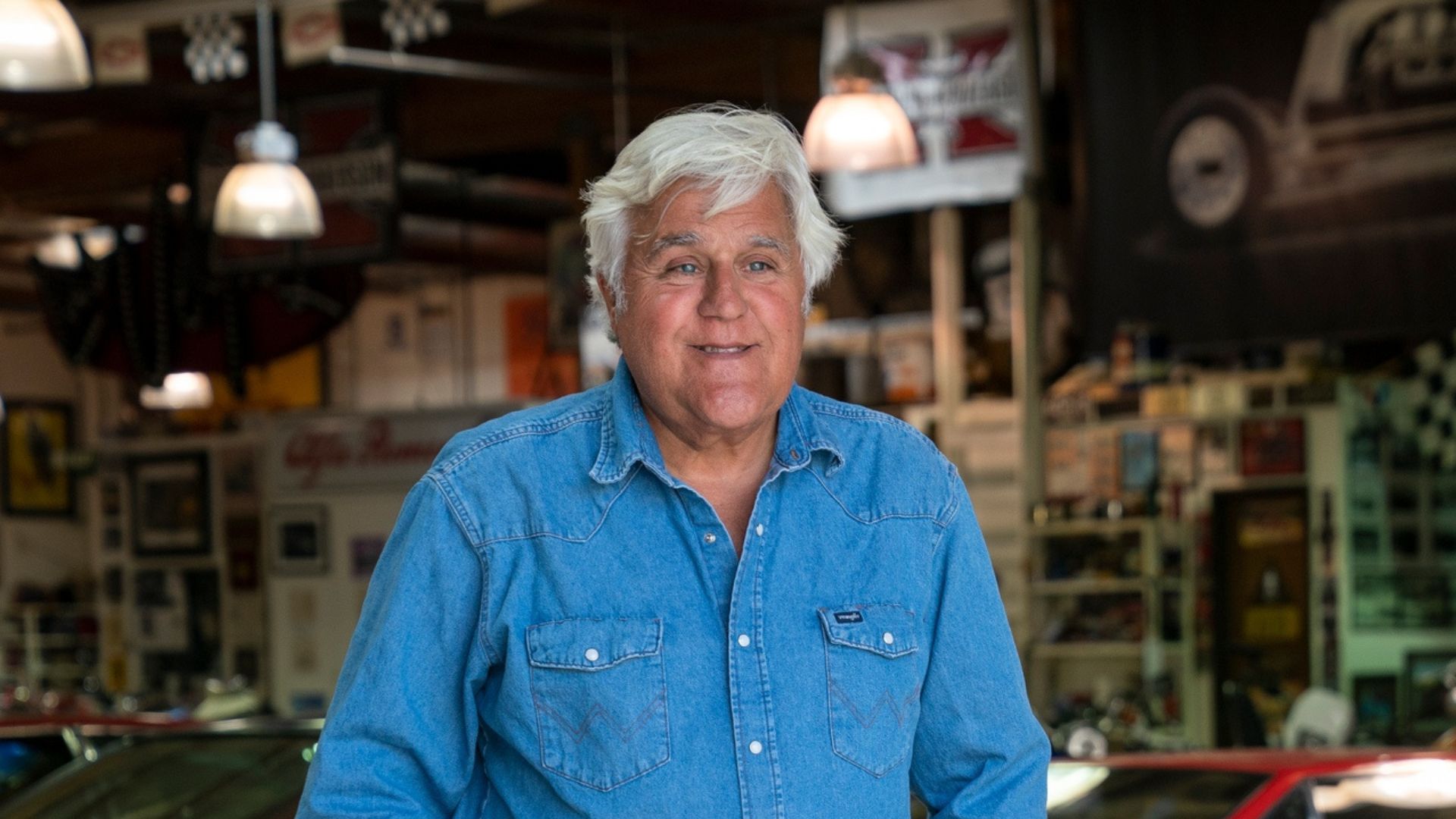
Image via Jay Leno’s Garage/Facebook
Senate Bill 1392 spent this week sitting at item 217 on the California Assembly’s third reading file, which is the least dramatic possible description of a bill that would finally cut collector cars loose from the smog check. It got there on August 13, when the Assembly Appropriations Committee suspended Rule 63 and voted it out 15–0. Last year’s version of the same idea walked into that room in August 2025 and never walked out.
The bill does not leave the branding to anybody else, either. Section 1 reads, in its entirety: “This act shall be known, and may be cited, as Jay Leno’s Law.”
What the exemption actually covers
California currently hands out exactly one age-based smog pass: vehicles built before the 1976 model year. That line has not moved since April 1, 2005, when AB 2683 scrapped the old 30-year rolling exemption and froze the cutoff in place. Worth remembering before anyone frames this as a partisan brawl — that bill was carried by a Democrat, signed by a Republican governor, and it is the entire reason your 1977 Trans Am visits a smog station and your neighbor’s 1975 does not.
There is a collector carve-out already on the books, and it is thinner than most owners think. A car at least 35 model years old and insured as a collector vehicle skips the visual and functional portions of the test — the under-hood scavenger hunt for missing air pumps and EGR plumbing — but it still has to meet the tailpipe standards for its class and model year, and still has to pass a fuel cap pressure check and a look for liquid leaks. Fail the sniffer and you are in the same hole as a Camry owner.
SB 1392 swaps that partial pass for a real exemption, and it applies it in all three places the certificate normally bites: initial registration, biennial renewal, and transfer of ownership. Qualifying collector vehicles built before the 1981 model year come out from under it first. Then it steps forward one model year at a time — pre-1982 on January 1, 2028, pre-1983 in 2029, pre-1984 in 2030, pre-1985 in 2031, and pre-1986 on January 1, 2032, where the escalator stops for good.
The definition is the whole ballgame
Here is the part that gets skipped in the celebration. The Health and Safety Code language does not exempt “collector motor vehicles” generally. It exempts vehicles meeting paragraph (1) of subdivision (a) of Vehicle Code Section 259 — one specific paragraph, and SB 1392 rewrites the section around it.
As amended, Section 259 recognizes three routes to collector status: a car at least 35 model years old that is either insured as a collector vehicle with proof filed at the DMV or determined, through a process the department has to build, to be driven fewer than 1,000 miles a year; a vehicle qualifying under Section 5004, the horseless-carriage and historical-vehicle track; or a “special interest vehicle” under Section 5051. Only the first one buys you the smog exemption. The other two are along for the ride on the definition and nothing else.
Every qualifying car also has to clear subdivision (b): used primarily in shows, parades, charitable functions and historical exhibitions for display, maintenance and preservation, and not the owner’s primary mode of transportation. That last clause is the tell. This bill is written to be defensible against the obvious criticism — that a smog exemption for old cars is really a smog exemption for cheap daily drivers — and the drafting reflects a session’s worth of amendments in both houses.
The suspense-file math that trapped it last year
Bills with real state costs get parked on the Appropriations suspense file, where most of them quietly stop existing. Last year’s SB 712 was held there in the Assembly on August 29, 2025, with no vote and no obituary. Understanding why takes about ninety seconds with the fiscal analysis.
Cost side: the DMV faces unknown one-time IT costs the Senate Appropriations Committee pegged in the “mid- to high-hundreds of thousands of dollars,” plus ongoing workload in the “low hundreds of thousands of dollars annually.” The Air Resources Board estimated roughly $1.59 million a year and 7.2 positions to quantify the forgone emission reductions and find replacements for them.
Revenue side: if 20 percent of eligible 1976–1980 vehicles claim the exemption, the state loses about $38,000 in smog certification fees in year one. At 50 percent uptake, about $95,000. By 2032, with the full 1976–1985 pool eligible, those figures grow to roughly $89,000 and $223,000.
Read those two paragraphs together and the politics snap into focus. Sacramento was never protecting $95,000 in fee revenue. It was staring at an administrative bill several times larger than the exemption is worth, attached to a program serving a constituency that does not show up in air-quality models. That is exactly the kind of bill the suspense file exists to swallow — and it is why getting off suspense, not the floor vote, was the hard part.
The sleeper provision is the sale
Most coverage of this fight fixates on the biennial renewal. The transfer-of-ownership exemption is the one that will change behavior fastest. In California the certificate has to be produced when the car changes hands, and in practice the seller eats it. Anyone who has tried to move a carbureted 1979 anything knows how that conversation goes: the car fails, the buyer discovers leverage, and $400 of “let me just get it to pass” work turns into a renegotiation.
Delete that step and you remove a standing tax on every private sale in the segment. Do not expect a valuation spike — late-’70s malaise metal is not blue-chip muscle, and the eligible pool is small — but friction has a price, and on a $12,000 car a $400 problem is real money. The staged rollout also gives the market something it rarely gets from Sacramento: a published schedule. If you are shopping an ’84 or ’85, you now know the year the paperwork problem is supposed to disappear.
Why these cars fail in the first place
The committee record includes the useful number here: roughly 108,000 vehicles from the 1976–1985 model years were smog tested over a two-year window, and about 23,000 of them failed — a 21 percent failure rate. Both camps cite it. Supporters see 23,000 owners chasing parts that stopped being manufactured during the first Reagan administration. Opponents see 23,000 cars that would have kept driving around dirty.
Mechanically, this era is genuinely miserable to certify. These engines run carburetors strangled by vacuum-routed emissions hardware, air injection pumps, EGR valves and first-generation catalysts, and by the turn of the decade they start picking up feedback carbs and primitive engine computers with no OBD port to interrogate. Diagnosis is a flowchart, a vacuum gauge and a technician who was doing this work when it was new. Replacement emissions parts need CARB approval to be legal, and for a lot of these applications nobody is bothering to certify them anymore.
The state’s backstop is thin. The Bureau of Automotive Repair’s Consumer Assistance Program will put up to $1,100 toward emissions repairs on a 1976–1995 vehicle, but only if it failed its biennial inspection and household income sits at or below 225 percent of the federal poverty level. That is a program for someone’s only car, not someone’s second Corvette.
The opposition is not imaginary
Seventeen organizations registered against the bill, including the California Air Pollution Control Officers Association, the American Lung Association, the Natural Resources Defense Council, the Sierra Club, the Bay Area Air Quality Management District and the Union of Concerned Scientists. Their argument in the committee file is narrower than “old cars are dirty”: most Californians still breathe air that misses federal or state health standards, the Air Resources Board has documented a 165-ton-per-day NOx shortfall it has to make up somewhere, and an exemption keyed to collector status removes the one routine inspection that would catch a tampered emissions system.
The sponsor, SEMA, put California’s specialty aftermarket at $40.44 billion in economic impact and 149,325 jobs, and pointed out that a BAR-97 inspection can run north of $200. SEMA has spent the last few years pushing on the certification side of this problem too, with mixed results. Both things can be true at once: the fleet-wide emissions effect of this bill is small, and the enforcement gap it opens is real.
What owners should do right now: nothing
SB 1392 still has to clear the Assembly floor by August 31, the constitutional deadline for each house to pass bills this year. Because the Assembly amended it on June 24, the Senate then has to concur before it can be enrolled. After that the governor has until September 30 to sign or veto. As an ordinary non-urgency statute, it would take effect January 1, 2027 — which means a registration due this fall still needs a certificate, whatever happens on the floor.
If it does become law, the collector-insurance route is the one that will work on day one. The under-1,000-mile alternative depends on a DMV verification process that does not exist yet and is a meaningful chunk of that IT estimate. Collector policies come with their own strings — typically a separate daily driver, secure storage and a mileage cap — and Section 259(b) now turns “this isn’t my primary transportation” from an underwriting question into a statutory one. Keep the insurance documentation, keep the mileage records, and leave the emissions hardware bolted on.
California is also not the only state with lawmakers rethinking what an old car is allowed to do; Minnesota has gone the other direction. Which is the broader point about SB 1392. It is not a rollback of California emissions policy, and anyone selling it that way is selling something. It is a narrow, means-tested, sunset-scheduled exemption for cars that mostly sit — and it took two sessions, three sets of amendments and a fiscal analysis showing the state loses less than a used transmission’s worth of revenue to get this far.
About the Author